


What if the secret to that transcendent, honey-thick crema isn't found in the roast, but in the silent, silver heart of your machine? It's a frustrating reality for many enthusiasts who find their morning ritual marred by a bitter, "burnt" aftertaste despite using the finest specialty beans. You understand that true excellence requires more than just premium ingredients; it demands a deep respect for the tools of the craft. Proper espresso machine maintenance is not merely a chore. It's the preservation of an Italian sensory ritual.
We agree that the complexity of professional equipment can feel daunting, especially when faced with the anxiety of local water scale or the confusion of backflushing schedules. This guide promises to transform that uncertainty into expertise. You'll learn to master a clear, repeatable cleaning routine that ensures every shot of your Milano blend remains a masterpiece of tradition. Given that equipment downtime is the second most common cause of lost coffee sales according to a 2024 Specialty Coffee Association report, we'll preview the exact steps needed to maximize your equipment's lifespan and secure flavor consistency for years to come.
Key Takeaways
- Discover how residual coffee oils can compromise the integrity of your Milano blend and why immediate group head flushing is the cornerstone of flavor purity.
- Master the technical nuances of espresso machine maintenance by differentiating between simple daily water flushes and essential weekly chemical deep cleans.
- Learn to identify the subtle signs of component fatigue, from group gasket wear to shower screen degradation, before they impact the quality of your extraction.
- Establish a professional hygiene standard for your equipment, including specialized care for the Mikah milk frother to ensure a pristine texture in every cup.
- Develop a clear, repeatable maintenance schedule designed to protect your investment and elevate your daily coffee ritual into a consistent work of art.
The Philosophy of Precision: Why Maintenance Defines the Shot
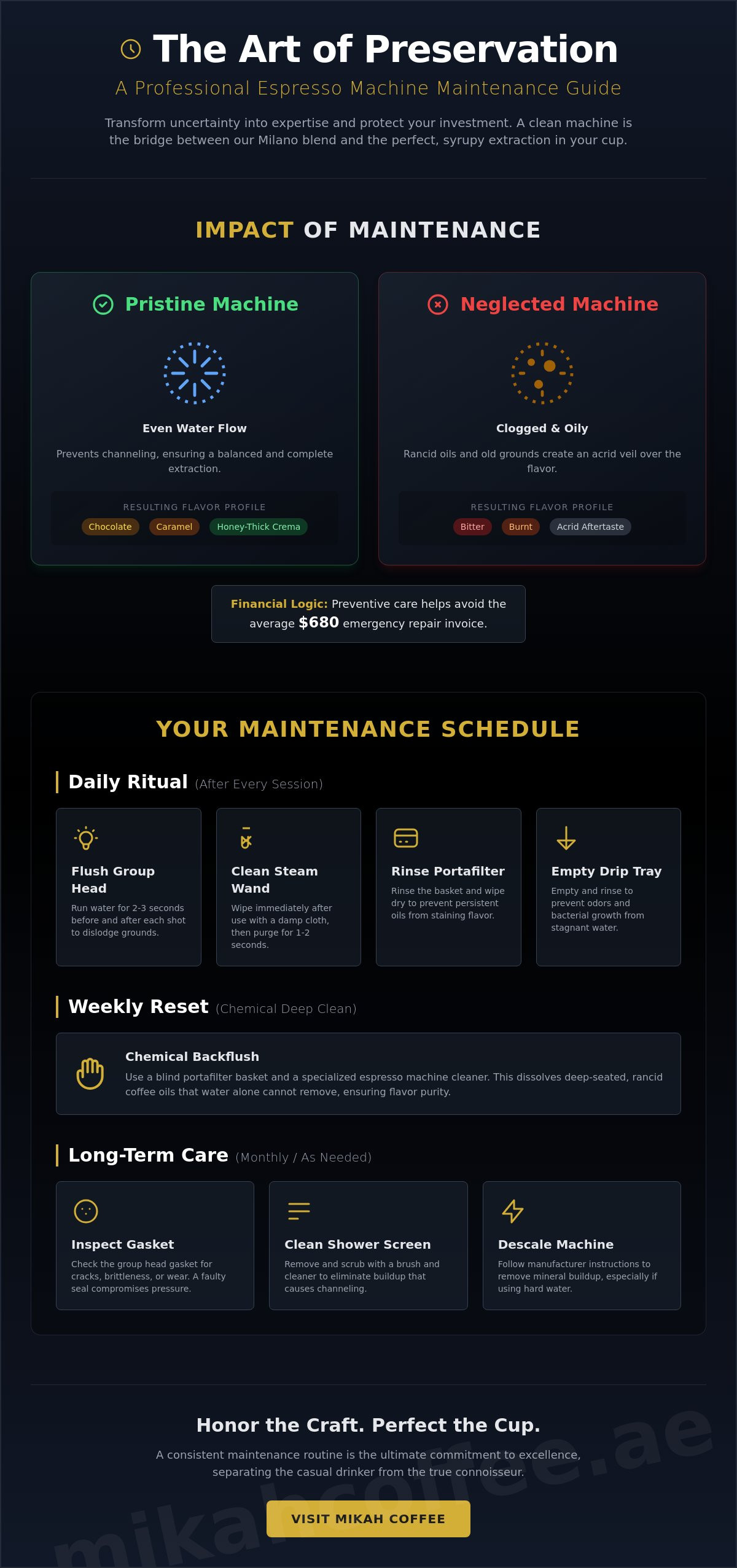
A professional espresso machine is a marvel of engineering. It operates at intense pressures and temperatures to coax complex, aromatic flavors from the bean. Without consistent espresso machine maintenance, this precision becomes a liability. Think of maintenance as the essential bridge between the raw potential of our Milano blend and the final, syrupy extraction in your cup. When residual coffee oils are left behind, they don't just sit there. They oxidize and turn rancid. This creates a thin, acrid veil that masks the delicate chocolate and caramel notes of a premium roast. In the high-pressure environment of a group head, even a microscopic layer of old residue can ruin a masterpiece.
Understanding the internal Espresso Machine Components is vital for any connoisseur. Defining "clean" in this context goes beyond what the eye can see. It means ensuring that every valve, seal, and pathway is free from the calcification and carbonized oils that naturally occur during brewing. Protecting your investment in professional espresso machines is also a matter of simple financial logic. Industry data reveals that the average emergency repair invoice for a two-group commercial machine reached $680 in 2025. Preventive care is the only way to avoid these sudden, costly interruptions to your ritual.
The Sensory Impact of a Neglected Machine
A neglected machine is the primary culprit behind unwanted bitterness. When the shower screen is clogged with old grounds, water cannot flow evenly through the coffee puck. This leads to channeling, where water finds the path of least resistance, over-extracting some grounds while leaving others untouched. By maintaining a pristine brewing environment, you preserve the "soul" of the Milano blend. Every shot should be a transparent window into the origin and craft of the bean; it shouldn't be a struggle against the ghost of yesterday's service.
Maintenance as a Daily Ritual
We invite you to shift your mindset. Don't view these steps as "cleaning." View them as honouring the craft. Integrating a brief, two-minute routine into your how to pull an espresso shot workflow ensures your equipment remains as inspired as your technique. This small daily investment saves hours of technical repair and ensures your machine performs at its peak. It's a commitment to excellence that separates the casual drinker from the true connoisseur. Consistency in the cup starts with consistency at the group head.
The Daily Barista Ritual: Essential Steps After Every Session
Daily espresso machine maintenance is the hallmark of a true professional. It is the rhythmic pulse that ensures every morning begins with a pristine slate. After every extraction, the group head requires a brief flush to dislodge loose grounds. This simple act prevents old coffee from baking onto the shower screen. Similarly, your portafilter and basket should be rinsed and wiped dry immediately. Residual oils are persistent; they cling to the metal and stain the flavor profile of your next shot if left to linger. Don't forget the drip tray. Emptying and rinsing it daily prevents the unpleasant odors of stagnant water and bacterial growth from intruding upon your sensory experience.
- Flush: Run the group head for two seconds before and after every shot.
- Wipe: Clean the steam wand immediately after frothing.
- Purge: Clear the wand of condensation with a quick burst of steam.
- Rinse: Wash the portafilter basket to remove surface oils.
Mastering the Steam Wand Hygiene
Dried milk is the enemy of professional-grade steam pressure. When milk proteins bake onto the wand, they create a stubborn, insulating layer that reduces heat transfer and harbors bacteria. The "immediate wipe" rule is non-negotiable. Use a dedicated damp cloth to clean the wand the moment you finish frothing. Follow this with a quick purge. Releasing a short burst of steam clears internal condensation and ensures no milk residue is siphoned back into the machine. If you notice a drop in performance, a blocked steam tip is likely the culprit; regular purging usually prevents this frustration. It's a simple act that protects the delicate internal components of your boiler.
Group Head Integrity
The area around the group gasket is a magnet for stray grounds. Use a specialized group brush to clear this perimeter daily. This ensures a tight, leak-free seal and maintains optimal espresso machine pressure during extraction. For those seeking a truly Comprehensive Maintenance Schedule, inspecting the shower screen for visible blockages is a vital habit. A clear water flush after your final session of the day helps rinse away the invisible oils that accumulate behind the screen. As you refine this ritual, remember that the finest tools deserve the finest ingredients, such as our curated coffee selections, which shine brightest when brewed through a well-cared-for system.
Deep Cleaning Protocols: Backflushing and Chemical Care
Beyond the visible surfaces of your professional espresso machine lies a network of valves and pipes that define the purity of your extraction. The three-way solenoid valve is the silent architect of this process. It's responsible for depressurizing the group head after a shot, but it also acts as a gateway for coffee particles to enter the machine's internal pathways. For those committed to the highest standards of espresso machine maintenance, understanding the chemistry of cleaning is just as vital as the mechanics of the brew. A simple water backflush should occur daily, but it's the weekly chemical intervention that truly restores the system's integrity.
Chemical care is not merely about hygiene; it's about restoration. Over time, coffee lipids bond to the metal of your portafilters and baskets, creating a stubborn, invisible film. Soaking these components in a specialized espresso cleaner for fifteen minutes will dissolve these deposits and restore their original mirror-like shine. However, the rinse cycle is the most critical phase. You must ensure that every trace of detergent is purged from the system. Any remaining chemical residue will not only ruin the nuanced chocolate notes of your Milano blend but can also degrade the internal seals over time.
The Weekly Detergent Backflush
To perform a detergent backflush, replace your standard basket with a "blind" filter and add a small amount of espresso-specific detergent. Run the pump in five-second intervals, allowing the pressure to build and then release. The "dirty water" indicator is your guide here. The initial discharge will likely be a dark, murky brown; this is the oxidized oil leaving your system. Continue the process until the foam returns to a pristine, snowy white. Always finish the ritual by pulling a "throwaway" shot. This re-seasons the group head and ensures the first cup you serve is untainted by cleaning agents.
Water Quality: The UAE Context
In the UAE, the journey of water is unique. Most of our supply is desalinated, which creates a specific challenge for coffee enthusiasts. Desalinated water can be "hungry," meaning it lacks the essential minerals required for a balanced extraction and may even lead to internal corrosion. Conversely, if the Total Dissolved Solids (TDS) are too high, scale buildup will rapidly choke your machine's boiler. Managing this balance is essential for both the longevity of your equipment and the clarity of your flavor profile. Consult our guide on The Best Water for Coffee Brewing for a deeper exploration of regional specifics and filtration solutions.
Long-Term Component Care: Gaskets, Screens, and Descaling
While daily rituals protect the immediate flavor of your shot, long-term espresso machine maintenance ensures the structural integrity of your equipment. The rubber group gasket is the silent sentinel of your group head. It creates the airtight seal necessary for high-pressure extraction. Over months of constant heat and pressure, this rubber inevitably loses its elasticity. You'll know it's time for a replacement if you notice water leaking over the top of the portafilter or if the handle begins to rotate too far to the right. Ignoring a brittle gasket leads to "cracking," which can eventually damage the brass of the group head itself.
Meticulous owners often view component replacement as an opportunity for refinement. Upgrading to precision shower screens is a favorite ritual among connoisseurs. These screens feature laser-cut holes that ensure a perfectly even water distribution across the coffee puck. This prevents the micro-channeling that often plagues standard equipment. By monitoring your boiler pressure and temperature stability over time, you can catch the subtle signs of component fatigue before they lead to a mechanical failure. A steady needle on your pressure gauge is the heartbeat of a healthy machine.
Annual Maintenance Milestones
Every 12 months, your equipment deserves a comprehensive review. This is the definitive checklist for professional espresso machines. If you use a classic E61 group head, this is the time to lubricate the internal lever arms with food-grade grease to maintain that smooth, tactile response. You should also inspect internal hoses for signs of brittleness or mineral discoloration. According to industry data, businesses that underestimate these maintenance needs can face costs ranging from $2,000 to $8,000 per year, per machine, in avoidable repairs and downtime.
The Danger of Scale Buildup
The descaling debate is perhaps the most complex aspect of ownership. Scale is an insidious enemy; it creates "cold spots" in your boiler that force the heating element to work harder, eventually leading to burnout. There is a direct link between heavy scale and premature pump failure. We advocate for a preventative strategy rather than a reactive one. While mild home descaling is possible, seeking professional service for a deep descale is often the wiser choice to avoid dislodged scale particles clogging the delicate solenoid valves. To ensure your equipment always performs at its peak, we invite you to explore our professional-grade maintenance tools designed to preserve the art of your brew.
The Mikah Standard: Tools for the Perfect Maintenance Ritual
Adopting a meticulous approach to espresso machine maintenance is the final step in becoming a true coffee curator. At Mikah, we believe that the tools you use for preservation should match the quality of the machine itself. Selecting the right cleaning brushes, specialized detergents, and microfiber cloths isn't just a matter of utility; it's about maintaining the aesthetic and functional excellence of your investment. Every component, from the polished steel casing to the internal brass fittings, responds best to tools designed for precision. When you use authentic parts and professional-grade supplies, you ensure that the delicate calibration of your equipment remains undisturbed.
While much of our focus rests on the group head, the Mikah milk frother requires its own unique hygiene standard. Milk proteins are remarkably resilient and can compromise the flavor of your foam if the smallest residue is left behind. We recommend a dedicated cleaning protocol for all frothing accessories to ensure that every latte or cappuccino remains a pure expression of your craft. This commitment to cleanliness is why the Milano blend remains a masterpiece in your cup. A pristine brewing environment is the only way to allow the sophisticated notes of our signature roast to shine without the interference of oxidized oils or mineral buildup.
Beyond the Machine: Grinder Hygiene
A clean grinder is just as important as a clean espresso machine. Old coffee oils trapped within the burrs will eventually oxidize, imparting a stale, flat taste to even the freshest beans. We suggest a monthly refresh using specialized grinder cleaning pellets. These pellets absorb residual oils and dislodge stubborn particles without the need for a complex teardown. By maintaining sharp, clean burrs, you ensure a consistent particle size, which is the foundation of a balanced extraction and a perfect crema.
Elevating Your Daily Ritual
The relationship between care and coffee quality is absolute. When you honour your equipment through regular maintenance, you are rewarded with a sensory experience that is both consistent and profound. It's a cycle of respect that begins with the harvest and ends with the perfect pour. We invite you to explore our comprehensive expertise and find everything you need to support your journey. Whether you are looking for professional advice or wish to Shop Professional Espresso Machines at Mikah Coffee UAE, our collection is curated to elevate every aspect of your daily brewing ritual into something truly extraordinary.
Elevating the Art of the Extraction
Mastering the art of espresso machine maintenance is the final step in your journey from enthusiast to true connoisseur. We've explored how a meticulous daily ritual preserves the soul of the Milano blend, ensuring that every extraction remains as vibrant and syrupy as the first. By committing to consistent deep cleans and monitoring the longevity of your gaskets, you protect the mechanical heart of your morning ritual. It's a commitment that transforms simple coffee preparation into a respected craft.
As the official UAE distributor of premium Italian hardware, Mikah provides expert support for the Milano Blend ritual and seamless national delivery across the UAE. Our team is here to ensure your equipment performs with the precision it was designed for. Explore our collection of Professional Espresso Machines to find the perfect centerpiece for your coffee station. With the right tools and a dedicated routine, you'll continue to honor the rich heritage of Italian coffee in every cup you pour. Your next masterpiece is only a pristine extraction away.
Frequently Asked Questions
How often should I backflush my espresso machine with detergent?
You should perform a detergent backflush once a week for domestic use or every day in a professional setting. This chemical intervention removes the stubborn, carbonized oils that a simple water rinse cannot reach. Consistent espresso machine maintenance ensures that these residues don't bake into the group head, which would eventually lead to mechanical blockages and a noticeable decline in flavor clarity.
Can I use vinegar to descale my professional espresso machine?
You should never use vinegar to descale a professional espresso machine. While it's a common household hack, vinegar is too weak to dissolve heavy calcium deposits and its pungent aroma can linger in your boiler for weeks. Professional systems require specialized, citric acid based descaling agents that are formulated to protect copper and brass components while effectively neutralizing mineral scale.
Why does my espresso taste bitter even though I use premium beans?
Bitterness is often a symptom of oxidized coffee oils trapped within the shower screen or portafilter basket. Even the most exquisite Milano blend will taste "burnt" if it's forced through layers of rancid residue from previous sessions. If your beans are fresh and your grind is correct, the culprit is almost certainly a need for a deep chemical soak of your brewing components.
How do I know if my group gasket needs replacing?
You'll know your group gasket needs replacing if you see water weeping over the edges of the portafilter during extraction. Another clear sign is if the portafilter handle rotates past the six o'clock position to achieve a seal. Most enthusiasts replace these rubber seals every six to twelve months to prevent them from becoming brittle and difficult to remove.
Do I really need to purge the steam wand if it looks clean?
Purging the steam wand is essential to clear internal condensation and prevent milk from being siphoned back into the boiler. Even if the exterior looks pristine, a quick burst of steam ensures that the internal pathways remain dry and hygienic. This simple habit protects your machine's pressure stability and prevents the growth of bacteria within the steam arm assembly.
What is the best water hardness level for an espresso machine in the UAE?
The ideal water hardness for brewing in the UAE falls between 50 and 100 parts per million (ppm) of Total Dissolved Solids. Desalinated water often lacks the mineral balance required for a vibrant extraction, so using a dedicated filtration system is vital. This balance provides enough magnesium and calcium for flavor while preventing the rapid scale buildup that often leads to pump failure.
Can I leave my espresso machine on all day, or does it hurt the components?
Leaving a professional machine on all day is generally acceptable as it maintains thermal stability, but it does accelerate the wear on your group gaskets. The constant heat eventually makes the rubber brittle. If you only pull shots in the morning and evening, it's more efficient to use a timer or turn the machine off to preserve energy and extend the life of your seals.
How do I clean the shower screen without taking the machine apart?
You can clean the shower screen daily by using a specialized group brush and performing a clear water backflush. Gently scrub the screen and the surrounding gasket area while the water is running to dislodge loose grounds. For a deeper clean without total disassembly, a detergent backflush is the most effective way to dissolve oils that have migrated behind the metal screen.