


A professional espresso machine is not an appliance; it is a precision instrument that requires a harmony of thermal stability, pressure control, and soul. You've likely felt the frustration of inconsistent extraction or the confusion that comes with technical terms like PID controllers and Heat Exchangers. Selecting from the finest professional espresso machines is about more than just aesthetics. It's about bridging the gap between a simple caffeine fix and a sensory masterpiece. This is an investment in a machine built to last decades, not just a few seasons.
You already know that the difference between a good espresso and a transcendent one lies in the details that consumer-grade gear often misses. We promise to help you master the technical nuances and Italian artistry required to select a machine that brings cafe-quality crema into your own space. This guide explores the critical role of temperature stability, the reality of maintenance, and the true value behind premium craftsmanship. Let's elevate your brewing ritual from a daily routine into a curated experience of excellence.
Key Takeaways
- Identify the hallmarks of true quality by distinguishing between mass-produced appliances and professional espresso machines crafted from enduring materials like stainless steel, brass, and copper.
- Master the technical landscape of boiler systems and thermal stability to ensure your extraction remains precise, repeatable, and rich in flavor.
- Navigate the choice between elegant prosumer designs for the home and high-volume commercial systems built for the rigorous demands of a busy cafe.
- Prepare your environment for machine longevity by understanding the critical role of water filtration and infrastructural compatibility within the UAE.
- Learn how the synergy between precision engineering and premium specialty coffee, such as the Mikah Milano Blend, transforms a daily routine into a sophisticated sensory ritual.
Beyond the Appliance: What Defines Professional Espresso Machines?
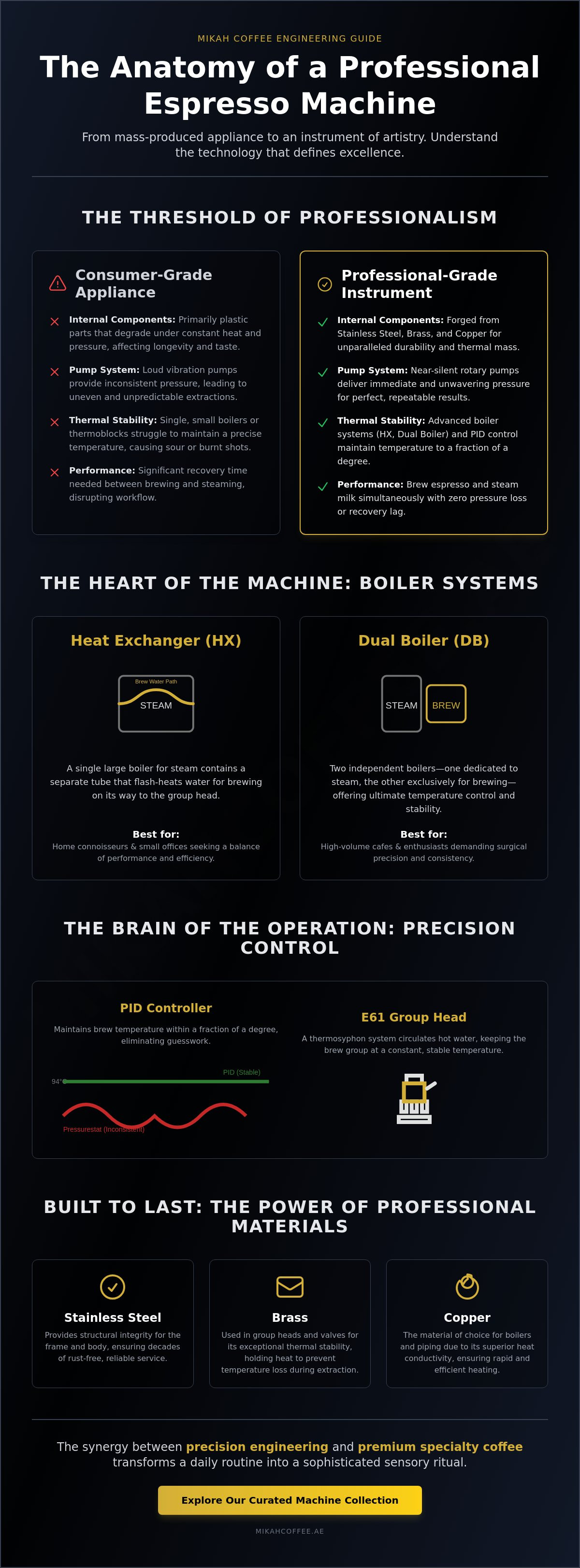
A true espresso machine isn't just another kitchen gadget. It's a testament to engineering and a vessel for culture. While consumer-grade models often rely on internal plastic components that degrade under the high heat and pressure of daily use, professional espresso machines are forged from heavy-duty materials like Grade 304 stainless steel, brass, and copper. This shift in material isn't just about durability. It's about thermal mass. These metals hold heat with a stubborn persistence, ensuring that the water hitting your coffee grounds remains at a precise, unwavering temperature. Professionalism is defined by consistency. It's the ability to produce a perfect, syrupy extraction at 7:00 AM and repeat that exact flavor profile for the 100th guest of the day.
The Threshold of Professionalism
What truly separates a hobbyist tool from a professional instrument? It starts with the portafilter. Standard commercial-grade 58mm portafilters allow for a wider, more even distribution of coffee, which is essential for a balanced extraction. Inside the chassis, the difference becomes even more apparent. While entry-level machines use buzzing vibration pumps, professional systems utilize near-silent rotary pumps that provide immediate, stable pressure. This stability allows you to brew an espresso and steam silk-textured milk simultaneously without the machine gasping for a recovery period. Understanding the evolution of Espresso machine technology reveals how these components work in concert to deliver a shot that tastes as vibrant on the 100th pull as it did on the first. The lack of recovery lag means your ritual remains fluid and uninterrupted.
Italian Heritage and the Art of the Machine
The soul of the espresso ritual is undeniably Italian. For decades, the "Made in Italy" mark has represented a commitment to both mechanical precision and aesthetic beauty. It's a heritage where every dial and lever is designed with an appreciation for the "art" of the craft. This isn't just about hardware; it's about a philosophy of quality that values the ritual itself. At Mikah, we see ourselves as curators of this tradition within the UAE. We select machines that don't just occupy space on a counter but transform the environment into a high-end boutique. By pairing these exquisite machines with our Mikah Coffee Beans, specifically the Milano Blend, you're not just making coffee. You're participating in a century-old legacy of excellence. It turns a simple morning routine into a deliberate, artistic expression.
The Anatomy of Excellence: Understanding Technical Specifications
Technical mastery is the bridge between a quality bean and a transcendent cup. While the exterior of professional espresso machines speaks of elegance, the internal architecture dictates the flavor profile. Thermal stability is the silent hero in this equation. Without it, the delicate aromatic oils in your coffee are either scorched by excess heat or left dormant by a tepid flow. Precision isn't just a goal; it's the standard that ensures every shot reflects the true character of the origin.
Boiler Technology: Finding Your Flow
Boiler design determines how a machine manages its thermal energy. Heat Exchanger (HX) systems utilize a single large boiler for steam, with a copper tube running through it to flash-heat brew water on demand. It's an efficient, space-saving balance for home connoisseurs and small offices. Dual Boiler systems, however, offer absolute independence. One boiler is dedicated to steam, while the other is tuned strictly for the group head. This allows for surgical precision. When choosing your ideal espresso machine, consider your volume and need for control. Saturated group heads, where the group is an extension of the boiler itself, provide the highest level of temperature consistency for high-volume environments.
Digital precision isn't a luxury in the world of specialty coffee. It's a requirement. PID (Proportional-Integral-Derivative) controllers replace old-fashioned pressure stats, maintaining water temperature within a fraction of a degree. This technology often works in tandem with the iconic E61 group head. Originally designed in 1961, the E61 uses a thermosyphon system to keep the brewing components constantly hot. It ensures that even if the machine has been idle, the first shot of the morning is as thermally perfect as the last.
Pressure and Flow Control
The industry standard of 9 bars of pressure ensures water penetrates the coffee puck with enough force to emulsify oils into a rich crema. Modern professional hardware now includes programmable pre-infusion. This process gently wets the coffee at low pressure before ramping up to full force. It prevents "channeling," where water finds a path of least resistance and creates a bitter, uneven brew. Flow profiling is the newest frontier, allowing you to vary pressure throughout the extraction to highlight specific fruity or chocolatey notes in the bean.
Achieving this level of precision requires more than just mechanical excellence. It demands a bean that can stand up to the scrutiny of such fine-tuned equipment. Exploring the curated selections at Mikah ensures your technical mastery is rewarded with the highest quality specialty coffee, designed to shine under professional-grade pressure.
Prosumer vs. Commercial: Identifying Your Ideal Scale
Choosing between a boutique home setup and an industrial powerhouse requires more than just a budget; it requires an honest assessment of your daily rhythm. While the heart of the technology remains the same, the scale of delivery defines the category. Many enthusiasts find themselves at a crossroads, caught between the desire for cafe-quality results and the practicalities of a domestic environment. This is where the 'prosumer' category serves as a vital bridge, offering the heavy-duty internal components of professional espresso machines within a chassis designed for elegance and spatial efficiency. When evaluating hardware, aligning with the industry standards for professional espresso ensures that your investment meets the rigorous benchmarks of temperature and pressure required for specialty coffee.
The Prosumer Advantage
A prosumer machine is often considered the ultimate gift for the home connoisseur. These units typically feature the same 58mm brass group heads and PID controllers found in cafes, yet they're sized to fit under standard kitchen cabinetry. The luxury of hand-polished stainless steel provides an aesthetic that complements a refined home interior. Maintenance is also more manageable for a single user. Since these machines don't face the 24/7 heat stress of a commercial environment, seals and gaskets last longer, and the descaling process is significantly less intensive than industrial counterparts.
When to Step Up to Commercial
The transition to a full commercial machine is dictated by volume and the need for speed. If you're outfitting a boutique hotel or a high-traffic office, the group count becomes your most critical metric. Industry data suggests that for any location serving more than 250 cups a day, a 2-group machine is essential to maintain service flow. For high-volume venues serving over 100 cups per hour during peak times, a 3-group machine is recommended to prevent customer wait times. These machines require more than just counter space; they need:
- Dedicated Power: Commercial units often require 220V-240V dedicated circuits to power large heating elements.
- Direct Plumbing: High-volume service makes manual water reservoir refills impossible. Plumbed-in connections with drainage are mandatory.
- Filtration Systems: Industrial machines process hundreds of liters of water, making professional-grade softening and filtration non-negotiable for longevity.
Capacity planning is about looking at your busiest hour, not just your daily average. A commercial system is built for endurance, featuring larger boilers that can provide endless steam for lattes without losing brew temperature. While these professional espresso machines require a more significant footprint, they offer the reliability needed to turn a coffee service into a seamless, high-performance operation. Whether you're a dedicated home barista or a business owner, identifying your peak demand is the first step toward a successful investment.
The UAE Selection Framework: Longevity and Maintenance
Purchasing an elite instrument is merely the first movement in the symphony of espresso. To ensure your investment survives the test of time, you must consider the environmental variables unique to the region. In the UAE, the climate and infrastructure demand a specific approach to care. Longevity isn't an accident. It's the result of a methodical framework that protects the delicate internals of professional espresso machines from the very elements they interact with daily. Have you considered how the local environment affects the precision of your hardware?
Water: The Ingredient That Saves (or Kills) Your Machine
Water is the lifeblood of espresso, yet it's also the primary cause of mechanical failure. In the UAE, water typically contains a high concentration of Total Dissolved Solids (TDS). While these minerals are necessary for flavor, an excess leads to rapid limescale buildup within copper boilers and narrow water paths. Utilizing advanced filtration, such as BWT magnesium-exchange cartridges or specialized reverse osmosis systems, is essential. Proper water chemistry doesn't just protect the metal; it unlocks the complex notes of your Milano blend coffee beans. Without the right mineral balance, the authentic Italian soul of the bean remains trapped, masked by bitterness or flat acidity.
Preventative Maintenance for Professional Gear
A daily cleaning ritual is the difference between a machine that lasts five years and one that lasts twenty. Backflushing the group head with a specialized detergent removes the rancid coffee oils that accumulate behind the shower screen. It's a simple, five-minute task that preserves the purity of every shot. However, deeper maintenance requires a more nuanced touch. Many believe home descaling is a solution, but for professional systems, improper descaling can dislodge large scale flakes that clog the internal gicleurs. Expert servicing is the only way to handle heavy-duty descaling safely. You should also plan to replace soft parts like group gaskets and shower screens every six to twelve months to maintain a perfect seal. Precision requires vigilance.
Establishing this framework ensures that your brewing ritual remains an elevated experience rather than a source of frustration. By verifying your power supply and plumbing compatibility early, you avoid the common pitfalls of high-end ownership. Ready to begin your journey with equipment built for excellence? Explore our curated range of professional brewing hardware and find the perfect match for your space.
The Mikah Experience: Curating Your Professional Journey
Excellence is not a destination but a curated path. At Mikah, we believe that the journey toward the perfect cup requires more than just a transaction; it requires a dedicated partnership. We bridge the gap between centuries of Italian tradition and the specific technical needs of the UAE's sophisticated coffee culture. Our role is that of a guide, ensuring that your choice among professional espresso machines isn't just a purchase, but an entry into a legacy of craftsmanship. We bring the expertise of Milan to your doorstep, helping you navigate the technical complexities we've explored in this guide with the grace and depth of a true connoisseur. Why settle for a machine that simply functions when you can own a piece of engineering history?
A Holistic Approach to Coffee
Investing in a precision instrument is only half of the equation. Even the most advanced hardware fails to deliver its full potential without premium coffee beans that have been roasted with an equal level of care. The synergy between a stable thermal system and a bean like our Milano Blend is what creates that elusive, syrupy crema that defines a master-level extraction. Don't overlook the importance of the grinder, either. It's the silent partner that determines the surface area and extraction rate of your coffee, acting as the primary gatekeeper of flavor. To complete the ritual, consider how the Mikah milk frother can transform your extraction into a silk-textured latte, bringing the full sensory experience of a high-end boutique into your personal or professional space. This holistic view ensures that every component of your brewing ritual is in perfect harmony.
Your Invitation to Excellence
Your personal style should be reflected in the equipment you use. Whether you're seeking a minimalist prosumer unit for a private study or a multi-group powerhouse for a boutique venue, we offer personalized consultations to find your perfect match. We take the time to understand your volume needs, your aesthetic preferences, and your long-term goals. This is an investment in a legacy. These machines are built to be serviced and cherished for decades, not discarded after a few seasons. We're dedicated to your experience, providing the expert support needed to maintain the integrity of your investment over its lifetime. We invite you to explore our curated selection of professional espresso machines and begin elevating your daily ritual into something truly meaningful. It's time to bring the art of the Italian cafe into your own world with a partner who values quality as much as you do.
Your Legacy of Excellence Awaits
Mastering the art of espresso is a continuous journey of discovery and refinement. You've uncovered the technical secrets behind thermal stability and the distinct advantages of choosing hardware that matches your specific scale. These professional espresso machines are more than just tools; they're the heartbeat of a sophisticated coffee culture that values quality above all else. By implementing a rigorous maintenance framework and respecting local environmental factors, you ensure that your brewing ritual remains pristine for a lifetime.
Mikah has championed the Italian engineering heritage since 1984, offering a curated selection of prosumer and commercial gear designed for those who refuse to compromise. With our expert national support and maintenance, you're never alone in your pursuit of the perfect shot. It's time to transform your daily coffee into an extraordinary sensory experience.
Discover the Art of Precision: Shop Professional Espresso Machines
Your path to perfection begins with a single, deliberate choice. We look forward to guiding you every step of the way.
Frequently Asked Questions
What is the difference between a home espresso machine and a professional one?
Build quality and internal engineering define the primary difference. While standard home machines often rely on plastic components and vibration pumps, professional espresso machines utilize heavy-duty brass, stainless steel, and silent rotary pumps. This robust construction ensures thermal stability and consistent pressure, allowing the machine to produce back-to-back shots without a decrease in quality.
How much should I spend on a professional espresso machine for my home?
A high-end prosumer model typically requires an investment between AED 7,000 and AED 25,000. This price range reflects the use of commercial-grade internals, such as dual boilers and PID controllers, housed in a domestic footprint. Investing in this tier ensures your hardware is built to last decades rather than just a few years.
Do professional espresso machines require special plumbing in the UAE?
Plumbing requirements depend entirely on the machine’s intended volume. Most prosumer models include internal water reservoirs for ease of use, but full commercial units require direct plumbing and drainage. Regardless of the connection, utilizing specialized filtration is essential in the UAE to manage high mineral content and protect the boilers from scale.
What is a PID controller, and do I really need one for my machine?
A PID controller is a digital system that maintains water temperature within a fraction of a degree. You definitely need one if you're brewing specialty coffee. Without this precision, water temperature can fluctuate wildly, leading to inconsistent extractions that mask the delicate notes of a premium roast.
How long does a professional-grade espresso machine typically last?
A well-maintained professional machine can easily last twenty years or more. These instruments are designed to be serviced and repaired rather than replaced. By following a consistent cleaning ritual and replacing wear-and-tear parts like gaskets, you preserve the machine's performance for the long term.
Can I use Nespresso capsules in a professional espresso machine?
No, these machines are designed for freshly ground coffee used in a traditional portafilter. While Mikah offers Nespresso compatible capsules for dedicated capsule systems, professional espresso machines focus on the manual craft of extraction. This process allows for a level of flavor depth and texture that capsules cannot replicate.
What is the best way to clean and maintain a high-end espresso machine?
Daily backflushing with a specialized detergent is the most effective way to keep the group head pristine. You should also wipe the steam wand after every use to prevent milk buildup and replace group gaskets every twelve months. Professional descaling is the only safe way to handle mineral deposits in the internal boilers.
Which is better: a single boiler or a dual boiler espresso machine?
Dual boiler machines are the superior choice for those who want absolute control and efficiency. They feature separate boilers for brewing and steaming, which means you can froth milk while your espresso is extracting. Single boiler systems are more compact but require a waiting period to switch between temperatures, which can disrupt your workflow.