


According to a 2026 study by the Specialty Coffee Association, 82% of baristas now use weight in grams rather than volume to measure their espresso yield. This shift from ounces to precision measurement highlights a fundamental truth about the craft. If you've ever felt the frustration of watching a beautiful crema vanish or wasting a bag of specialty beans on sour, inconsistent results, you aren't alone. Mastering how to pull an espresso shot is less about luck and more about honoring a precise, centuries-old Italian ritual with modern accuracy. It's the difference between a simple caffeine fix and a moment of pure, sensory indulgence.
You likely believe that cafe-quality coffee requires a professional's touch; however, the secret lies in understanding the variables that define excellence. We'll show you how to transform your kitchen into a high-end boutique by mastering the Italian standard of taste. You'll learn the exact 1:2 brew ratio used by 66% of top baristas, the importance of a 25 to 30 second extraction, and how to use professional espresso machines to achieve repeatable perfection. From dialing in your Mikah Coffee Beans to the final golden drop, this guide provides the clarity you need to brew with confidence.
Key Takeaways
- Identify the visual hallmarks of a flawless extraction. You'll learn to recognize how the golden crema and rich body indicate a perfectly balanced flavor profile.
- Master the technical variables of how to pull an espresso shot by moving beyond volume and adopting the weight-based precision required for professional standards.
- Discover the essential hardware requirements for a high-end home setup; focusing on how consistent pressure and temperature elevate your daily craft.
- Learn the art of "dialing in" your beans. This troubleshooting guide helps you eliminate harshness and achieve a sweet, syrupy finish every time.
The Anatomy of an Espresso Shot: More Than Just a Drink
An espresso shot is an exercise in controlled intensity. At its core, it's a 25 to 35ml concentrated extraction forced through a finely ground bed of coffee under exactly 9 bars of pressure. To truly understand What is Espresso?, one must look beyond the liquid itself and view it as a chemical transformation. The high pressure emulsifies oils and traps carbon dioxide, creating a beverage that is physically thicker and aromatically more complex than any other brew. When you learn how to pull an espresso shot, you aren't just making coffee; you're orchestrating a delicate balance of physics and flavor.
The ritual of preparation is where the magic begins. Every movement, from the way you level the grounds to the pressure of your tamp, dictates how the water will interact with the coffee's cellular structure. This isn't merely about consistency. It's about respecting the aromatic potential of the bean. Freshly roasted beans, particularly those with a refined profile like the Milano blend coffee beans, are rich in CO2. This gas is essential for creating that dense, velvet-like texture that lingers on the palate long after the last sip. Without this gas, the shot feels thin and the flavors muted.
The Three Layers of Sensory Excellence
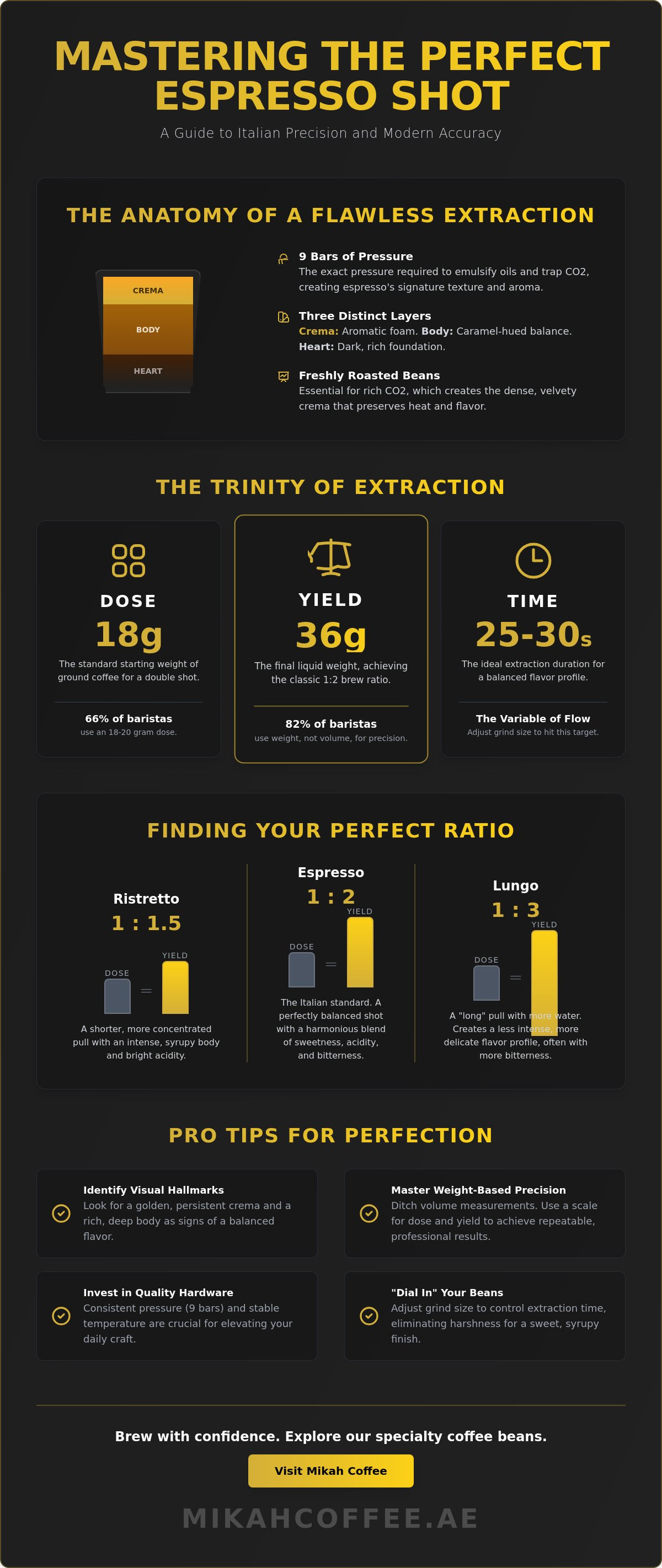
A perfect pull reveals itself through three distinct visual layers. The Heart is the dark, bottom layer that anchors the shot with deep cocoa and earthy foundations. Resting above it is the Body, a middle section of caramel hues where the vibrant dance of acidity and sweetness occurs. Finally, the Crema sits on top. This golden, frothy emulsion carries the most intense aromatics and serves as a natural seal, preserving the heat and fragrance of the liquid beneath. If the crema is thin or dissipates quickly, it's often a sign that the beans have lost their vital gases.
The Italian Standard vs. Modern Specialty
In traditional Milanese coffee culture, the 1:2 ratio remains the golden rule. This means if you start with 18 grams of coffee, you aim for 36 grams of liquid. While modern specialty trends occasionally push for longer extractions, the Italian soul of the craft relies on a "slow-roasted" approach. These beans require a precise extraction temperature to avoid bitterness. Understanding the nuances between a concentrated Ristretto, a standard Espresso, and a longer Lungo pull allows you to tailor the experience to your specific palate. Learning how to pull an espresso shot with this level of detail ensures that every cup is a tribute to heritage rather than just a routine.
The Trinity of Extraction: Dose, Yield, and Time
Precision is the hallmark of a true connoisseur. While the visual beauty of the shot provides an immediate emotional connection, the underlying mathematics ensure that the experience is repeatable. Mastering how to pull an espresso shot requires a commitment to three interconnected variables: dose, yield, and time. These aren't just numbers on a screen. They represent the physical boundaries of flavor. If you change one, the others will shift in response; a delicate dance that determines whether your morning cup is a revelation or a disappointment.
A 2026 survey by the Specialty Coffee Association revealed that 82% of baristas now use weight to measure their espresso yield. This shift away from liquid volume reflects a deeper understanding of coffee's volatile nature. Because crema density varies, two shots that look identical in a glass can have vastly different masses. To achieve the Italian standard of excellence, we must trade the measuring cup for a precision scale. Using exact measurements allows you to respect the heritage of your beans while leveraging modern accuracy.
Dose and Yield: The Weight of Success
The journey begins with the dose. In the professional world, 18 grams of ground coffee has become the definitive standard for a double portafilter basket. In fact, 66% of baristas surveyed in 2026 use this 18 to 20 gram range. This specific mass provides the necessary resistance for the water to extract the coffee's oils without over-taxing the machine. Once your dose is locked, your yield becomes your North Star. The classic 1:2 ratio, where 18g of coffee produces 36g of liquid, is where most professionals start their morning. If a shot tastes overly bright, increasing the yield slightly can highlight hidden sweetness. Conversely, a shorter yield can dampen unwanted bitterness in darker roasts. For those seeking the ultimate foundation, our specialty coffee selections provide the perfect canvas for these adjustments.
Time: The Variable of Flow
If dose and yield are the "what," time is the "how." The optimal extraction window sits between 25 and 30 seconds, a range reported by 51% of baristas as their golden standard. It's vital to remember that time is a result of your grind size rather than a setting you simply toggle. For maximum accuracy, follow the "First Drop" rule: start your timer the moment you engage the pump, not when the liquid first appears. If your shot finishes in 15 seconds, the water has found a path of least resistance. This is known as channeling. This results in a thin, watery texture that lacks character. A slow, syrupy flow that hits the 28-second mark is the sign of a perfectly prepared bed. When you understand these mechanics, you gain total control over how to pull an espresso shot that rivals the best boutiques in Milan.
Precision Hardware: The Tools Behind the Shot
Achieving the perfect extraction is impossible without a foundation of stable, high-performance hardware. While the technique of how to pull an espresso shot is vital, your equipment acts as the silent partner in this daily ritual. A machine must provide more than just raw pressure; it requires absolute thermal stability. Modern professional espresso machines now feature PID temperature control as a baseline, ensuring the water hitting your coffee bed doesn't fluctuate by even a fraction of a degree. Without this precision, the delicate sugars in your beans can easily turn to ash before they reach your cup.
The grinder is the true heart of your setup. A quality burr grinder ensures each particle is uniform, preventing the erratic flow that ruins a shot. If you're serious about your craft, a stepless grinder is non-negotiable. It allows for infinite micro-adjustments, giving you the control to find that elusive sweet spot between sour and bitter. Beyond the grind, maintenance is the final pillar of hardware excellence. Rancid oil buildup in the group head is a silent killer of flavor. Regular backflushing is essential to keep the sensory profile of your coffee pure and vibrant.
The Importance of a Prosumer Grinder
Precision requires control. Stepless grinders are the preferred choice for enthusiasts because they don't rely on pre-set "clicks," allowing you to refine the grind size to the micron. This level of detail is necessary to manage heat during the process; if a grinder runs too hot, it can "cook" the beans before the water even touches them. To ensure a flawless bed of coffee, many baristas now use a WDT (Weiss Distribution Technique) tool. This simple needle-based device breaks up clumps, ensuring the water flows evenly through the portafilter rather than finding a path of least resistance.
Water Chemistry in the UAE
In the UAE, the water narrative is unique. Most of our supply is desalinated, which often lacks the specific mineral structure needed to pull flavor from coffee solids effectively. Using pure distilled water is equally problematic; it's too "hungry" and can strip away the nuances of the bean while potentially corroding your machine's internals. Finding the right balance of Total Dissolved Solids (TDS) is the secret to a bright, vibrant cup. For a deeper look at this essential chemistry, explore The Best Water for Coffee Brewing. When you master the water, you truly master how to pull an espresso shot that stands apart from the rest.
Step-by-Step: Pulling the Professional Shot
The ritual begins long before the first bean enters the grinder. Precision is a state of mind. To achieve excellence, your equipment must reach thermal equilibrium. Ensuring your portafilter and cup are pre-heated prevents the water's temperature from crashing the moment it touches the metal. A cold portafilter is a silent thief of flavor, stripping away the bright acidity you've worked so hard to preserve. Once your machine is ready, the physical execution of how to pull an espresso shot becomes a focused exercise in geometry and pressure.
Consistency is the goal. After dosing your 18 grams of coffee, you must ensure the bed is perfectly level. Air pockets are the enemy of extraction. If the water finds a path of least resistance, it will bypass the flavor-rich grounds, leaving you with a shot that is both bitter and watery. To ensure your ritual starts with the finest materials, explore our curated selection of specialty coffee and discover the difference that premium origin makes.
Puck Prep: The Secret to Even Extraction
When learning how to pull an espresso shot, many beginners over-index on force while ignoring levelness. Tamping requires a consistent 15kg of pressure, but once the coffee is compressed, additional force does nothing to improve the shot. It's far more vital that your tamper is perfectly horizontal. Avoid the common temptation to tap the side of your portafilter with the tamper; this "Knock" myth creates tiny fractures in the coffee bed that lead to immediate channeling. Visualize the water flow as a uniform front, moving through the puck at a steady, viscous pace.
The Extraction Phase
As you engage the pump, watch for the "tiger striping" effect. These dark and light amber streaks are a visual confirmation of bean freshness and proper emulsification. Extraction is the process of water dissolving 18-22% of the coffee mass. If the stream begins to turn a pale, translucent yellow, you've reached the "blonding" point. This is your signal to stop the pull immediately. Allowing the shot to run past this stage introduces harsh, ashy notes that overwhelm the delicate sweetness of the heart. Finish your ritual by purging the group head and cleaning the basket; a professional's station is always ready for the next masterpiece.
Troubleshooting: Dialing in Your Flavor Profile
The final stage of the espresso ritual is an ongoing conversation between the barista and the bean. Even with the most meticulous preparation, variables shift. Atmospheric conditions, bean age, and even the residual heat of your equipment can alter the final taste. Mastering how to pull an espresso shot requires more than just following a recipe; it demands a refined palate capable of diagnosing flavor imbalances. When a shot doesn't meet the Italian standard of excellence, we must look to the "dialing in" process to restore its soul. This is where precision meets intuition.
If your espresso tastes sour, sharp, or unpleasantly acidic, you're likely facing under-extraction. The water has moved too quickly through the coffee, failing to dissolve the sugars that balance the natural acids. Conversely, a bitter, harsh, or ashy cup indicates over-extraction, where the water has stripped away woodier, unpleasant compounds. In rare cases of extreme under-extraction, you may even detect a distinct saltiness. This is a clear signal that the water has only touched the very surface of the grounds. In the UAE, environmental factors play a significant role. Coffee is hygroscopic, meaning it absorbs moisture from the air. High humidity can cause your grind to clump or expand, requiring subtle, daily adjustments to your grinder settings to maintain consistency.
The Flavor Compass
Navigating the nuances of extraction becomes simpler when you follow a logical path of adjustment. Use these sensory cues to guide your next pull:
- If the shot is sour and thin: Grind finer to increase resistance, or increase your yield slightly to allow more water to pull out the sweetness.
- If the shot is bitter and harsh: Grind coarser to speed up the flow, or consider decreasing your water temperature by one or two degrees.
- If the shot lacks body: Re-evaluate your tamping consistency. Ensure the bed is perfectly level to prevent the watery texture caused by channeling.
Optimizing for the Milano Blend
A sophisticated medium-dark roast requires a specific touch to reveal its true character. For a profile like our Milano Blend, we recommend a slightly lower extraction temperature of 92°C. This prevents the delicate oils from scorching, which can mask the bean's inherent sweetness. To highlight the luxurious notes of dark chocolate and toasted hazelnut, many connoisseurs prefer a tighter 1:1.8 brew ratio. This shorter pull results in a syrupy, velvet texture that defines the authentic Milanese experience. To truly elevate your craft and ensure every variable is under your command, Explore our Professional Espresso Machines. Investing in precision hardware is the final step in your journey to mastering how to pull an espresso shot that is nothing short of a masterpiece.
Elevating Your Daily Craft
The journey from a simple bean to a perfect extraction is a path of constant refinement. You've explored the technical trinity of dose, yield, and time, and learned how the unique environment of the UAE influences your grind. Mastering how to pull an espresso shot is an art form that honors tradition while embracing modern precision. It's about more than just caffeine; it's about the sensory delight of the perfect crema and the rich, balanced notes of a well-dialed heart.
If you're inspired by the craft of espresso and want to bring that professional quality to your next event, you can check out Intentional Espresso for premium mobile catering services.
With an authentic Italian heritage dating back to 1984, Mikah is dedicated to your brewing success. We provide a curated selection of prosumer brewing equipment and offer national UAE delivery for our fresh Milano Blend beans. This ensures your home boutique is always stocked with excellence. Are you ready to transform your morning routine into a meaningful ritual? Elevate your ritual with Mikah Professional Espresso Machines and bring the soul of Milan into your kitchen. Your pursuit of the perfect cup starts with the right tools and a passion for the craft.
Frequently Asked Questions
How many grams should a double espresso shot be?
A double espresso shot should ideally use 18 to 20 grams of ground coffee. This specific mass was confirmed as the industry standard by 66% of baristas in a 2026 survey. Using this precise dose ensures there is enough resistance in the portafilter to extract a rich, syrupy body without over-taxing your machine's pump.
Why does my espresso shot taste sour?
A sour taste is almost always a sign of under-extraction. This happens when the water moves through the coffee too quickly, failing to dissolve the sugars that balance the natural acids. To fix this when learning how to pull an espresso shot, try refining your grind size or slightly increasing the yield to allow for a more thorough extraction.
How long should it take to pull a 36g espresso shot?
A standard 36g yield should take between 25 and 30 seconds to extract from the moment you engage the pump. According to 2026 industry data, 51% of professional baristas aim for this specific window. If your shot finishes earlier, it will likely be watery; if it takes longer, you may introduce harsh, bitter notes that overshadow the bean's origin.
Can I pull a good espresso shot without a grinder?
Achieving professional results is nearly impossible without a high-quality burr grinder. Pre-ground coffee lacks the vital CO2 gases needed for crema and cannot be adjusted to match your machine's specific pressure. Without the ability to "dial in" the grind size to the micron, achieving a balanced extraction becomes a matter of luck rather than a repeatable ritual.
Why is there no crema on my espresso?
A lack of crema typically indicates that your coffee beans are stale or the extraction pressure is too low. Crema is an emulsion of oils and CO2. As beans age, they lose the gas necessary to create that signature golden foam. Using a fresh roast like the Milano Blend ensures the vibrant, velvety texture that defines the Italian standard.
Does the water temperature really matter for espresso?
Water temperature is critical and should be maintained between 195 and 205°F (90 to 96°C). Temperature directly affects the solubility of the coffee solids. If the water is too cool, the shot will taste sour and thin. If it's too hot, you risk scorching the delicate oils, resulting in a burnt, ashy flavor profile that ruins the sensory experience.
How often should I clean my espresso machine group head?
You should clean your group head daily to prevent the buildup of rancid coffee oils. A simple water backflush after your final shot of the day is essential for maintaining flavor purity. For a deeper clean, use a specialized detergent once a week to ensure your how to pull an espresso shot process isn't tainted by old, bitter residues.
What is "channeling" in espresso brewing?
Channeling occurs when water finds a path of least resistance through the coffee puck rather than flowing through it uniformly. This results in a shot that is simultaneously bitter and sour because some grounds are over-extracted while others are barely touched. Proper distribution and a level tamp are your best defenses against this common brewing flaw.