


Why does that bag of award-winning specialty coffee, brewed with meticulous care in your own kitchen, often lack the vibrant clarity you experienced at the local roastery? It's a quiet frustration shared by many who invest in premium beans and professional espresso machines. You follow the recipe to the letter, yet the flavor remains stubbornly dull or uninspiring. You aren't alone in this pursuit of the perfect cup, and the culprit usually isn't your technique. It's the liquid you use to fill your kettle.
Finding the best water for coffee brewing is the final, essential step in mastering the art of the craft. Water is far more than a base; it's the active solvent that dictates which delicate notes are unlocked from the bean and which are left behind. In this guide, you'll discover how the chemistry of your water transforms your coffee from a simple drink into a sophisticated sensory experience. We'll demystify technical concepts like alkalinity and TDS, providing a repeatable solution to achieve cafe-quality results while protecting your valuable brewing tools from the hidden dangers of limescale.
Key Takeaways
- Recognize water's role as a sophisticated solvent that extracts the precise oils and acids needed for a superior sensory experience.
- Identify the best water for coffee brewing by understanding the delicate balance between mineral content and alkalinity.
- Protect your investment in professional espresso machines by implementing filtration strategies that eliminate the threat of damaging limescale.
- Explore practical, repeatable solutions for water mineralisation that ensure consistent quality across every cup you brew at home.
- Learn how to tailor your water profile to enhance the specific characteristics of premium roasts, including the authentic notes of our Milano blend.
The Invisible Ingredient: Why Water Defines Your Coffee Ritual
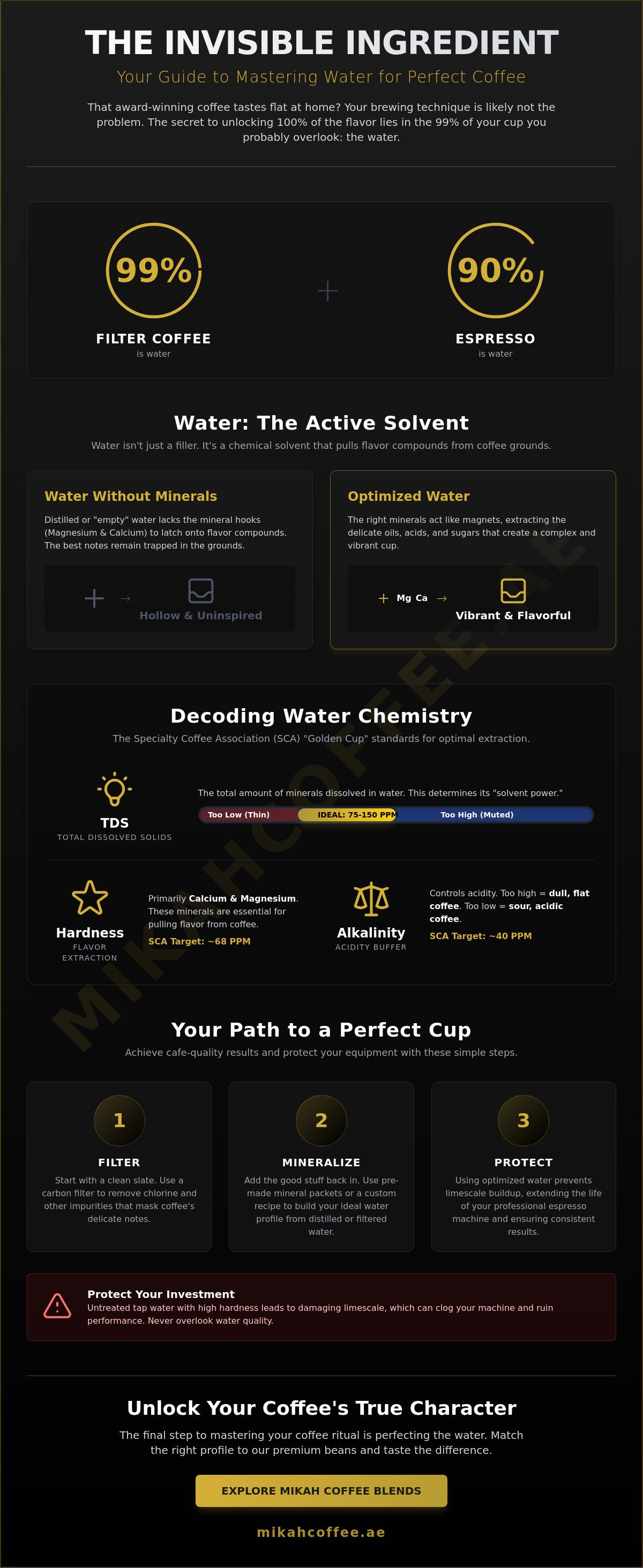
Think of your morning cup. Whether it's a delicate pour-over from a V60 or a rich shot pulled from one of our professional espresso machines, water is the silent majority. It constitutes nearly 99% of a filter brew and roughly 90% of an espresso shot. While we often obsess over the origin of the bean or the precision of the grind, we frequently overlook the very medium that makes the drink possible. Water isn't merely a filler. It's a sophisticated solvent. Its primary role is to reach into the cellular structure of the coffee grounds and pull out the volatile oils, organic acids, and sugars that create the flavor profiles we crave.
There's a profound difference between water that's simply "clean" and water that's "coffee-optimised." Most tap water is treated for safety, focusing on the removal of pathogens and heavy metals. However, the chemicals used for this process, such as chlorine, can be devastating to the nuances of specialty coffee. Even if your water is perfectly safe to drink, its mineral composition might be working against you. Finding the best water for coffee brewing means looking beyond purity to find a chemical balance that enhances rather than masks. When the mineral count is too high or the alkalinity is out of sync, even the most vibrant, high-altitude beans can taste flat, woody, or unpleasantly bitter.
The Science of Extraction
Extraction is a molecular dance. Certain minerals, specifically magnesium and calcium, act as tiny magnets that latch onto flavor compounds and pull them into the liquid. Without these mineral hooks, the water lacks the strength to do its job. This is precisely why distilled or demineralized water results in a cup that feels hollow and uninspired; there's nothing in the water to facilitate the transfer of flavor. In the context of the many variables in coffee preparation, we must view the liquid as an active participant. Extraction is the delicate balance between the solvent's pulling power and the bean's structural resistance. If the water is too empty, it leaves the best flavors trapped in the grounds. If it's too full of existing minerals, it has no room to accept the coffee's essence.
The Sensory Impact of Water
The transition from viewing water as a utility to treating it as a luxury component changes everything about your ritual. It affects the mouthfeel, the perceived body, and that elegant, lingering finish that defines a truly great roast. When water is over-saturated with minerals, it creates a muted effect. The bright acidity of a light roast is neutralized, leaving you with a cup that feels heavy and dull on the tongue. By curating your water, you allow the true heritage of the bean to shine through. It's the difference between looking at a masterpiece through a fogged window and seeing it in the clear, morning light. This shift in perspective is what separates the casual drinker from the true connoisseur.
Decoding Coffee Water Chemistry: TDS, Hardness, and Alkalinity
To master the art of extraction, one must look beneath the surface of the liquid. Chemistry isn't a hurdle; it's the map to flavor. Total Dissolved Solids, or TDS, represents the concentration of organic and inorganic substances dissolved in your water. While it's tempting to seek absolute purity, "Zero TDS" water is a connoisseur's mistake. It lacks the mineral muscle to pull the soul from the bean. For those seeking the best water for coffee brewing, the Specialty Coffee Association (SCA) suggests a "Golden Cup" standard, aiming for a balanced mineral presence that allows the coffee’s inherent character to bloom. This equilibrium ensures that you aren't just drinking a beverage, but experiencing the history of the soil where the beans were grown.
Understanding Total Dissolved Solids (TDS)
How do you measure this invisible influence? A simple handheld TDS meter provides a baseline for your home water. For a balanced extraction that feels neither hollow nor cluttered, aim for a range between 75 and 150 ppm (parts per million). This window provides enough solvent power to highlight the bright notes of a precision-brewed V60 without overwhelming the palate with mineral interference. If your TDS is too low, the coffee will taste thin and tea-like. If it's too high, the water is already "full" and cannot absorb the delicate oils that give specialty coffee its signature mouthfeel.
Hardness vs. Alkalinity
Hardness refers to the concentration of multivalent cations, primarily magnesium and calcium. These elements are the workhorses of extraction. According to peer-reviewed research on water chemistry, magnesium is particularly effective at pulling out sharp, fruity acids, while calcium helps emphasize heavier, sweeter notes. However, hardness needs a counterweight: alkalinity. Alkalinity acts as a buffer, neutralizing some of the coffee's natural acidity. If it's too high, your brew will taste chalky or flat. If it's too low, the cup becomes aggressively sour. Achieving equilibrium is essential when brewing a complex roast like our Milano blend coffee beans, where the chocolatey depth requires a steady chemical hand. It's also vital to distinguish between permanent and temporary hardness; temporary hardness is the variety that precipitates as limescale when heated, threatening the precision of your equipment.
| Variable | V60 Pour Over | Espresso |
|---|---|---|
| Total Hardness | 50-100 ppm | 100-150 ppm |
| Alkalinity | 40-70 ppm | 50-80 ppm |
| TDS Range | 75-125 ppm | 120-150 ppm |
Choosing the best water for coffee brewing involves adjusting these ratios based on your specific method. Espresso, being a high-pressure concentrate, demands more careful buffering than filter coffee to avoid an overwhelming acidity. By understanding these metrics, you move from guessing to curation, ensuring every ritual is a masterpiece of precision.
Practical Solutions for Home Brewers: From Filtration to Mineralisation
Achieving the perfect cup requires more than just a premium V60; it requires a reliable water strategy. Activated carbon filters are a popular starting point for many. They're effective at stripping away chlorine and unpleasant odors, yet they leave the mineral content largely untouched. If your tap water is excessively hard, a simple carbon filter won't be enough to prevent a chalky extraction. Ion-exchange pitchers go a step further by swapping out heavy minerals for sodium or hydrogen. While these are better for flavor, they require frequent cartridge changes to remain effective and consistent.
In regions where desalination is the norm, such as the UAE, many households rely on Reverse Osmosis (RO) systems. While RO water is exceptionally clean and safe for your equipment, it's essentially a blank canvas that lacks the character needed for extraction. As noted by Mahlkönig USA on water hardness, the presence of specific minerals is non-negotiable for achieving a balanced flavor profile. Without these mineral "hooks," your coffee will lack the vibrant body and sweetness you expect from high-quality beans. Finding the best water for coffee brewing in these environments often means taking that pure RO water and adding back what was lost.
Optimising Desalinated and RO Water
If you're starting with RO or distilled water, you have the ultimate control. You aren't fighting existing imbalances; you're building the perfect solvent from the ground up. The most practical solution for the home connoisseur is the use of mineral packets. These pre-measured doses of magnesium and calcium can be added to a gallon of pure water, instantly creating an SCA-standard profile. This method is the simplest path to finding the best water for coffee brewing because it removes the guesswork of local tap variations. It ensures that the delicate, floral notes of your specialty coffee are always front and center, regardless of where you live.
The Luxury of Consistency
Repeatability is the hallmark of a true coffee professional. Once you've found a water solution that makes your favorite roast sing, you must protect that consistency. If you prefer bottled water, don't just grab any brand from the shelf. Scan the label for a TDS around 100 mg/L and a low bicarbonate count to ensure the acidity isn't muted. Store your optimised water in a cool, dark place, ideally in glass carafes, to prevent any environmental factors from affecting the flavor. Before committing a whole bag of rare beans to a new water source, run a small test. Brew two small cups; one with your trusted water and one with the newcomer. The difference in clarity will often be startling.
Protecting Your Investment: Water and Machine Longevity
Investing in professional espresso machines is a commitment to excellence. It's a ritual that demands precision from both the barista and the equipment. However, many enthusiasts forget that the internal components of these machines are incredibly sensitive to mineral composition. Limescale is the silent killer of high-end equipment. It doesn't just affect the taste; it compromises the very engineering that makes great coffee possible. When you prioritize the best water for coffee brewing, you aren't just perfecting a flavor profile. You're ensuring the longevity of your investment and the peace of mind that comes with a reliable setup.
Scale acts as an insulator. Inside your boiler, it coats the heating elements, forcing the machine to work harder to reach the correct temperature. This leads to inconsistent shot temperatures and fluctuating pressure. Over time, these mineral deposits can clog narrow pathways, such as the gicleur or the steam wand. If you've noticed your milk frothing lacks its usual vigor, scale might be the culprit. The steam pressure required for that silky microfoam depends on a clean, efficient boiler. Professional repairs are costly and often preventable. While descaling is a necessary cure for existing problems, proactive water management is the true prevention. Don't wait for a mechanical failure to address what comes out of your tap.
The Mechanics of Scale Buildup
When water is heated, the temporary hardness precipitates out as calcium carbonate. This solidifies on any hot surface it touches. The result is a gradual degradation of the heat exchange system. You might find that your first shot is perfect, but the second is lukewarm. This thermal instability is a direct consequence of mineral buildup. Managing your water chemistry ensures these minerals remain in suspension rather than bonding to your machine's copper and steel internals.
Water Filtration for Machines
Choosing the right filtration method depends on your specific setup. In-tank filters are convenient for reservoir-fed machines, while plumbed-in systems offer a more robust, long-term solution. Regardless of the system, monitoring is essential. Filters eventually exhaust their capacity and lose their effectiveness. Keeping a simple hardness test kit on hand allows you to verify that your water remains in the safe zone. Maintaining your equipment ensures a lifetime of perfect shots and preserves the resale value of your machine. High-performance machines deserve the best water for coffee brewing to function at their intended capacity.
To ensure your brewing setup remains in peak condition and your extractions remain flawless, explore our curated selection of specialty coffee and professional tools designed for the true connoisseur.
The Ritual of Perfection: Matching Water to the Milano Blend
The journey from a raw bean to a perfectly pulled espresso shot is a narrative of precision. While we've explored the technicalities of TDS and the silent threat of limescale, the ultimate goal remains the sensory experience in the cup. This is where the chemistry meets the craft. When you use the best water for coffee brewing, you aren't just following a recipe; you're conducting a symphony of flavors that have been curated over generations. At Mikah, we believe that every element of the brew, from the pressure of the pump to the mineral count of the solvent, must be in harmony to honor the heritage of the bean.
Consider our Milano blend coffee beans. This blend is a tribute to the authentic Italian soul, characterized by its deep, chocolatey notes and a syrupy body that lingers. A darker, more traditional roast like this requires a different water philosophy than a bright, acidic specialty bean. While light roasts often demand higher magnesium to drag out vibrant acids, the Milano blend flourishes with a more balanced, slightly softer approach. If the water is too aggressive, it risks pulling out charred bitterness. By fine-tuning your solvent, you preserve the delicate cocoa sweetness and the velvety crema that define the Milano experience.
Brewing the Milano Soul
For traditional Italian espresso, consistency is paramount. We recommend a TDS range toward the higher end of the spectrum, around 130 to 150 ppm, to support the heavy mouthfeel of the blend. This mineral density provides the necessary structure for the oils to emulsify properly under pressure. It's about more than just taste; it's about the "slow journalism" of a mindful coffee morning. When you take the time to prepare your water, you're signaling to yourself that the ritual matters. You're transforming a daily habit into a moment of intentional luxury.
Your Next Steps to Mastery
Mastery is not a destination but a continuous process of refinement. We encourage you to experiment with small batches of water, adjusting the mineral balance until the flavors in your cup align with your personal palate. Does the chocolate note pop? Is the finish clean? These are the questions of a true connoisseur. Once you've mastered the water, the rest of the ritual falls into place. We invite you to explore our curated selection of professional brewing tools to further elevate your home setup. From precision V60 drippers to high-performance machines, every tool we offer is chosen to help you find the best water for coffee brewing and achieve the perfect extraction. Your journey to coffee perfection starts with the smallest molecule.
Mastering the Art of the Pour
The transition from a simple coffee drinker to a true connoisseur lies in the details. Water is far more than a base; it's a dynamic solvent that dictates the clarity and depth of every extraction. By balancing TDS and alkalinity, you ensure that the vibrant heritage of your beans is never masked by mineral interference. This mastery extends beyond the palate. It's a commitment to preserving the precision of your equipment through proactive care and refined chemistry.
Finding the best water for coffee brewing is an essential step in honoring the craft. Since 1984, we've remained dedicated to an authentic Italian heritage, curating experiences specifically for the sophisticated UAE palate. Our team provides expert-level support for home baristas, ensuring your daily ritual is supported by decades of knowledge and passion. It's time to take the next step in your journey toward the perfect cup.
Ready to transform your kitchen into a high-end boutique? Elevate your brewing ritual with Mikah’s professional equipment and experience the difference that precision makes. Your pursuit of excellence is a journey worth every sip.
Frequently Asked Questions
Can I use tap water for my espresso machine?
You shouldn't use unfiltered tap water in your professional espresso machine. Most municipal water supplies contain chlorine and high levels of temporary hardness that lead to rapid limescale buildup. This accumulation compromises the heating elements and internal valves, eventually leading to costly repairs. If you must use tap water, ensure it passes through a high-quality ion-exchange filter to protect your investment and improve the flavor profile.
Is bottled water always better for coffee brewing?
Bottled water isn't a guaranteed solution for finding the best water for coffee brewing. While some brands offer a balanced mineral profile, others are essentially purified water with no mineral content or high-alkalinity spring water that mutes acidity. Always check the label for a TDS around 100 mg/L. You should avoid brands with excessive sodium or bicarbonate levels, as these will mask the delicate notes of specialty coffee.
What is the ideal TDS for pour-over coffee?
The ideal TDS for pour-over coffee, particularly when using a precision tool like the V60, typically falls between 75 and 125 ppm. This specific range provides enough mineral "hooks" to extract sweetness and floral notes without overwhelming the delicate body of the bean. Aiming for this window ensures a clean, vibrant cup that highlights the unique origin characteristics of your specialty roast rather than a muddy or hollow extraction.
Does boiling water remove the minerals that affect coffee taste?
Boiling water doesn't remove the minerals that affect coffee taste; it actually concentrates them as pure water evaporates. While some calcium carbonate may precipitate as scale at the bottom of your kettle, the overall mineral density remains high. For a truly curated brew, you must address the water's chemical composition before it ever reaches the boiling point. Relying on boiling alone will not solve the issues of over-extraction or scale.
Will distilled water damage my coffee machine?
Distilled water can indeed damage your equipment over time. Because it lacks minerals, it becomes chemically "aggressive" and may leach metals from the copper or brass components inside your machine. Many modern sensors also require a minimum mineral content to detect water levels. Using distilled water could lead to your boiler running dry or malfunctioning because the machine fails to recognize that the reservoir is full.
How often should I test the water I use for brewing?
You should test your water every three to six months, especially if you rely on a home filtration system or local tap water. Filter cartridges lose their effectiveness over time, and municipal water profiles can shift significantly with the seasons. Regular testing with a simple TDS meter or hardness strips ensures your extraction remains consistent. It also keeps your professional espresso machine protected from unexpected mineral spikes that cause scale.
What is the difference between hard water and soft water in coffee?
Hard water contains high concentrations of calcium and magnesium, which often lead to heavy scale buildup and over-extracted, bitter flavors. Soft water has fewer minerals, which can result in a cleaner but sometimes "hollow" or tea-like brew. Finding the best water for coffee brewing involves reaching a middle ground. You need just enough minerals to facilitate a sophisticated extraction without causing the mechanical damage associated with excessive hardness.
Can I make my own coffee water at home?
You can easily create custom brewing water at home by starting with a "blank canvas" like RO or distilled water. By adding pre-measured mineral packets or DIY mineral concentrates, you can replicate the specific water profiles used in world-class cafes. This approach provides the ultimate consistency for brewing premium roasts like our Milano blend. It ensures every cup meets your exact standards for body, sweetness, and clarity.