


That gleaming "15-bar" sticker on your machine's box isn't a badge of superior performance. It's often a distraction from the true art of extraction. You've likely felt the frustration of using exquisite beans only to end up with a shot that's inexplicably thin or harsh. It's a common hurdle for the home enthusiast. This espresso machine pressure guide is designed to bridge the gap between confusing marketing terminology and the refined reality of the perfect pour. We understand that you seek more than just caffeine; you're looking for a sensory experience that honors the heritage of specialty coffee.
You already know that consistency is the hallmark of a true connoisseur, yet pressure remains one of the most misunderstood variables in the home kitchen. We'll show you why 9 bars of pressure became the golden standard for authentic Italian espresso and how mastering this mechanical force can eliminate those frustratingly bitter or sour notes. You'll learn to look past the inflated numbers on entry-level pumps to find the precision required for professional-grade results. From understanding PID temperature control to exploring the modern frontier of pressure profiling, this journey will give you the confidence to curate a cafe-quality ritual every single morning.
Key Takeaways
- Understand why 9 bars of pressure remains the timeless industry benchmark for achieving the syrupy body and rich crema of authentic Italian espresso.
- Learn to distinguish between pump capacity and actual brew pressure by using this espresso machine pressure guide to navigate common marketing myths.
- Master the relationship between grind size and resistance to ensure your machine’s force results in a balanced extraction rather than a bitter or sour shot.
- Discover how advanced techniques like pre-infusion can eliminate channeling and reveal the complex flavor notes of premium specialty coffee.
- Identify the essential hardware features, such as brew pressure gauges and PID controllers, that define professional-grade equipment and consistent results.
The Golden Standard: Why 9 Bars of Pressure Defines Espresso
In the pursuit of the perfect shot, one number reigns supreme. Nine bars. To understand why this specific measurement is the cornerstone of any espresso machine pressure guide, we must first define what a "bar" actually represents. It's a unit of atmospheric pressure where one bar equals approximately 14.5 pounds per square inch (psi). To visualize the sheer force involved, imagine yourself diving deep into the ocean. Reaching a depth of 90 meters would exert the same weight on your body as the water being forced through a coffee puck at nine bars. It's a staggering amount of pressure, yet it's exactly what's required to transform humble grounds into liquid gold.
This intensity isn't arbitrary. It's the mechanical threshold where the magic of emulsification happens. At nine bars, the hot water doesn't just pass through the coffee; it forces the insoluble oils to marry with the liquid, creating the velvety, hazelnut-hued crema that defines a true espresso. Without this specific force, you're simply brewing very strong coffee. This balance is essential for anyone using an espresso machine pressure guide to troubleshoot their home setup.
The Evolution from Levers to Pumps
The history of espresso took a pivotal turn in 1947 when Achille Gaggia introduced his lever-operated piston. Suddenly, baristas could exceed the steam pressure of earlier machines, reaching that elusive high-pressure zone through physical strength. The true revolution arrived in 1961 with the Faema E61 group head. This machine introduced the electric rotary pump, providing a level of stability that manual levers couldn't match. Modern Professional Espresso Machines don't aim for the highest pressure possible. Instead, they prioritize the unwavering consistency of nine bars to ensure every shot reflects the roaster's intent rather than the barista's muscle fatigue.
9 Bars vs. The Italian Tradition
The Milano style of roasting, characterized by its sophisticated balance and rich body, is deeply intertwined with this nine-bar standard. When using a curated selection like our Milano Blend, the pressure works in harmony with a fine grind to achieve an extraction window of 25 to 30 seconds. This duration is critical. It's long enough to pull out the sweetness and aromatics without inviting the harsh tannins of over-extraction. This delicate equilibrium preserves the nuanced flavor profile of the beans. It ensures that the final cup is an elegant expression of craftsmanship, offering a sensory journey that honors decades of Italian heritage and precision.
The Mechanics of Extraction: Pressure vs. Resistance
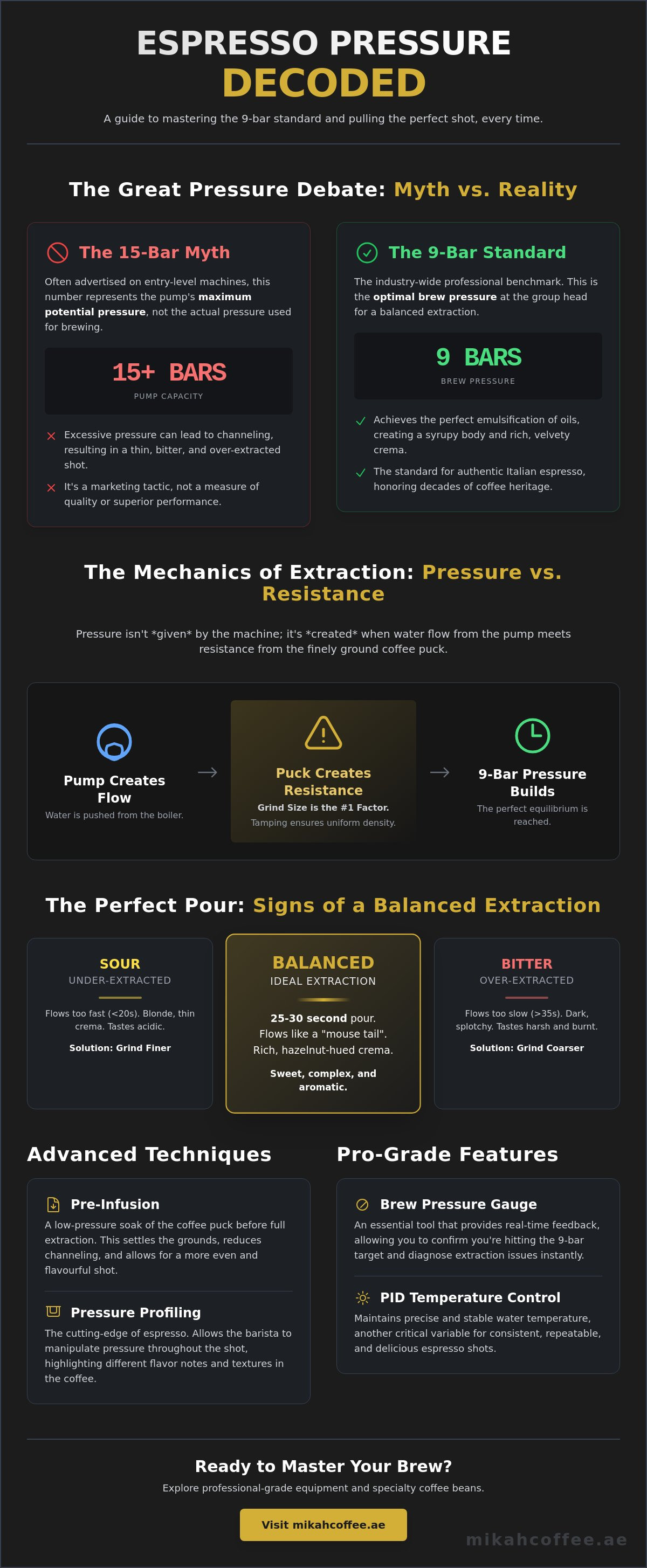
A common misconception exists among aspiring home baristas. Many believe the machine simply "gives" the coffee 9 bars of force. In reality, the pump only creates flow. Pressure is a reactive force, born only when that flow meets resistance. In this espresso machine pressure guide, we recognize the coffee puck as the true architect of extraction. If you were to engage your pump without a portafilter in place, your pressure gauge would likely remain at zero. The water must be challenged to create the intensity required for espresso.
This challenge is primarily governed by your grind size. When you "dial in" your beans, you're essentially calibrating the resistance of the coffee bed. A finer grind creates a denser barrier with less space between particles, forcing the water to build up pressure to pass through. Conversely, a coarse grind offers too many exit paths, leading to a watery, under-extracted shot. While tamping is a vital part of the ritual, its purpose isn't to provide the bulk of the resistance. Instead, tamping ensures a level, uniform surface that prevents "channeling," a phenomenon where water finds a weak point in the puck and rushes through, leaving the rest of the coffee dry and wasted.
How do you know when the synergy is correct? Watch the stream. A perfect 9-bar extraction begins with a slow, syrupy drip that matures into a steady, elegant "mouse tail." This thin, continuous flow indicates that the resistance of the coffee and the force of the pump have reached a state of equilibrium. To achieve this level of precision, many enthusiasts choose to invest in Professional Espresso Machines that offer the stability needed to replicate these results daily.
The Role of the Portafilter and Basket
The geometry of your basket significantly influences back-pressure. Entry-level machines often utilize pressurized, or "double-wall," baskets. These use a single small exit hole to artificially create pressure, which can mask a poor grind but limits your flavor potential. For the true connoisseur, non-pressurized baskets are the only choice. They rely entirely on the quality of your grind and the density of the hole pattern to manage flow, offering the transparency needed to taste the origin of your beans.
Water Quality and Pressure Consistency
The health of your machine's internal components is just as vital as your technique. Limescale buildup is the silent enemy of pressure consistency. When minerals accumulate within the pump or the narrow pathways of the group head, they restrict flow and cause the pressure to fluctuate wildly. This inconsistency makes it impossible to troubleshoot your shots effectively. Beyond maintenance, the mineral balance of your water changes how it interacts with the coffee oils. To protect your investment and ensure a flawless extraction, consult our guide on the best water for coffee brewing for a deeper look at the perfect solvent.
Debunking the 15-Bar Myth: Is More Pressure Better?
Have you ever wondered why entry-level machines proudly display "15 Bars" or "19 Bars" on their packaging, while the world's finest cafes use exactly nine? It's a classic case of marketing "more is better" logic. In reality, these inflated numbers don't represent the pressure used during the actual brewing process. Instead, they represent the maximum burst capacity of a budget-friendly vibration pump. This espresso machine pressure guide aims to dismantle that myth once and for all. When water hits a coffee puck at 15 bars, it doesn't extract more flavor. It acts like a high-pressure washer, shredding the delicate structure of the coffee bed and resulting in a cup that's both harsh and thin.
High-quality hardware avoids this brute force through a component called an Over-Pressure Valve (OPV). This vital part acts as a sophisticated gatekeeper, bleeding off excess pressure from the pump to ensure that only a steady, regulated 9 bars ever reaches your coffee. Machines without a properly tuned OPV often force the user to grind exceptionally fine just to slow the flow, which inevitably leads to over-extraction. This ruins the experience by masking the bright, floral notes of specialty beans with a dry, ashy bitterness.
Vibration Pumps vs. Rotary Pumps
The difference often comes down to the heart of the machine. Vibration pumps are small, loud, and rely on a piston moving back and forth within a spring. They're effective for home use but lack the immediate, silent stability of commercial counterparts. Because professional espresso machines prioritize a refined brewing ritual, they almost exclusively utilize rotary pumps. These systems provide a flat, unwavering pressure curve from the moment you engage the group head, ensuring your extraction remains undisturbed by the mechanical pulsing common in entry-level gear.
The Channelling Effect
Excessive pressure is the primary architect of channelling. Water is inherently lazy; it always seeks the path of least resistance. When forced into the portafilter at 15 bars, the water doesn't saturate the puck evenly. It punches tiny holes or "channels" through the coffee bed. You'll recognize this by the visual cues: the stream might spurt, spray, or suddenly turn a pale, watery blonde prematurely. While meticulous puck preparation is your first line of defense, even the most skilled barista can't fully compensate for the erratic force of an unregulated pump. Mastering this espresso machine pressure guide means choosing equipment that respects the coffee's natural resistance.
Advanced Brewing: Pre-infusion and Pressure Profiling
Once you've mastered the 9-bar standard, the next evolution in your journey involves the art of the "soft start." This is where pre-infusion enters the ritual. Nine bars is only the beginning. This espresso machine pressure guide recognizes that the most balanced shots often start with a gentle touch rather than immediate force. Pre-infusion is the deliberate act of saturating the coffee puck at a lower pressure, typically between 3 and 4 bars, before the pump ramps up to full power. This stage is crucial. It allows the coffee particles to absorb moisture and expand, effectively sealing any microscopic gaps in the coffee bed. By the time the full force of extraction arrives, the puck is a unified, resilient barrier. This preparation minimizes the risk of channelling, ensuring that every drop of water contributes to a balanced cup.
Beyond the start of the shot lies the sophisticated world of pressure profiling. This technique involves manually or automatically varying the pressure throughout the entire extraction window. It's a method that pays homage to the original lever machines, where pressure naturally tapered off as the spring tension decreased. Modern enthusiasts use this to highlight specific flavor profiles. By mimicking this declining pressure curve, you can emphasize sweetness and reduce the bitterness that often creeps into the final seconds of a traditional 9-bar shot. It's about treating the extraction as a dynamic process rather than a static one.
The Science of the Pre-Wet
Low-pressure saturation is particularly transformative for lighter specialty roasts. These beans are denser and more resistant to giving up their soluble compounds. Pre-infusion provides the necessary "dwell time" to increase extraction yield and unlock a hidden spectrum of sweetness and clarity. It prevents the water from simply rushing through the puck without picking up the coffee's character. If you're ready to refine your technique, learn how to pull a perfect espresso shot using these advanced saturation methods to elevate your daily cup.
Manual vs. Automatic Profiling
There is a distinct, tactile joy in manual profiling. Using a paddle-driven machine allows the barista to feel the resistance of the coffee and adjust the flow in real-time. It turns the brewing process into a performance. For those who prefer precision and repeatability, modern high-end home machines offer programmable pressure curves. You can set the machine to start at 3 bars for 5 seconds, ramp to 9 bars, and then gracefully drop to 6 bars for the final finish. This final taper is highly effective. By dropping the pressure in the last five seconds, you preserve the delicate aromatics while leaving the harshness behind. To bring this level of control into your kitchen, explore our collection of Professional Espresso Machines and discover the difference that precision makes.
Selecting Your Instrument: Professional Pressure Control
Choosing the right equipment is the final step in your transformation from a casual drinker to a home barista. This espresso machine pressure guide has explored the "why" and "how" of extraction, but without a precise instrument, even the most skilled hands will struggle. A machine that lacks the ability to regulate force is like a fine violin with loose strings; it simply cannot perform the masterpiece you intend. When evaluating your next investment, prioritize clarity and control over flashy aesthetics or inflated bar ratings.
The most critical feature for any enthusiast is a dedicated brew pressure gauge. This isn't just a decorative dial. It's your primary feedback loop. It allows you to see in real-time how your grind and tamp are resisting the pump's flow. In 2026, a PID (Proportional-Integral-Derivative) controller has also become a baseline requirement. While often discussed in the context of temperature, a high-quality PID system ensures the entire machine operates with the rock-solid stability needed to maintain a consistent 9-bar environment shot after shot.
Essential Features for the Home Connoisseur
To truly master your craft, look for hardware that offers an adjustable Over-Pressure Valve (OPV). This allows you to fine-tune your 9-bar limit, ensuring that the pump never overpowers the delicate coffee puck. Additionally, consider the following technical advantages:
- Dual Boiler Systems: These separate the high-pressure steam needed for milk from the precise, lower-pressure water required for brewing, preventing one from interfering with the other.
- Built-in Shot Timers: When used alongside your pressure gauge, a timer helps you confirm that your resistance and flow are perfectly synchronized.
- Rotary Pumps: As discussed previously, these provide a more immediate and silent path to the golden standard of pressure compared to smaller vibration models.
The Mikah Coffee UAE Professional Standard
Our commitment to the art of coffee extends beyond the beans themselves. We believe that the ritual of brewing deserves equipment that respects the century-old Italian tradition of precision. The selection at Mikah Coffee UAE is curated specifically for machines that deliver the unwavering 9-bar stability our Milano Blend requires. When you pair Italian-engineered hardware with a slow-roasted, sophisticated blend, the results are nothing short of transformative. You aren't just making a drink; you're conducting a sensory symphony. We invite you to explore our curated range of professional espresso machines to find the perfect partner for your morning ritual.
As you continue to refine your technique using this espresso machine pressure guide, remember that while pressure is the heart of the machine, the bean remains its soul. The mechanical force provides the structure, but the quality of your coffee provides the life. With the right instrument in your hands and a passion for the craft in your heart, the perfect shot is no longer a matter of chance. It's a matter of science.
Mastering Your Daily Extraction Ritual
You've moved beyond the surface level of home brewing. You now understand that nine bars is more than just a number; it's the mechanical heart of authentic espresso. By mastering the synergy between your grind resistance and the pump's flow, you've unlocked the ability to troubleshoot every shot with professional confidence. This espresso machine pressure guide serves as your roadmap from the confusion of marketing myths to the clarity of technical precision. The transition from a bitter, inconsistent pour to a syrupy, balanced masterpiece is no longer a matter of luck.
The journey to excellence requires an instrument that respects these principles. At Mikah Coffee UAE, our selection features Italian-engineered precision designed to maintain the golden standard with unwavering stability. We support your pursuit of perfection with UAE national delivery and expert technical support for all our professional hardware, ensuring your home setup mirrors the standards of the world's finest cafes. Elevate your ritual with our professional espresso machines and transform your morning coffee into a true work of craft. Your dedication to the art of extraction deserves nothing less than excellence.
Frequently Asked Questions
Why is 9 bars the standard for espresso?
Nine bars of pressure is the industry standard because it provides the perfect balance between oil emulsification and flavor extraction. This specific force allows water to pull out the aromatic compounds and create a rich crema without over-extracting the bitter tannins found in the bean. It has remained the benchmark for excellence since the introduction of the Faema E61 group head in 1961.
Can I pull a good shot with a 15-bar machine?
You can certainly pull an excellent shot with a 15-bar machine, provided it has an internal regulator. The 15-bar label usually refers to the maximum potential of the vibration pump, but the machine's internal valves typically limit the actual brewing pressure to the ideal 9 bars. The key is ensuring your grind size provides the correct resistance for that regulated flow.
Does tamping harder increase the brew pressure?
Tamping harder does not significantly increase brew pressure once you've achieved a fully compressed coffee bed. Most baristas find that applying roughly 15 kilograms of force is sufficient to remove air pockets. Beyond that point, the resistance is almost entirely determined by your grind size and the density of the coffee particles rather than the physical weight of your tamp.
What is an Over-Pressure Valve (OPV) and do I need one?
An Over-Pressure Valve (OPV) is a mechanical component that redirects excess water back to the reservoir to maintain a stable 9-bar limit. It's an essential feature for any serious home setup. Without an OPV, a pump might force water through the puck at erratic, high pressures. This often leads to the harsh channelling described earlier in this espresso machine pressure guide.
How do I know if my machine is reaching 9 bars of pressure?
The most reliable way to verify your pressure is by checking a dedicated brew pressure gauge while the shot is running. If your machine doesn't have a gauge, you can use a blind cleaning filter to force the pump to its maximum regulated limit. A professional machine should hold steady at 9 bars during this test, confirming the accuracy of your espresso machine pressure guide settings.
What happens if the pressure is too high during extraction?
Excessive pressure often results in a shot that is both bitter and thin due to a phenomenon called channelling. When the force exceeds 10 or 11 bars, the water tends to punch holes through the coffee puck rather than saturating it evenly. This leaves much of the coffee unextracted while the water that does pass through picks up harsh, astringent flavors from the friction.
Is pre-infusion necessary for every espresso shot?
While not strictly mandatory for every shot, pre-infusion is highly beneficial for achieving a consistent extraction. It's particularly useful when working with light, specialty roasts that are denser and harder to saturate. By wetting the puck at low pressure first, you ensure the coffee expands and seals potential weak points. This leads to a much sweeter and more complex final cup.
Why does my pressure gauge drop at the end of the shot?
Your pressure gauge drops at the end of the shot because the coffee puck is physically breaking down. As the water extracts the soluble solids from the grounds, the puck loses its structural integrity and offers less resistance to the pump's flow. This natural decline is often desirable. It prevents the extraction of heavier, more bitter compounds that typically emerge in the final moments of brewing.