


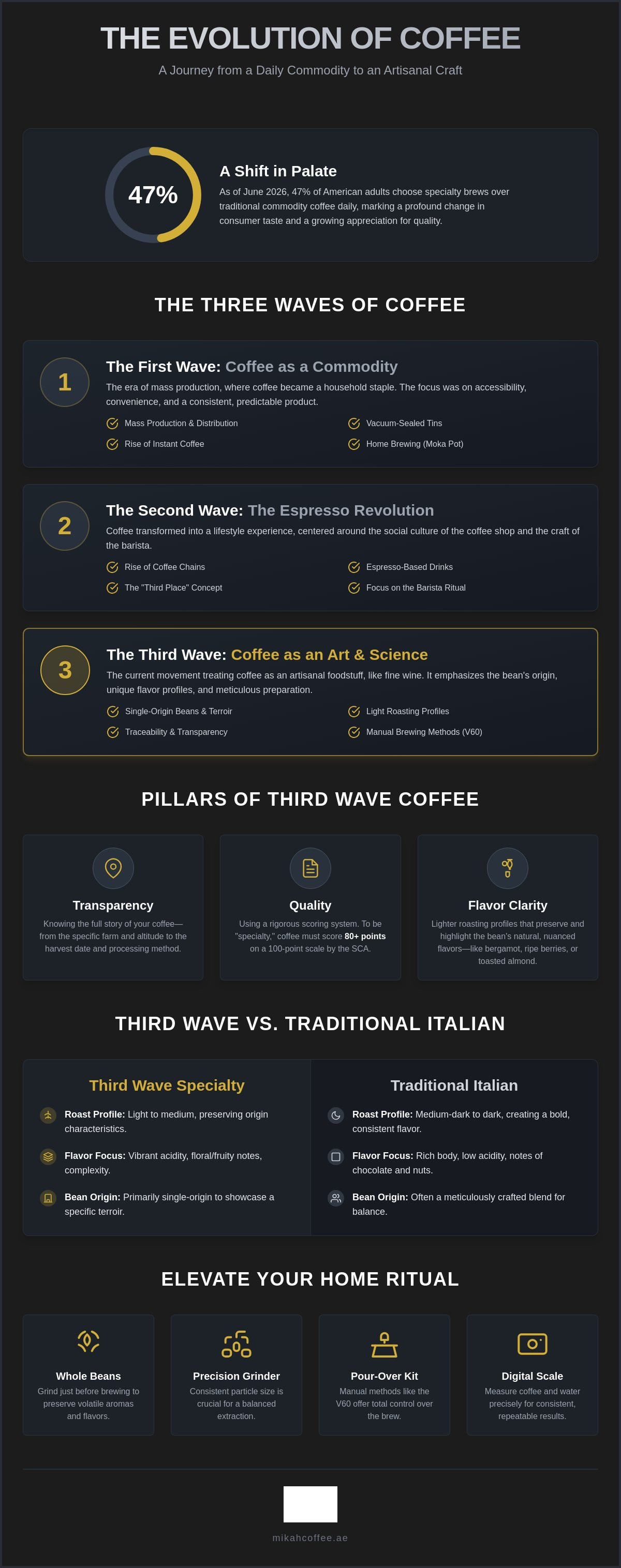
Did you know that as of June 2026, 47% of American adults now choose specialty brews over traditional commodity coffee every single day? This shift marks a profound change in our global palate. You might find yourself standing before a minimalist cafe menu, feeling a bit lost among terms like terroir, anaerobic fermentation, or cupping scores. You aren't alone in wondering what is third wave coffee and why it carries such a premium reputation. It's more than just a trend; it's a movement that treats the humble bean with the same reverence a sommelier gives a rare vintage wine.
It's perfectly natural to feel overwhelmed by technical jargon or the pressure to produce a perfect V60 pour at home. You deserve a cup that tastes as vibrant as the description on the bag. In this guide, we'll demystify the evolution of coffee from a kitchen staple to an artisanal craft. You will discover how to identify truly exceptional beans and learn the pillars of the specialty movement. We'll explore the rich history of these beans and provide you with the knowledge to appreciate nuanced flavor profiles in every sip.
Key Takeaways
- Understand what is third wave coffee by exploring its shift from a daily caffeine necessity to a culinary experience that prioritizes transparency and the unique terroir of the bean.
- Trace the journey of coffee through its three distinct eras, learning how the movement evolved from mass-produced convenience to the meticulous, artisanal standards of today's specialty roasters.
- Learn to identify high-quality beans by focusing on single-origin transparency and lighter roasting profiles that preserve a coffee's natural floral and fruity characteristics.
- Contrast the vibrant acidity of modern specialty roasts with the sophisticated body of traditional Italian styles, such as the signature Milano Blend, to find your ideal palate preference.
- Elevate your daily ritual with professional-grade tools like the V60 and learn why investing in whole-bean freshness and a precision grinder is non-negotiable for the home connoisseur.
Defining the Third Wave: More Than Just a Cup of Coffee
To truly understand what is third wave coffee, you must look beyond the ceramic mug and the steam. It is a fundamental shift in perception. We've moved away from treating coffee as a bitter, dark commodity meant only for a quick energy boost. Instead, the movement treats the bean as a complex, artisanal foodstuff. It's a culinary experience that demands the same reverence as a rare vintage wine or a small-batch craft spirit. This philosophy prioritizes the inherent quality of the bean, celebrating its unique story from the soil to the final pour.
We've witnessed a dramatic departure from the "dark and bitter" profiles that defined previous generations. In the past, heavy roasting was often used to mask defects in low-quality beans. Today, the goal is clarity. Roasters now aim for nuanced and complex flavor profiles. When you sip a modern specialty brew, you might encounter notes of bergamot, toasted almond, or even ripe berries. These aren't added flavors; they're the natural characteristics of the bean, preserved through meticulous, lighter roasting techniques. Transparency and traceability have become the industry hallmarks. A Third-wave coffee roaster will tell you the name of the farm, the altitude where the trees grew, and the exact date the beans were harvested.
The Concept of Specialty Coffee
Quality isn't just a marketing claim; it's a measurable standard. The Specialty Coffee Association (SCA) provides a rigorous framework for defining excellence. For a bean to earn the "specialty" title, it must score 80 points or higher on a 100-point scale. This evaluation considers everything from aroma and acidity to body and balance. This "bean-to-cup" narrative ensures that every hand that touched the product—the farmer, the sorter, the roaster—upheld the highest standards. It's a system that mirrors the provenance-focused world of fine dining, where the origin of the ingredient is just as important as the skill of the chef.
Why the UAE is Embracing the Movement
The UAE has seen a remarkable surge in specialty coffee culture. As of June 2026, global specialty consumption continues to climb, and local connoisseurs are leading the charge. In cities like Dubai and Abu Dhabi, the demand for refined, origin-focused brews has transformed the retail landscape. Residents are moving away from generic, mass-produced options in favor of curated experiences. Mikah plays a vital role in this cultural shift by acting as a professional guide. By offering professional espresso machines and precision V60 kits, Mikah empowers UAE coffee lovers to elevate their daily rituals. It's about bringing the expertise of a high-end boutique directly into your kitchen, ensuring that your home brewing results are as consistent and sophisticated as a professional cafe menu.
The Evolution of Coffee: Understanding the Three Waves
History is rarely a straight line. In the world of coffee, progress has arrived in distinct surges. Each wave represents a fundamental shift in how we source, prepare, and enjoy our daily brew. While the modern enthusiast often asks what is third wave coffee, it's impossible to appreciate this peak without understanding the foundations laid by the eras that came before. These movements weren't just about changing tastes; they were about a changing world that slowly learned to value the journey of the bean as much as the caffeine it provided.
The First Wave: Coffee as a Commodity
The First Wave was defined by accessibility and convenience. Following the post-war boom, the industry focused on mass production and shelf-life. This was the age of the vacuum-sealed tin and the rise of instant coffee. It transformed a luxury item into a household staple that was predictable and cheap. In traditional Italian homes, the iconic Moka Pot became the heart of the kitchen, bridging the gap between convenience and culture. Our own Milano blend coffee beans represent a heritage-rich evolution of this era. It honors that classic Italian soul and body while meeting the high-quality standards expected by today's sophisticated drinkers.
The Second Wave: The Espresso Revolution
The Second Wave arrived with the rise of the espresso bar and the "Starbucks effect." Coffee became a lifestyle choice rather than a mere beverage. We learned to appreciate the ritual of the barista and the social aspect of the coffee house as the "third place" between home and work. This era introduced the public to latte art and complex, milk-based drinks. It was a time of exploration where the world first met professional espresso machines on a grand scale. The focus shifted toward the experience of the cafe, though the beans were often still roasted dark to ensure a uniform taste across thousands of global locations.
Finally, we arrive at the current era. If the First Wave was about accessibility and the Second was about the experience, the Third Wave is about the bean itself. This is the essence of what is third wave coffee: a relentless focus on the individual farmer and the micro-lot. We no longer just drink "coffee from Brazil." We drink coffee from a specific hillside, harvested by a specific family, and roasted to highlight its unique terroir. Each wave built upon the last, moving us from a simple commodity to a sophisticated sensory ritual. If you're ready to start your own journey, exploring a curated selection of specialty beans is the perfect first step to elevating your home ritual.
The Three Pillars of Third Wave Coffee
While the history of the movement provides context, its daily practice rests upon three non-negotiable foundations. These pillars transform a simple beverage into a sophisticated sensory experience. If you've ever wondered what is third wave coffee in a practical sense, it's the meticulous intersection of provenance, roasting chemistry, and brewing physics. This isn't just about drinking coffee; it's about honoring a craft that begins in high-altitude soil and ends with a perfectly extracted cup.
Origin and Terroir
Provenance is the heart of the specialty movement. We prioritize high-altitude Arabica beans because the thin air and cooler temperatures force the coffee cherries to grow slowly. This slow maturation creates a denser bean with a more concentrated flavor profile. Just as a sommelier speaks of terroir in wine, a coffee connoisseur recognizes how soil composition, rainfall, and local flora dictate the notes in your cup. When you examine a bag of specialty beans, you'll see more than just a country of origin. You will find the name of the specific farm or "micro-lot," the altitude, and the processing method used to clean the beans. Identifying these single-origin labels is your first step in ensuring quality and transparency.
The Art of the Light Roast
The roasting philosophy of the third wave is a radical departure from traditional methods. We've moved away from the charred, smoky flavors of dark roasts that often mask the bean's true character. Instead, we embrace lighter roasting profiles. This approach preserves the natural sugars and delicate compounds inherent in the bean. Roasting is a delicate dance between heat and time, where a few seconds can mean the difference between a bright, floral cup and a muted, generic one. Contrary to popular belief, this doesn't always result in a sharp acidity. When done correctly, a light roast offers a profound balance, highlighting fruit-forward notes and floral aromatics that would otherwise be lost to the flames.
Precision Brewing with the V60
Control is the final piece of the puzzle. Manual brewing methods have become the gold standard because they allow the connoisseur to manipulate every variable, from water temperature to grind size. Among these, the V60 stands alone for its ability to produce unparalleled flavor clarity. The conical shape and spiral ridges of the dripper facilitate a clean extraction that highlights the bean's most subtle nuances. For those looking to master this ritual at home, investing in a professional V60 pour over kit UAE is essential. It provides the precision needed to turn a morning routine into a meaningful craft, ensuring that the hard work of the farmer and roaster is fully realized in your cup.
Transparency extends beyond the label through direct trade. By building sustainable, transparent relationships with growers, third-wave roasters ensure that farmers are paid fairly for their expertise. This ethical foundation isn't just about social responsibility; it's a commitment to the long-term quality of the industry. When the farmer thrives, the coffee thrives, and the entire ecosystem of what is third wave coffee continues to flourish.
Third Wave vs. Traditional Italian: Finding Your Perfect Roast
The choice between traditional Italian roasting and modern specialty methods often sparks intense debate among enthusiasts. Many newcomers wonder what is third wave coffee in comparison to the classic espresso they've enjoyed for years. It isn't a matter of one being "better" than the other. It's about different culinary goals. While the third wave prioritizes the bean's origin through light roasting, the traditional Italian approach seeks a harmonious, velvety balance. High-quality coffee exists comfortably in both frameworks. A common misconception suggests that specialty coffee is always "sour." In reality, a well-executed light roast is about vibrant acidity and natural sweetness, not unpleasant sharpness. It's about clarity rather than bitterness.
The Sensory Profile of the Third Wave
Expect a profile that is vastly different from the heavy, chocolatey notes of a dark roast. You'll find aromatics like jasmine, bright citrus, stone fruit, and red berries. The body is often lighter, possessing a tea-like clarity that is best appreciated through a pour-over. Developing your palate to recognize these subtle differences takes time and intention. Start by smelling the dry grounds and then the wet aroma. Sip slowly as the coffee cools. You'll notice the flavors change and become more pronounced as the temperature drops, revealing the true character of the terroir we discussed earlier.
When Tradition Meets Quality
Traditional roasting doesn't mean sacrificing specialty standards. Our signature Milano Blend remains a staple for those who desire a rich, velvety espresso with a lasting crema. It's a sophisticated bridge between heritage and modern precision. At Mikah, we apply the same rigorous sourcing and quality control to these medium-dark profiles as we do to our lighter specialty beans. This ensures a luxury experience that avoids the "charred" flavors of lower-grade commodity coffee.
Your choice often depends on your preferred preparation. If you favor milk-based drinks like lattes or flat whites, a traditional profile provides the necessary body to cut through the creaminess. If you drink your coffee black, the third-wave light roasts offer a cleaner, more transparent window into the bean's origin. Both styles have their place in a connoisseur's kitchen. It's about matching the roast to the ritual. If you're ready to experience this balance of tradition and innovation, explore our curated coffee collections to find your perfect roast profile today.
Understanding what is third wave coffee allows you to appreciate the full spectrum of the industry. You don't have to choose a side. You can appreciate the bright, floral complexity of an Ethiopian single-origin in the morning and the deep, comforting body of a Milano espresso in the afternoon. This versatility is what makes the modern coffee landscape so exciting for the UAE's growing community of coffee lovers.
How to Elevate Your Home Ritual: Joining the Third Wave
Understanding what is third wave coffee is only the first step. The true joy lies in translating these lofty ideals into your daily morning ritual. Transitioning from a casual drinker to a connoisseur requires a shift in mindset; you must move from viewing coffee as a simple beverage to seeing it as a precise culinary craft. It begins with the bean. Freshly roasted, whole-bean coffee is non-negotiable. Once a bean is ground, its aromatic compounds begin to dissipate within minutes. To preserve the floral and fruity notes we've discussed, you must grind your beans immediately before brewing.
This makes a quality burr grinder the most important piece of gear in your kitchen. Unlike blade grinders that shatter beans into inconsistent shards, a burr grinder ensures a uniform particle size. Why does this matter? Consistency allows for even extraction, preventing your cup from tasting both bitter and sour at the same time. In the UAE, you must also consider your water. Desalinated tap water often contains minerals or treatments that can mute the delicate acidity of a light roast. Using a simple charcoal filter or bottled water with a balanced mineral profile will drastically improve the clarity of your brew.
Essential Gear for the Budding Connoisseur
Precision is the hallmark of the specialty movement. A digital scale is essential for maintaining consistent ratios between water and coffee, removing the guesswork from your morning. If you enjoy milk-based drinks, a Mikah milk frother online allows you to achieve that velvety, cafe-quality texture that complements a sophisticated roast. You might also find yourself choosing between different lifestyles. For busy mornings, high-quality Nespresso compatible capsules UAE offer a bridge to specialty flavors, while manual V60 kits provide the ultimate craft experience when you have a moment to linger.
Continuous Learning
The journey doesn't end with the right equipment. The specialty movement is a community of constant exploration. Attend local cupping sessions in Dubai or Abu Dhabi to train your palate alongside other enthusiasts. Follow specialty blogs to stay updated on new processing methods or harvest seasons. Don't be afraid to experiment with your brew times and water temperatures to find the "sweet spot" for every new bag of beans. Each origin tells a different story, and your role is to be its best possible narrator. If you're ready to start your transformation, explore our curated selection of specialty beans and equipment to begin your journey into the art of the craft.
Embrace the Art of the Perfect Pour
The journey from a simple morning caffeine fix to a sophisticated sensory ritual is one of the most rewarding transitions a connoisseur can make. You've discovered how the movement prioritizes the unique story of the farm and the chemistry of a lighter roast. Understanding what is third wave coffee is ultimately about respecting the integrity of the bean and the precision of the process. Whether you prefer the bright clarity of a single-origin V60 or the velvety body of a traditional espresso, the power to elevate your daily experience is now in your hands.
Since 1984, Mikah has honored deep Italian roots while curating the very best of the specialty world for the UAE market. You don't have to settle for inconsistent results at home when professional-grade tools and meticulously sourced beans are within reach. It's time to transform your kitchen into a high-end boutique of flavor. Elevate your home brewing ritual with Mikah Coffee UAE and discover a premium selection designed for the modern expert. Your next exceptional cup is waiting.
Frequently Asked Questions
Is third wave coffee the same as specialty coffee?
No, these terms describe different aspects of the industry. Specialty coffee refers to a technical quality grade, specifically beans that score 80 points or higher on a 100 point scale by the Specialty Coffee Association. In contrast, the third wave is the cultural and philosophical movement that treats coffee as an artisanal craft rather than a simple commodity.
Why is third wave coffee more expensive than grocery store brands?
You are paying for meticulous quality and ethical transparency. Specialty roasters often pay significant premiums above commodity prices to secure the best harvests from specific farms. These beans are hand-sorted and roasted in small batches with precision equipment to ensure the delicate flavor profiles remain intact throughout the journey to your cup.
Can I brew third wave coffee in a standard drip machine?
You can use a standard machine, but you might miss the subtle nuances that define the bean. Most home drip brewers don't reach the stable water temperatures required for proper specialty extraction. To truly understand what is third wave coffee, we recommend using manual methods like a V60 to unlock the clarity and vibrant acidity inherent in the roast.
Does third wave coffee always have a light roast?
While light roasts are a hallmark of the movement, the primary goal is to highlight the bean's natural character. Some roasters prefer a medium profile to develop more body and sweetness. The defining factor isn't just the color of the bean; it's the refusal to use heavy, dark roasting to mask defects or low quality coffee.
What is the difference between single-origin and a coffee blend?
Single-origin beans come from one specific farm, estate, or region, allowing you to taste the pure terroir of that location. A blend, like our signature Milano Blend, combines beans from different origins to create a sophisticated, consistent profile. Blends are often designed to balance body and acidity, making them a favorite for traditional espresso preparations.
Why do third wave cafes focus so much on latte art?
Latte art is a visual indicator of a barista's technical skill and the milk's quality. To create a detailed pattern, the milk must be steamed into a perfect microfoam with a velvety texture. This ensures a superior mouthfeel and highlights the natural sweetness of the milk, which complements the complex notes of the specialty espresso base.
Is third wave coffee better for the environment and farmers?
The movement generally prioritizes direct trade relationships that pay farmers well above Fair Trade minimums. These higher prices incentivize sustainable farming practices and allow growers to invest in their land and communities. By focusing on quality over volume, the industry encourages ecological health and the long term viability of rare coffee varieties.
How do I know if a coffee shop in the UAE is truly 'third wave'?
Look for transparency in their sourcing and preparation. A genuine specialty cafe will proudly display the origin, processing method, and roast date on their bags. They will typically offer manual brewing options and employ baristas who can explain what is third wave coffee and how it differs from traditional commodity brews.