


Why does a meticulously sourced bag of beans sometimes taste like a sharp lemon rather than the vibrant masterpiece promised on the label? It's a common frustration for the home enthusiast. You spend more on quality, yet the result feels thin or unpleasantly biting. Understanding coffee acidity and body is the essential bridge between a simple morning caffeine fix and a sophisticated sensory ritual. Acidity provides the light and brightness in your cup, while body acts as the structural foundation, defining the weight and texture on your palate.
You likely agree that consistency is the ultimate goal, yet achieving it often feels like a moving target. With the 2026 SCA standards refining our approach to extraction and water chemistry, there has never been a better time to elevate your expertise. This guide will help you master the delicate interplay between brightness and mouthfeel to transform your daily routine into a professional tasting experience. We'll explore how to decode roaster labels with confidence, adjust brewing variables to eliminate sourness, and appreciate the curated art of the Italian blend.
Key Takeaways
- Learn to distinguish between the bright "sparkle" of acidity and the velvety mouthfeel of a coffee's body to better articulate your specific flavor preferences.
- Master the architectural relationship between roast levels and terroir, gaining a deeper understanding coffee acidity and body as they evolve from the farm to the roaster.
- Discover how to manipulate grind size and extraction variables to correct thin, watery textures or sharp, sour notes in your daily home brew.
- Explore the heritage of the Milano blend and see how professional roasters achieve a perfect equilibrium through the strategic blending of diverse bean origins.
- Gain the refined vocabulary needed to read coffee labels with confidence, ensuring every selection aligns perfectly with your desired sensory profile.
Defining the Sensory Pillars: What are Acidity and Body?
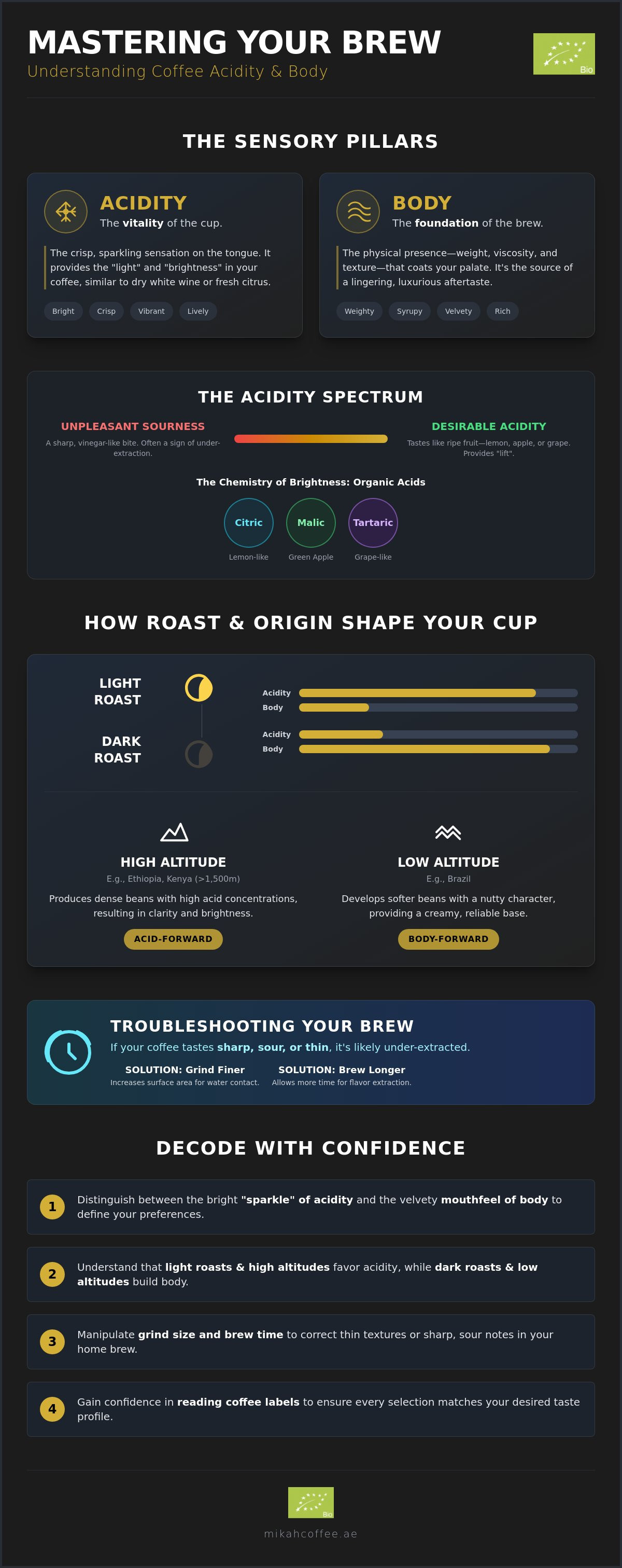
To appreciate a truly exceptional cup, one must look beyond the generic label of "strong coffee." Instead, we view the beverage as a carefully constructed landscape. When you're first understanding coffee acidity and body, it's helpful to view them as the DNA of every specialty blend; they are the fundamental coordinates that define a bean's character. Acidity is the vitality of the cup. It's the crisp, sparkling sensation that dances across the tip and sides of your tongue, much like the first sip of a dry white wine or a fresh citrus infusion. Body, by contrast, is the physical presence. It's the weight, viscosity, and texture that coats the palate, providing a sense of luxury and permanence to the experience.
A common hurdle for many enthusiasts is distinguishing between pleasant acidity and unpleasant sourness. While they may seem related, they represent opposite ends of the quality spectrum. Desirable acidity tastes like ripe fruit; think of the brightness of a lemon, the sweetness of a Fuji apple, or the snap of a red grape. Sourness, however, is often a sign of under-extraction or poor storage, manifesting as a sharp, vinegar-like bite that puckers the mouth. Professional coffee tasting protocols prioritize this distinction, as a balanced cup uses acidity to provide "lift" without becoming abrasive.
The Chemistry of Brightness
The "sparkle" in your cup isn't accidental; it's a result of specific organic acids. Citric acid brings a familiar lemon-like punch, malic acid offers the crispness of a green apple, and tartaric acid provides a sophisticated, grape-like finish. It's vital to separate "scientific acidity" from "sensory acidity." While most coffee sits at a pH of around 5, the perceived brightness depends more on the concentration of these organic compounds than the actual hydrogen ion count. High-altitude cultivation slows the cherry's maturation process, allowing for the development of complex organic acids that translate into vibrant brightness in the cup. This complexity is what prevents a high-acid coffee from tasting flat or one-dimensional.
The Tactile Sensation of Body
Body is the tactile architecture of the brew. It's created by the suspension of fats, oils, and microscopic undissolved solids that escape the filter and land on your tongue. This creates the "mouthfeel," a sensation that can range from light and tea-like to heavy and syrupy. Body is often the most overlooked element by beginner tasters, yet it's the primary driver of the lingering aftertaste. A coffee with a "heavy body" will have a finish that persists for minutes, allowing the deeper, chocolatey or nutty notes to resonate long after the sip is gone. Without sufficient body, even the most vibrant acidity can feel hollow and fleeting.
Roast and Origin: How the Bean’s Journey Shapes the Profile
The journey from soil to cup is a series of profound transformations. Every chapter in a bean's biography, from the altitude of the farm to the final seconds in the roasting drum, alters its chemical composition. Central to understanding coffee acidity and body is recognizing that these traits aren't static; they are sculpted by the environment and the roaster's hand. While a bean may possess the genetic potential for brightness, it's the craft of the curator that decides whether that potential is realized or transformed into something more tactile and resonant.
Roasting presents a fascinating paradox. As the bean absorbs heat, the vibrant organic acids we discussed previously begin to degrade. Simultaneously, sugars caramelize and cellular structures weaken, releasing the internal oils that increase a liquid's viscosity. This creates an inverse relationship. The liveliness of a light roast is often sacrificed to gain the velvety, chocolate-toned weight of a darker profile. When professionals use The Coffee Taster's Flavor Wheel, they are often looking for the point where these two forces intersect to create a complex, multi-layered experience.
Terroir and altitude act as the primary architects of this foundation. High-altitude estates, often found in Ethiopia or Kenya at elevations exceeding 1,500 meters, produce dense beans with high acid concentrations. These "acid-forward" beans are prized for their clarity. Conversely, lower-altitude Brazilian crops develop with less atmospheric stress. This results in a softer bean with a naturally nutty, "body-forward" character that provides a reliable, creamy base for many traditional blends.
Light vs. Dark Roast Dynamics
- Light Roasts: These preserve the "origin character," maintaining high acidity and a tea-like body.
- Medium Roasts: The transition point where fruit acids begin to mellow and sweetness peaks.
- Dark Roasts: Here, acidity is minimal. The profile is dominated by carbon, smoke, and a heavy, lingering mouthfeel.
The Impact of Processing Methods
How a cherry is handled after harvest further refines its architecture. The Washed Process removes the fruit entirely before drying, resulting in a clean, high-acidity cup with a light body. The Natural Process allows the bean to dry inside the fruit, imbuing it with heavy sweetness and a creamy, syrupy texture. The Honey Process acts as a sophisticated hybrid, stripping some fruit but leaving enough mucilage to balance brightness with a rounded mouthfeel. If you are eager to taste these distinctions, exploring a curated selection of specialty coffee can reveal how processing subtly shifts the balance of your morning brew.
The Italian roasting tradition avoids polarizing extremes. Instead of chasing maximum acidity or total darkness, it seeks a "harmonic middle." This philosophy uses the roast to bridge the gap, ensuring the acidity provides structure while the body offers a luxurious, comforting foundation. It's an exercise in equilibrium that transforms a simple beverage into a masterpiece of flavor architecture.
The Connoisseur’s Palate: Identifying Texture and Tone
"Strong" and "weak" are descriptors of concentration, not character. To truly appreciate excellence, we must adopt the language of the curator. Refining your sensory vocabulary is the next step in understanding coffee acidity and body. Have you ever wondered why a bright Ethiopian bean feels refreshing while an under-extracted brew feels aggressive? The answer lies in the presence of sweetness. Sweetness acts as the essential bridge, softening the edges of organic acids and preventing them from becoming sharp or vinegary. Without this sugary foundation, acidity becomes a defect rather than a virtue.
Professional tasters use a technique known as "the slurp" to evaluate these nuances. By forcefully drawing the liquid across the palate with a sharp intake of air, they aerate the coffee. This spreads the brew over every taste bud and allows aromatic compounds to reach the olfactory system. It's during this moment that you can distinguish between the "sparkle" of quality acidity and the "sourness" of a defect. Sourness is often thin and biting, a hallmark of under-extraction where the water hasn't had enough time to pull out the balancing sugars. True acidity, by contrast, has a three-dimensional quality that feels intentional and ripe.
A Vocabulary for Body
The tactile experience of coffee is often more intuitive than flavor. We categorize this weight through specific descriptors that reflect the liquid's viscosity:
- Silky or Tea-like: This is a delicate, elegant texture. It's most common in light roasts prepared via a V60, where the paper filter removes most oils to highlight clarity.
- Creamy or Smooth: The classic middle ground. This mouthfeel is the hallmark of a well-balanced medium roast, offering a gentle, rounded presence that feels like whole milk.
- Syrupy or Heavy: A dense, coating sensation. You'll find this in premium Italian espressos where the high concentration of oils creates a liquid that clings to the tongue.
A Vocabulary for Acidity
Acidity is about the "tone" of the brightness and how it interacts with your senses:
- Vibrant or Crisp: This is the gold standard for many enthusiasts. It provides an energetic lift that cleanses the palate and leaves you wanting another sip.
- Mellow or Soft: A subtle, integrated brightness. It doesn't scream for attention but provides the necessary structure to support deeper notes of chocolate or caramel.
- Dull or Flat: This is the absence of life. It usually indicates that the beans are stale or have been roasted so dark that the organic acids have been completely destroyed.
By learning to isolate these sensations, you stop simply drinking coffee and start analyzing its architecture. Do you notice how a heavy body can sometimes mask a delicate acidity? Or how a crisp finish can make a medium-bodied cup feel lighter than it actually is? These are the questions that turn a morning ritual into a professional tasting experience.
Brewing for Balance: Manipulating Flavor with Technique
Extraction is an act of translation. It is the moment where the chemical potential of the bean becomes a sensory reality. Mastering the mechanics of your brew is the final, most critical step in understanding coffee acidity and body. Think of extraction as a chronological timeline. The organic acids we explored earlier are the first compounds to dissolve into the water. Sweetness follows, and finally, the heavier bitter compounds and plant fibers emerge. If your brew time is too short, you're left with a one-dimensional, sour cup. If it's too long, the delicate brightness is buried under a wave of dry bitterness.
Grind size is your primary lever for control. A finer grind increases the surface area exposed to water, accelerating extraction and emphasizing body and sweetness. Conversely, a coarser grind slows the process, highlighting the sparkling acidity of the bean's origin. Water temperature plays a similarly vital role. While near-boiling water can sometimes "scorch" delicate floral acids, cooler water may fail to extract the oils necessary for a satisfying mouthfeel. We typically recommend a range between 90°C and 96°C to preserve that fragile equilibrium.
Hardware Influence: V60 vs. Espresso
The equipment you choose acts as a filter for the bean's personality. If you prefer high-clarity acidity and a light, tea-like body, utilizing a V60 pour over kit UAE allows for precise control over the flow rate. The paper filter captures most oils, leaving a clean and vibrant cup. In contrast, professional espresso machines use high pressure to emulsify coffee oils into a rich crema, maximizing body and intensity. For those seeking a middle ground, the Moka Pot offers a concentrated texture without the technical complexity of high-pressure extraction.
The Troubleshooting Guide
When the balance feels off, small adjustments can salvage the experience. Use these principles to calibrate your palate:
- If it’s too sour: Your acidity is dominating because you haven't extracted enough sweetness. Grind finer or increase your water temperature to pull more from the bean.
- If it’s too bitter or heavy: You've extracted too much. Coarsen your grind or shorten the brew time to let the acidity shine through.
- The Golden Ratio: Start with a ratio of 1:15 (one gram of coffee to 15 grams of water). This provides a reliable baseline from which you can adjust for a heavier or lighter body.
Every variable is a choice. By adjusting these small details, you move from being a passive consumer to an active architect of flavor. To begin your journey toward the perfect cup, explore our selection of specialty coffee and discover how technique transforms the bean.
The Milano Blend: A Masterclass in Equilibrium
The culmination of flavor architecture is found in the art of the blend. While single-origin beans offer a snapshot of a specific terroir, the Milano blend coffee beans represent a deliberate symphony of multiple origins. Achieving this requires a profound level of mastery in understanding coffee acidity and body. It isn't merely about mixing beans; it's about selecting a high-acidity Arabica to provide the "sparkle" and pairing it with body-rich beans that offer a structural, chocolatey foundation. This creates a complete palate experience where no single element overwhelms the others.
The roasting process is where this equilibrium is solidified. We utilize a slow-roasting methodology that treats the beans with patience. This technique is vital because it allows the internal sugars to caramelize deeply, developing a syrupy viscosity without burning off the delicate organic acids that provide character. True expertise in understanding coffee acidity and body allows you to appreciate why a blend is often more than the sum of its parts. Even as we transition this craftsmanship into Nespresso compatible capsules UAE, the focus remains on profile integrity. Modern capsule technology now allows us to preserve these volatile aromatics, ensuring that the convenience of a single-serve system doesn't require a sacrifice in sensory depth.
Crafting the Signature Mikah Profile
Our selection process is rigorous. We source beans that complement rather than compete, looking for a natural affinity between the bright fruit notes of one region and the heavy, nutty texture of another. In a true Milano espresso, the crema plays a vital role in the perceived body. This golden layer of emulsified oils acts as a tactile bridge, carrying the aroma and providing a luxurious mouthfeel. This balance is what makes the blend so versatile. It possesses the strength to cut through the sweetness of milk while remaining sophisticated enough to stand alone as a pure black coffee.
Bringing the Italian Boutique Experience Home
To truly elevate your daily ritual, you must consider the interaction between texture and temperature. Using a Mikah milk frother online allows you to introduce an "aerated body" to your beverages, creating a gourmet foam that enhances the liquid's natural weight. As a final connoisseur's tip: let your coffee cool slightly before the first sip. As the temperature drops, the perceived bitterness recedes, allowing the bright acidity to bloom and the complex sugars to become more apparent. We invite you to explore the full Mikah curated collection, where every bean is a testament to the enduring art of Italian coffee culture.
Mastering the Architecture of Your Morning Brew
Transitioning from a casual drinker to a connoisseur is a journey of sensory refinement. You've explored how high-altitude origins and precise roasting methods lay the foundation for brightness and texture. By manipulating your brewing variables, you now have the tools to transform a thin or sour cup into a balanced masterpiece. Truly understanding coffee acidity and body is about more than just definitions; it's about the intentional pursuit of equilibrium in every sip.
Since 1984, we've remained dedicated to the craft of authentic Italian slow-roasting to ensure this balance is present in every bean. Our curated selection of professional-grade brewing hardware and specialty coffees is available with premium national delivery across the UAE. The path to a better cup starts with the right foundation and the right expertise.
Explore the Milano Blend and experience the perfect balance of acidity and body. Your next cup is an opportunity to apply your new vocabulary and enjoy the elevated ritual you deserve.
Frequently Asked Questions
Is acidic coffee bad for my stomach?
Coffee acidity is generally a sensory descriptor rather than a measure of harmful chemical pH levels. Most coffee sits at a pH of around 5.0, which is far less acidic than natural stomach acid or common fruit juices. If you have a sensitive digestive system, you might find that darker, slow-roasted beans are gentler. These roasts contain lower concentrations of the specific compounds that can sometimes trigger discomfort.
Why does my coffee taste sour instead of "bright"?
Sourness is a common sign of under-extraction, occurring when the water hasn't pulled enough sweetness from the grounds to balance the organic acids. This results in a sharp, biting sensation rather than a vibrant "sparkle." To fix this, try refining your grind size or increasing your water temperature. These small adjustments help extract the balancing sugars that turn a sour defect into a pleasant, bright attribute.
Does adding milk change the acidity of the coffee?
Yes, milk acts as a natural buffering agent that physically and chemically reduces the perceived acidity of your brew. The proteins in milk bind to the coffee's acidic compounds, effectively softening the "snap" on your tongue. Simultaneously, the fats in milk increase the overall body and creaminess of the beverage. This is why many drinkers prefer milk-based drinks when using high-acid, light-roasted beans.
Which brewing method produces the most body?
Espresso and immersion methods like the French Press are the most effective for achieving a heavy, syrupy body. These techniques allow more undissolved solids and natural oils to remain in the final liquid, resulting in a velvety texture that coats the palate. While a paper filter highlights clarity, the high pressure of an espresso machine emulsifies fats to create the dense mouthfeel that defines the traditional Italian experience.
Do dark roasts have more caffeine because they have more body?
No, caffeine content remains relatively stable during the roasting process, and dark roasts actually contain slightly less caffeine by volume. As beans roast longer, they lose mass and expand in size, meaning a scoop of dark roast beans weighs less than a scoop of light roast. The heavy body you perceive is a result of oil development and cellular breakdown, not an increase in stimulant concentration.
Can I have high acidity and high body in the same cup?
Achieving this rare combination requires a mastery of understanding coffee acidity and body through strategic blending and roasting. By combining high-altitude Arabica beans for brightness with a naturally body-rich variety, you can create a cup that possesses both a vibrant "lift" and a luxurious texture. This is the philosophy behind the Milano blend, where the roast is carefully timed to preserve acidity while maximizing viscosity.
How does water quality in the UAE affect coffee acidity?
The mineral composition of water in the UAE can significantly impact the clarity and brightness of your brew. High levels of bicarbonate often found in local water can act as a buffer, neutralizing organic acids and making a vibrant coffee taste muted or flat. For those invested in understanding coffee acidity and body, using filtered or bottled water with a balanced mineral profile is essential to ensure the bean's true architecture remains unmasked.
What is the best way to store beans to preserve their acidity?
Storing your beans in an airtight, opaque container in a cool, dry place is the most effective way to prevent oxidation. Exposure to oxygen, light, and heat causes the delicate organic acids to degrade rapidly, eventually leaving your coffee tasting stale and flat. To maintain that fresh, energetic sparkle, avoid the refrigerator or freezer. Instead, keep your beans in a dedicated coffee canister and grind them just before brewing.