


That glistening, oily sheen on your favorite dark roast might look like a sign of quality, but it's often the silent enemy of your super-automatic machine. Have you ever wondered why your shots taste increasingly bitter or why your grinder seems to struggle after just a few months of use? Finding the right coffee beans for automatic espresso machines is a delicate balance between achieving a rich, thick crema and ensuring your machine's long-term reliability.
We understand the frustration of a watery espresso or the anxiety of a looming repair bill. You deserve a morning ritual that's both luxurious and dependable. You're about to discover how to select the perfect Italian beans that deliver cafe-quality crema while protecting your automatic machine's delicate internal grinder. We will explore the "dry-roast" tradition and the ideal profiles, such as the classic Milano blend, that bring the sophisticated atmosphere of a high-end boutique directly into your kitchen. It is time to elevate your daily cup with the precision and heritage your palate demands.
Key Takeaways
- Learn how to identify the subtle differences between oily and dry-roasted beans to prevent costly grinder clogs and ensure long-term machine reliability.
- Discover why the refined "Milano Style" roast is the premier choice when selecting coffee beans for automatic espresso machines for a harmonious and traditional cup.
- Understand the internal mechanics of your super-automatic brew group and why bean brittleness plays a vital role in achieving a professional-grade tamp.
- Master the nuances of your machine's settings, from water quality to dosage, to extract a thick and velvety crema without compromising your hardware.
- See how the Mikah Milano Blend provides a curated, dry-finish solution that honors Italian tradition while protecting your delicate internal components.
Understanding Automatic Extraction: Why Your Machine is Selective
Precision defines the experience of a super-automatic machine. While a manual barista possesses the tactile intuition to adjust their technique, your machine operates within a world of programmed parameters and mechanical sensors. This internal brew group is a marvel of engineering, yet its reliance on automation means it is inherently more selective about the input it receives. To truly appreciate the engineering involved, one must first understand what espresso is at its core: a concentrated extraction that demands perfect resistance from the coffee puck.
Unlike a manual portafilter where you control the tamp, an automatic machine uses a mechanical piston to compress the grounds. This process requires a specific bean brittleness. If a bean is too soft or saturated with surface oils, it will not shatter into the uniform particles required for a clean extraction. Instead, it can clump, leading to the watery or uneven shots many owners struggle to fix. Choosing the right coffee beans for automatic espresso machines ensures that the built-in burr grinder can produce a consistent, powdery texture that allows the pre-infusion cycle to saturate the coffee evenly. This synergy between bean density and machine mechanics is the secret to a professional result at home.
The Super-Automatic Brewing Cycle
The journey from hopper to cup involves a sophisticated sequence: grinding, dosing, and tamping, all occurring within seconds. Consistency is the primary goal here. If the beans vary significantly in density, the machine's sensors may miscalculate the dosage, resulting in a weak or overly bitter cup. Most high-end machines in 2026 utilize automatic pressure regulation to mimic professional standards. However, this technology only succeeds if the coffee provides the correct hydraulic resistance. A well-selected bean creates a stable puck that withstands this pressure, yielding a rich, dark liquid topped with a persistent crema.
Arabica vs. Robusta in Automatic Systems
While specialty coffee circles often champion 100% Arabica, automatic systems often thrive on a balanced blend. Robusta beans provide the structural integrity that a super-auto needs to build a thick, lasting crema. The traditional "Italian ratio", typically a 70/30 or 80/20 Arabica to Robusta mix, offers a more forgiving extraction window. This combination provides a velvety mouthfeel and a bold flavor profile that maintains its character when paired with milk. It is a matter of finding harmony between the delicate, floral acidity of Arabica and the robust, crema-enhancing properties of premium Robusta. This balance is particularly effective for coffee beans for automatic espresso machines, as it compensates for the fixed temperature and pressure settings of most home units.
The Oily Bean Dilemma: Protecting Your Grinder’s Longevity
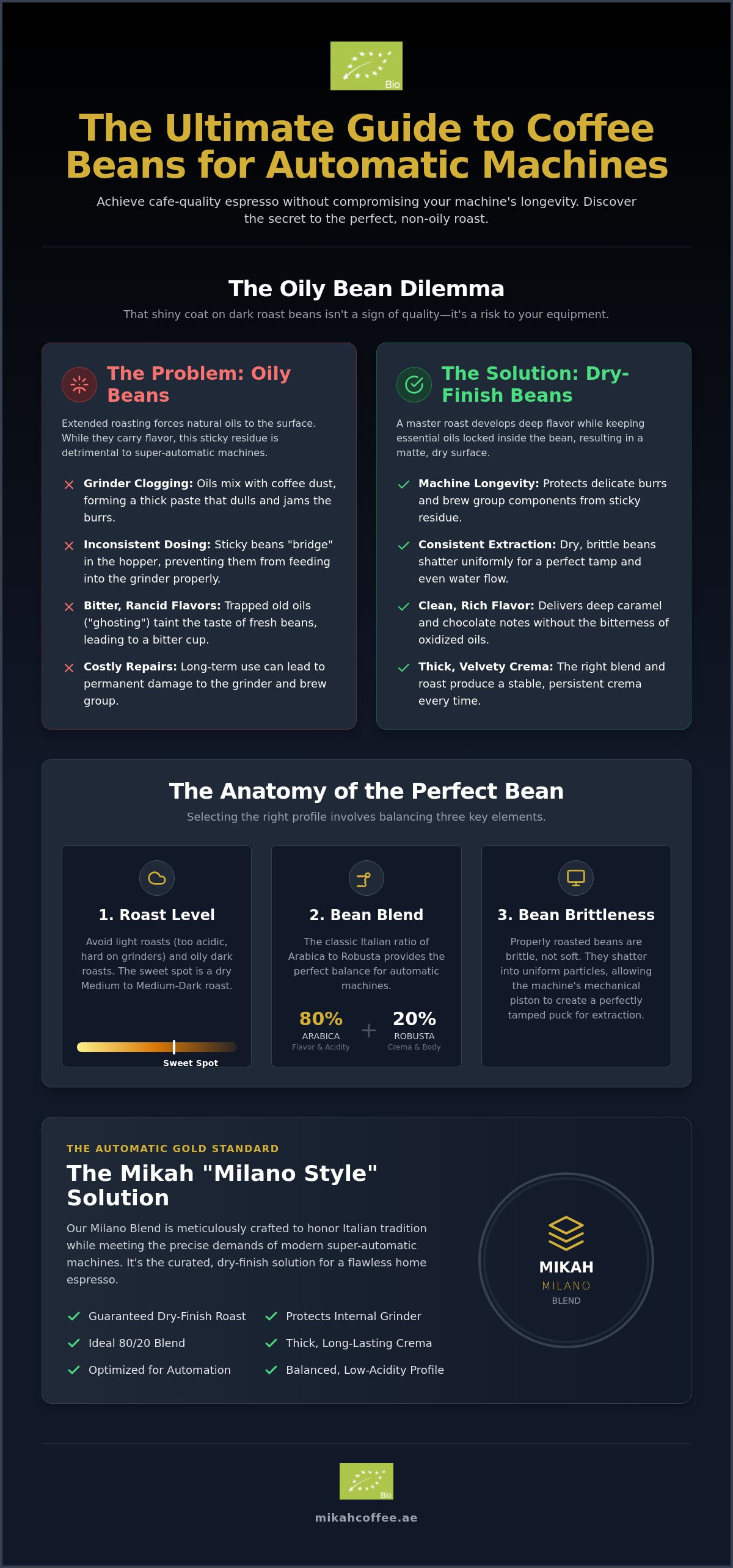
Visual allure often masks technical peril. In the world of specialty coffee, a dark, glistening bean is frequently mistaken for a sign of depth and intensity. However, for those seeking the best coffee beans for automatic espresso machines, that oily surface is a warning sign. These oils are lipids that have escaped the bean's cellular structure, usually due to extended roasting times or prolonged exposure to heat during storage. While they carry flavor, their presence outside the bean is a liability for your equipment.
When these oils come into contact with your machine's ceramic or steel burrs, they create a sticky film. This residue acts as a magnet for fine coffee dust. Over time, this mixture hardens into a stubborn paste that coats the grinding surfaces. Not only does this dull the precision of the burrs, but it also leads to "ghosting." This is when the rancid oils from previous batches taint the flavor of your fresh brew. Authentic Italian espresso relies on clean, sharp extraction, not the lingering bitterness of oxidized lipids.
There is a persistent myth that a dark roast must be oily to be authentic. This is simply untrue. A master roaster can achieve deep, chocolatey caramelization while keeping the essential oils trapped inside the bean. This "dry-roast" profile is the hallmark of a true connoisseur’s selection, offering all the intensity of a dark roast without the mechanical headache.
How Oil Clogs the Dosing System
The danger extends beyond the burrs. In super-automatic systems, beans must travel through a narrow hopper and dosing chute. Oily beans tend to "bridge," a phenomenon where they stick together and refuse to drop into the grinder. This leads to inconsistent dosing and "air shots" where the machine brews with half the required coffee. Even worse, the motor must work harder to push through the sludge, significantly increasing the risk of premature burnout. If you notice your grinder sounding strained or your pucks looking watery, your bean choice is likely the culprit.
Identifying "Dry" Dark Roasts
How do you spot the ideal bean? Look for a matte finish. High-quality coffee beans for automatic espresso machines should look like dark chocolate or mahogany, not polished obsidian. Slow-roasting techniques are essential here; they allow the bean to develop its profile gradually without rupturing the internal cells. Freshness also plays a role. The sweet spot is typically between 2 to 4 weeks after roasting. During this window, the beans have degassed sufficiently but haven't yet begun the structural breakdown that forces oils to the surface. Choosing a meticulously crafted blend ensures your machine remains as pristine as the day you unboxed it.
Selecting the Profile: Roast, Origin, and the Milano Standard
While protecting your hardware is a technical necessity, the ultimate goal remains the sensory experience in your cup. Many generic guides suggest sticking exclusively to medium roasts to avoid mechanical issues, yet this often leaves the connoisseur wanting more depth and character. The true gold standard for those seeking the finest coffee beans for automatic espresso machines is the "Milano Style" roast. This profile achieves a sophisticated balance, offering a deep, chocolatey base without the aggressive acidity often found in lighter specialty roasts. It's about finding a harmonious middle ground where technical compatibility meets the rich, traditional flavors of Northern Italy.
Origin plays a pivotal role in how these machines extract flavor. Brazilian beans are prized for their low acidity and nutty, caramel-like sweetness, providing a sturdy foundation for any sophisticated blend. In contrast, high-altitude Ethiopian beans can sometimes be too dense for the fixed brewing temperature of a super-auto, resulting in a sour extraction if not roasted with precision. Many traditional Italian roasters incorporate premium Indian beans to enhance the body and crema. This curated selection of origins ensures that the short extraction cycle of your machine captures a full spectrum of flavor, moving gracefully from notes of dark cocoa to a toasted almond finish.
The Medium-Dark Sweet Spot
Medium-dark roasts, often referred to as Full City, represent the functional peak for automatic extraction. At this level, the bean's cellular structure is sufficiently broken down to allow for high solubility. This solubility is a critical factor when choosing coffee beans for automatic espresso machines, as it ensures the machine can extract maximum intensity during its brief pre-infusion and brewing phases. You get the "thick" body and characteristic crema you desire without the bitterness or mechanical risks associated with over-roasted, oily beans. It's a precise point where sweetness and strength coexist in perfect proportion.
The Milano Blend Philosophy
The Northern Italian tradition favors a refined, low-acid profile that prioritizes elegance over sharpness. This philosophy is particularly resonant with the UAE palate, where there's a deep appreciation for rich, full-bodied coffee that pairs beautifully with silk-textured milk. It's an invitation to experience a timeless ritual in the comfort of your home. For a deeper look at this heritage and why it remains the benchmark for quality, explore The Milano Blend: Authentic Italian Soul in Every Bean. Selecting this specific roast profile ensures that every morning starts with a cup that is both technically perfect and emotionally evocative.
Maximizing Flavor: Settings, Freshness, and Water Quality
Selecting the finest coffee beans for automatic espresso machines is only the first step in your journey toward the perfect cup. To truly unlock the sensory potential of a premium roast, you must look beyond the hopper and consider the environment in which your coffee is brewed. Precision in your machine’s settings, combined with a respect for the chemistry of water and bean freshness, transforms a standard morning routine into a sophisticated ritual. Even the most exquisite Milano blend requires the right conditions to express its full range of chocolatey and nutty notes.
The Perfect Settings for Super-Autos
Finding the ideal grind size is a matter of timing and patience. While it's tempting to set your grinder to the finest possible setting for maximum strength, this often leads to over-extraction and a bitter, burnt profile. Aim for a grind that results in a steady, honey-like flow, typically achieving a full extraction within 25 to 30 seconds. If your machine allows for temperature adjustment, be cautious with the "High" setting. Excessive heat can scorch delicate Arabica beans, destroying the nuanced floral aromas you’ve paid to enjoy. Additionally, understand the technical difference between a "Double Shot" and a "Long Coffee." A true double shot uses a concentrated dose for intensity, whereas a long coffee simply passes more water through the same grounds, which can lead to a thin, over-extracted flavor.
Water Hardness and Extraction
In the UAE, the mineral composition of your water plays a defining role in the quality of your crema. Water acts as a solvent. If it lacks minerals, such as distilled water, it cannot effectively pull the essential oils from your beans, resulting in a flat and lifeless cup. Conversely, excessively hard water leads to rapid scale buildup and can mask the delicate flavors of your coffee. Utilizing your machine’s dedicated water filter is essential for consistency. These filters are designed to balance mineral content while protecting the internal boiler from the harsh effects of local water supplies. For a deeper understanding of the hardware that facilitates this process, see The Connoisseur’s Guide to Professional Espresso Machines.
Freshness and Degassing
Freshness is a spectrum, not a race. Using beans immediately after they leave the roaster can result in a "fizzy" crema due to excess carbon dioxide. Allow your coffee beans for automatic espresso machines to rest and degas for at least seven to ten days before use. Once the bag is opened, the hopper is not a storage container. Exposure to air and light quickly turns vibrant beans stale. Only fill your hopper with enough beans for a day or two, keeping the remainder in a cool, dark, airtight environment. If your espresso begins to lose its characteristic "snap" or the crema becomes thin and pale, it is a clear sign your beans have passed their peak.
Ready to elevate your home barista experience? Discover our meticulously curated range of premium coffee beans and start brewing with professional precision today.
The Mikah Solution: Why the Milano Blend is the Automatic Gold Standard
Elevating your daily ritual requires more than just high-end hardware; it demands a coffee that respects the engineering of your machine while honoring the soul of Italian tradition. Mikah’s Milano Blend serves as the definitive answer for those seeking the finest coffee beans for automatic espresso machines. It isn't merely a roast; it's a curated experience designed to bridge the gap between technical safety and sensory indulgence. By focusing on a versatile extraction profile, we've ensured that every shot captures the essence of a Milanese boutique, regardless of your machine's specific brand or model.
Central to our philosophy is the "Dry-Finish" guarantee. As we explored in the discussion on grinder longevity, surface oils are the primary cause of mechanical failure in super-autos. Our slow-roasting process ensures that the essential lipids remain trapped within the bean's structure, releasing only at the moment of extraction. This provides you with a rich, full-bodied flavor without the sticky residue that compromises your burrs. Consistency remains our hallmark. Whether it's your first bag or your fiftieth, you can expect the same meticulous quality and ethical sourcing that defines our heritage.
Sensory Profile of the Milano Blend
The Milano Blend offers a complex yet approachable palate. You'll immediately notice deep notes of dark chocolate and toasted bread, followed by a lingering, buttery hazelnut finish. It is a profile specifically engineered to cut through milk, making it the ideal foundation for a velvety cappuccino or a sophisticated latte. Visually, the result is stunning. Each extraction produces a persistent, tiger-striped crema that serves as a testament to the blend's structural integrity and freshness. It is a sensory journey that rewards the discerning palate with every sip.
Convenience Meets Luxury
We believe that luxury should be effortless. With our national delivery service across the UAE, the freshest roasts are delivered from our facility directly to your door. This ensures that you're always within the ideal two-to-four-week freshness window we previously identified as the sweet spot for automatic grinders. You gain the peace of mind that comes with using machine-safe, premium beans, allowing you to focus entirely on the enjoyment of your brew. Experience the difference today and Shop the Milano Blend for your automatic machine to transform your home coffee experience.
Begin Your Journey to Espresso Excellence
The pursuit of cafe-quality results at home is a journey of both technical precision and sensory discovery. You now understand that the longevity of your equipment depends on selecting a dry-roasted, machine-safe profile that avoids the pitfalls of surface oils. By embracing the Milano standard, you ensure your morning cup offers a rich, velvety crema without the risk of costly repairs. Choosing the right coffee beans for automatic espresso machines is the single most important decision you make for your machine's health and your own palate's satisfaction.
Our commitment to this craft is rooted in an authentic Italian heritage that dates back to 1984. Every bag of our Milano Blend is expertly slow-roasted to protect your grinder while delivering a sophisticated profile of chocolate and hazelnut. With premium national delivery across the UAE, the elevation of your daily ritual is only a few clicks away. Elevate your morning ritual with Mikah’s Milano Blend, the perfect bean for your automatic machine.
We invite you to step into a world where quality is never compromised and tradition is honored in every extraction. Your perfect cup is waiting.
Frequently Asked Questions
Can I use "Espresso Roast" beans in my automatic machine if they look shiny?
You should avoid using shiny beans in your super-automatic system because that surface sheen indicates escaped oils that can clog your grinder. While the label "Espresso Roast" sounds ideal, it often refers to an oily, dark profile designed for manual portafilters. For the best results, seek a medium-dark "dry roast" that provides intensity without the sticky residue that threatens your machine's internal burrs.
How often should I clean my grinder if I use darker roasts?
You should perform a basic cleaning of your grinder every two weeks when using darker roasts. Even with high-quality, non-oily beans, fine coffee dust and microscopic lipids accumulate over time. Using specialized cleaning tablets once a month helps strip away this buildup, ensuring your machine's sensors remain accurate and your flavor profile stays untainted by the bitterness of oxidized oils.
Why does my automatic machine espresso taste sour compared to a cafe?
Sourness is typically a sign of under-extraction, often caused by a grind that is too coarse or a brewing temperature that is too low. In a super-automatic machine, the contact time between water and coffee is brief. To fix this, adjust your grinder to a finer setting or increase the beverage temperature in your machine’s settings to ensure a more balanced, sweet extraction.
Are 100% Arabica beans better for automatic machines than blends?
Not necessarily, as blends often outperform 100% Arabica in automatic systems by providing the structural integrity needed for a thick crema. A touch of high-quality Robusta, as found in traditional Italian ratios, offers a more forgiving extraction window. This results in a more consistent, full-bodied cup that maintains its chocolatey character even when the machine's brewing parameters are fixed.
How long can I leave beans in the machine hopper?
You should only leave enough beans in the hopper for one or two days of consumption to maintain peak freshness. Hoppers are rarely airtight and are often exposed to heat from the machine's internal boiler, which accelerates the breakdown of essential lipids. For the best experience with coffee beans for automatic espresso machines, keep the bulk of your supply in a cool, dark, vacuum-sealed container.
What happens if I use flavored coffee beans in an automatic machine?
Using flavored coffee beans is highly discouraged as the syrups and artificial oils used in the flavoring process coat your grinder’s burrs almost instantly. This sticky film is nearly impossible to remove without a professional deep clean and can lead to total motor failure. If you enjoy flavored coffee, it's far safer to add high-quality syrups to the cup after the espresso has been brewed.
Do I need to change my grind settings when I switch bean brands?
Yes, you should expect to fine-tune your settings whenever you switch bean brands or even different batches of the same roast. Every coffee has a unique density and moisture content that reacts differently to the burrs. A small adjustment, usually one or two notches on your grinder dial, is often necessary to maintain that ideal honey-like flow and consistent extraction time.
Why is my crema thin despite using premium coffee beans?
Thin crema is often the result of beans that haven't degassed sufficiently or are past their peak freshness. If your beans are within the ideal two-to-four-week window, the issue may lie in your water's mineral content or a grind that is too coarse. When choosing coffee beans for automatic espresso machines, ensure they are slow-roasted to preserve the internal oils that create a persistent, tiger-striped crema.