


A single gram of coffee can hold over a thousand distinct flavor compounds, yet most are lost to imprecise technique. You've likely felt the frustration of opening a bag of premium, single-origin beans only to produce a cup that's either bitingly bitter or underwhelmingly thin. It's a common hurdle when learning how to use V60 for coffee, especially when the variables of grind size and water temperature feel like a moving target. Wasting exquisite beans through inconsistent brewing is a disappointment no connoisseur should have to face.
We believe that your daily coffee should be an elevated sensory experience, not a gamble. This guide will teach you the professional-grade methods required to master the pour-over, ensuring you extract those elusive floral and fruity notes with every brew. You'll gain absolute confidence in the bloom and pour phases, transforming your morning routine into a sophisticated ritual. We'll explore the specific nuances of the 2026 brewing standards, including how to adapt your technique for the UAE's unique water mineral profiles. Prepare to transform your kitchen into a high-end boutique where every cup is a masterpiece of clarity and craft.
Key Takeaways
- Discover why the V60’s 60-degree conical shape and internal spiral ribs are essential for achieving a deeper, more nuanced extraction.
- Learn the professional secrets of how to use V60 for coffee, from the critical rinsing of filters to mastering the CO2-releasing bloom phase.
- Assemble the ultimate UAE home barista toolkit and understand why temperature stability begins with pre-heating your vessel.
- Troubleshoot your brew by adjusting grind sizes to account for the specific mineral profiles of UAE water, ensuring a perfectly balanced cup every time.
- Transform your daily routine into a luxury experience by pairing precise pouring techniques with the hazelnut and cocoa notes of Mikah Coffee UAE's Milano Blend.
What is a V60 Coffee Dripper? Understanding the Connoisseur’s Choice
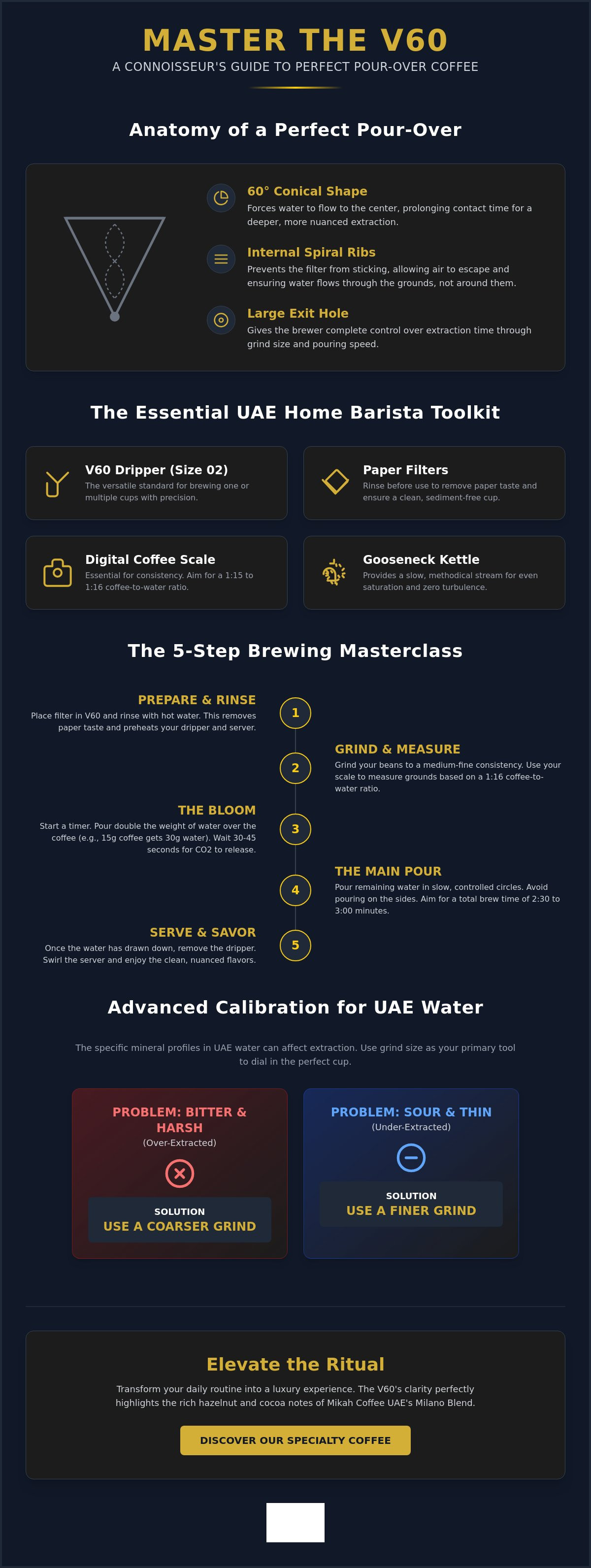
Named for the 60-degree angle of its conical shape, the V60 is more than just a kitchen gadget. It's an invitation to a deeper sensory experience. This specific geometry forces water to travel toward the center of the coffee bed, ensuring a prolonged contact time that results in a more thorough extraction. Unlike flat-bottomed drippers that can lead to uneven saturation, the V60's design rewards the brewer who understands how to use V60 for coffee with unparalleled flavor depth. It's a masterpiece of functional art.
The interior walls are adorned with spiral ribs that serve a vital aerodynamic purpose. They prevent the wet paper filter from clinging to the sides, which allows air to escape and ensures the water flows through the coffee grounds rather than around them. This efficiency is paired with a notably large exit hole at the base. Because the dripper doesn't restrict the flow, you have total control over the extraction time. Your choice of grind size and the speed of your pour become the primary tools for shaping the final profile of your cup.
Choosing your material is an essential part of the ritual. Ceramic drippers offer a sense of weighted luxury and excellent heat retention, provided they are thoroughly pre-heated. In contrast, many professionals in the UAE prefer high-quality plastic models. Plastic acts as an insulator, meaning it doesn't draw heat away from the brewing water as it passes through. This leads to more consistent results during those long, meditative pours, especially when you're aiming for precision in every drop.
V60 vs. Other Brewing Methods
The distinction between the V60 and other tools lies in the science of the pour-over coffee brewing method. While a French Press relies on immersion, where grounds sit in water for several minutes, the V60 uses percolation. This constant stream of fresh water passing through the grounds highlights a "sparkle" and acidity that immersion methods simply can't replicate. If you're curious about how these styles compare in a head-to-head battle, explore our guide on V60 vs French Press: Which Method Wins?
The Anatomy of a Perfect Pour-Over
A clean cup is the hallmark of this method. The dedicated paper filters are designed to trap fine sediments and bitter oils that might otherwise cloud the flavor. This clarity makes the V60 the preferred instrument for evaluating specialty coffee, as it allows the unique terroir of the beans to shine through without interference. Understanding how to use V60 for coffee means appreciating this transparency. The V60 is a precision-engineered tool for high-clarity extraction.
The Essential V60 Toolkit: Gear for the UAE Home Barista
Precision is the language of the connoisseur. While the dripper itself is the centerpiece, mastering how to use V60 for coffee requires a curated ecosystem of tools designed to work in harmony. Without the right gear, even the most expensive beans can yield a cup that feels lackluster. To achieve that crystalline clarity we discussed earlier, your toolkit must prioritize control and consistency above all else.
- The V60 Dripper (Size 02): This is the gold standard for most households. It's versatile enough to brew a single cup for a quiet morning or a larger server for guests.
- High-Quality Paper Filters: These are the gatekeepers of flavor. Rinsing them with hot water before adding your coffee is a non-negotiable step. This process removes any lingering "papery" taste and pre-heats your vessel.
- A Dedicated Coffee Scale: Spoons are for amateurs. To replicate a perfect brew, you must measure your coffee and water in grams. A 1:15 or 1:16 ratio is often the sweet spot for a balanced extraction.
- The Gooseneck Kettle: This is perhaps the most underrated tool. Its narrow, curved spout provides the methodical, thin stream of water required to saturate the coffee bed evenly without causing turbulence.
Investing in quality equipment ensures that every variable is under your command. If you're ready to start your journey, exploring our specialty coffee selections is the perfect first step toward building your professional-grade home setup.
Selecting Your Beans: The Soul of the Cup
The V60 is a magnifying glass for flavor. Because it emphasizes acidity and delicate aromatics, light to medium roasts are typically the preferred choice. These roasts preserve the unique characteristics of the bean's origin. Freshness is equally paramount. Transitioning from pre-ground coffee to whole beans ground just before brewing will unlock a world of complexity you might have previously missed. For those who appreciate a more traditional, sophisticated profile, the Milano blend coffee beans offer an exceptional V60 experience, delivering rich notes of hazelnut and cocoa with a refined, clean finish.
The Importance of the Grinder
Consistency is the secret to a professional brew. Burr grinders are essential because they crush beans into uniform particles, unlike blade grinders that produce a chaotic mix of dust and chunks. For a V60, you should target a "medium-fine" grind, roughly the texture of kosher salt. This specific size directly influences the "draw-down" time. If your grind is too fine, the water will stall, leading to over-extraction and bitterness. If it's too coarse, the water will rush through, leaving you with a sour, weak cup. Learning how to use V60 for coffee is, in many ways, an exercise in mastering this delicate calibration.
How to Brew V60 Coffee: A Step-by-Step Masterclass
Execution is where the science of coffee meets the soul of the barista. Having assembled your toolkit, the focus shifts to the deliberate movements that define the pour-over ritual. Mastering how to use V60 for coffee requires patience and a steady hand, as your goal is to manage the interaction between water and bean with absolute precision. Follow this professional-grade method to ensure a cup that is clean, nuanced, and free of sediment.
- Step 1: Rinsing and Pre-heating. Place your filter in the dripper and saturate it thoroughly with hot water. This removes any lingering cellulose taste and pre-heats your server to prevent a temperature drop. Always discard this rinse water before adding your grounds.
- Step 2: The Bloom. Add your freshly ground coffee and start your timer. Pour roughly double the weight of the coffee in water (about 30-45g) to saturate the grounds. The bloom is a 30-second window where the coffee 'breathes' before extraction, allowing trapped CO2 to escape.
- Step 3: The Main Pours. Begin pouring in slow, concentric circles from the center outward. Maintain a steady flow with your gooseneck kettle, keeping the water level consistent to ensure uniform saturation.
- Step 4: The Draw-Down. As you finish your final pour, observe the water passing through the bed. A successful brew will leave behind a flat, even surface of grounds, indicating that the water traveled through the coffee bed uniformly.
- Step 5: Aeration. Once the dripping stops, remove the V60. Swirl the coffee server vigorously for a few seconds. This introduces oxygen and blends the layers of extraction, opening up the aromatics before you pour into your cup.
The Golden Ratio: 15g to 250ml
Consistency starts with a reliable recipe. For most specialty beans, a ratio of 1:16 or 1:17 is the "sweet spot" that balances body with clarity. Using 15g of coffee to 250ml of water provides a vibrant, clean profile that highlights the bean's origin. If you're brewing for guests, you can easily scale this recipe; however, remember that larger batches may require a slightly coarser grind to maintain the same draw-down time. For a more technical breakdown of these measurements, consult our guide on the V60 brewing ratio.
Mastering the Pour Technique
Your pouring pattern dictates the flavor. Use gentle, concentric circles and avoid pouring directly against the edges of the filter. If water touches the paper directly, it can bypass the coffee grounds entirely, a phenomenon known as "channeling" that results in a weak, watery brew. You might choose pulse pouring, which involves several small pours to increase body and sweetness, or a continuous pour for a lighter, more tea-like clarity. Understanding how to use V60 for coffee is about choosing the technique that best suits your palate.
Advanced Calibration: Troubleshooting and UAE Water Quality
Calibration is the bridge between a good cup and a transcendent one. Even after you've learned the fundamental mechanics of how to use V60 for coffee, the variables of nature and chemistry often require subtle adjustments. A connoisseur doesn't just follow a recipe; they listen to the coffee. If your brew doesn't achieve the crystalline clarity you expect, the solution usually lies in the relationship between your grind size, water temperature, and contact time.
Is your coffee tasting unpleasantly sour or salty? This is a hallmark of under-extraction. To fix this, you should grind your beans finer or increase your water temperature to coax out more sweetness. Conversely, if the cup is bitingly bitter or leaves a dry sensation on your tongue, you've likely over-extracted. In this case, try a coarser grind or a slightly faster pour. Your total brew time serves as your primary diagnostic tool. Aim for a window of 2:30 to 3:30 minutes; anything outside this range suggests your calibration is off.
The "Flat Bed" test is your final visual cue. Once the draw-down is complete, the grounds at the bottom of your V60 should be level and even. If you see deep craters or grounds high up on the filter walls, it's a sign of uneven extraction. This usually happens when the pour is too aggressive or inconsistent. Refining your circular motion ensures that every gram of coffee contributes equally to the final sensory profile.
The UAE Water Factor
In the United Arab Emirates, water quality is the most significant "hidden" variable. Most tap water in the region is produced through desalination, which can leave it stripped of the essential minerals needed to "grab" flavor from the coffee grounds. For a truly professional V60 brew, your water should ideally have a neutral pH of 7.0 and a Total Dissolved Solids (TDS) count between 75 and 250 ppm, as recommended by the Specialty Coffee Association. Using standard tap water often mutes the delicate floral notes of premium beans. Many local enthusiasts prefer bottled brands with balanced mineral profiles, such as those that maintain a TDS near the 150 ppm ideal, to ensure the coffee's origin characteristics aren't lost to chemical imbalance.
Temperature Precision
Heat is the catalyst for flavor, but it must be controlled. We recommend a temperature range of 92°C to 96°C for most V60 applications. Pouring boiling water directly onto your grounds can scorch delicate oils and introduce harsh, ashy notes. Your roast level should dictate where you sit in this range; lighter roasts benefit from the higher end of the spectrum to encourage extraction, while medium-dark roasts perform better with slightly cooler water. Many home baristas utilize the stable hot water dispensers on professional espresso machines to ensure their starting temperature is precise and repeatable. Ready to put these advanced techniques to the test? Explore our range of specialty coffee to find the perfect beans for your next calibration session.
Elevating the Ritual with Mikah Coffee
At Mikah Coffee UAE, we believe that the soul of coffee lies in the intersection of heritage and innovation. While many associate Italian coffee exclusively with the intense pressure of espresso, the manual pour-over offers a different kind of excellence. It's a slow, intentional process that reveals the subtle architecture of the bean. Learning how to use V60 for coffee is a gateway to appreciating the complexities of our slow-roasted selections, bringing a touch of Milanese craft to your home in the Emirates.
To truly master this ritual, the quality of your hardware must match the caliber of your beans. The V60 pour over kit UAE curated by Mikah Coffee UAE provides the precision needed to execute every step we've discussed, from the initial bloom to the final draw-down. For those who enjoy a softer, more textured cup, you can even pair your brew with the Mikah milk frother online to create a sophisticated 'Cafe au Lait' that retains the clarity of a pour-over while adding a luxurious, velvety finish.
The Milano Blend: A V60 Revelation
Our signature Milano blend coffee beans offer a unique experience when prepared with a paper filter. While many specialty beans focus solely on high acidity, this blend provides a sturdy foundation of hazelnut and cocoa, balanced by a refined, clean acidity that only the V60 can highlight. As the cup cools, you'll notice the flavor profile transition from a comforting warmth to subtle citrus notes. Transform your kitchen into a Milanese boutique with every pour.
Your Journey to Mastery
Mastering how to use V60 for coffee is a journey, not a destination. We encourage you to keep a brew journal, noting the grind size, water temperature, and even the specific bottled water you use here in the UAE. Small adjustments lead to significant breakthroughs in flavor. Once you've perfected your pour-over technique, the wider collection at Mikah Coffee UAE awaits your exploration, offering everything from Nespresso compatible capsules to ceremonial grade matcha for your other daily rituals.
Discover the full Mikah Coffee UAE collection and elevate your daily ritual today.
Master the Art of the Pour
The transition from a simple morning caffeine fix to a curated sensory ritual is a hallmark of the modern connoisseur. By now, you've learned that mastering how to use V60 for coffee is an exercise in precision and patience. From the initial bloom that releases trapped gases to the final, steady draw-down, every movement influences the clarity and nuance of your cup. Success lies in the fine details; your water quality and grind consistency are just as vital as the beans themselves. These variables are what transform a standard beverage into a luxury experience.
At Mikah Coffee UAE, we've dedicated ourselves to this level of craftsmanship since 1984. Our authentic Italian heritage ensures that every product we offer meets the highest standards of excellence. Whether you're using our premium Milano Blend, favored by professionals across the UAE, or exploring our expertly curated gear, you're participating in a tradition of quality that spans decades. Don't settle for inconsistency when professional-grade results are within your reach. Elevate your brewing ritual with Mikah Coffee UAE’s curated V60 kits and coffee collections and begin your journey toward the perfect pour today. We're excited to be part of your daily ritual.
Frequently Asked Questions
What is the best grind size for a V60?
Target a medium-fine consistency, roughly resembling the texture of table salt or fine sand. This specific size allows for the optimal 2:30 to 3:30 minute draw-down time we discussed in the masterclass section. If the grind is too coarse, water rushes through without extracting flavor; if it's too fine, it will clog the filter and result in a bitter, over-extracted brew. Precision here is what separates a professional cup from an amateur one.
Why does my V60 take so long to drain?
A slow drain usually points to an abundance of "fines" or a grind that's too fine for your specific beans. These micro-particles settle at the bottom and block the paper's pores, creating a muddy bed that restricts flow. You might also be pouring too aggressively, causing the grounds to compact against the filter. Try using a high-quality burr grinder to ensure a more uniform particle distribution and a cleaner, more predictable flow rate.
Do I really need to rinse the V60 paper filter?
Rinsing is a non-negotiable step to strip away the dry, papery taste often found in cellulose filters. It also serves to pre-heat your ceramic or glass dripper, preventing the brewing water from losing its thermal energy upon contact. This thermal stability is essential for a consistent extraction throughout the entire pour. Always remember to discard the rinse water from your server before you begin the actual brewing process to maintain flavor purity.
Can I use regular supermarket coffee for a V60?
While it's possible to use supermarket coffee, the results often lack the vibrancy and clarity this method is famous for. The V60 acts as a magnifying glass for flavor, and generic pre-ground coffee is often too coarse or stale for such a precision-heavy technique. To truly appreciate the nuances of the pour-over, we suggest using fresh specialty beans that have been roasted within the last four weeks and grinding them just before use.
How much coffee should I use for one cup in a V60?
We recommend using 15 grams of coffee for a standard 250ml cup. This follows the 1:16.6 golden ratio, which provides a sophisticated balance of body and clarity for most light to medium roasts. If you prefer a more intense flavor profile, you might tighten the ratio to 1:15, using about 16.5 grams of coffee. Using a digital scale ensures that these measurements remain precise every time you brew, eliminating the guesswork of spoons.
What temperature should the water be for V60 brewing?
Aim for a precise range between 92°C and 96°C. In the UAE, where many home baristas utilize hot water dispensers from professional espresso machines, it's vital to verify the temperature isn't at a rolling boil. Water that is too hot will scorch the delicate oils and introduce harsh, ashy notes. Conversely, water below 90°C may fail to extract the complex sugars, leaving your cup tasting thin and unpleasantly sour.
What is the 'bloom' in coffee brewing?
The bloom is the rapid release of carbon dioxide that occurs when hot water first saturates the coffee grounds. This 30-to-45-second phase is a critical step in mastering how to use V60 for coffee. By allowing the gas to escape, you ensure that the subsequent pours can penetrate the grounds deeply without being repelled by gas bubbles. This leads to a much more uniform extraction and a cleaner flavor profile in the final cup.
Why does my V60 coffee taste bitter?
Bitterness is almost always a symptom of over-extraction. This occurs when the water has pulled too many compounds from the grounds, often due to a grind that's too fine or water that's too hot. If your total brew time exceeds the 3:30-minute mark, you'll likely encounter these harsh, dry notes. Try coarsening your grind slightly or increasing your pour speed to keep the extraction within the ideal window for a sweeter, more balanced result.