


The most expensive bag of coffee in the boutique is often the wrong one for your kitchen. With 47 percent of coffee drinkers now choosing specialty beans daily, the pressure to select the perfect origin has never been higher. You've likely stood before a wall of minimalist labels, feeling the weight of technical jargon like "anaerobic fermentation" or "washed process," only to head home with a premium bag that tastes nothing like you expected. Understanding how to choose coffee beans for brewing isn't merely about finding the highest quality; it's about finding the specific profile that sings when paired with your unique setup. It's frustrating to invest in a rare Pink Bourbon only for its delicate acidity to be lost in an improper extraction.
We believe that the daily coffee ritual should be a moment of pure, elevated craftsmanship rather than a guessing game. This guide will help you master the art of selecting beans by decoding roast profiles, exploring the influence of terroir, and identifying the perfect synergy between origin and equipment. Whether you're perfecting a vibrant V60 pour-over or seeking a rich, syrupy shot from a professional espresso machine, you'll learn to read every label with the confidence of a seasoned curator. We'll explore how to match flavor notes to your palate so every cup is consistently exceptional.
Key Takeaways
- Shift your perspective from simple caffeine delivery to a curated sensory experience where the quality of the bean matches the precision of your professional equipment.
- Discover how to choose coffee beans for brewing by analyzing the structural differences between varieties and the distinct flavor profiles offered by global single-origin terroirs.
- Select roast profiles with intention, opting for light roasts to preserve delicate origin characteristics or medium roasts for a harmonious balance of sweetness and acidity.
- Optimize your results by matching bean density and body to your specific setup, ensuring clarity in your V60 and rich texture in your espresso shots.
- Build a sophisticated home coffee library that honors the tradition of the craft, allowing you to choose the perfect bean for every mood and occasion.
Beyond the Bag: Why Choosing the Right Coffee Beans is a Foundational Ritual
For the modern connoisseur, the morning cup is an intentional act of curation. It isn't just about the jolt of caffeine; it's about the heritage held within every bean. As global coffee production continues to evolve with more sustainable and precise methods, the gap between commercial bulk beans and specialty selections has widened. Supermarket-grade beans are often roasted for shelf-life rather than flavor. They lack the structural integrity required to perform in a high-end environment. If you've invested in a professional espresso machine, using stale, oily beans is like putting low-grade fuel in a luxury vehicle. The machine can only be as good as the raw material you provide.
In the UAE, the coffee culture has shifted dramatically. It's no longer just about social gathering. It's about the pursuit of excellence. This "Connoisseur Standard" for 2026 demands transparency. We want to know the farm, the altitude, and the exact day the bean left the roaster. Learning how to choose coffee beans for brewing is the first step in honoring that standard. It transforms a simple habit into a meaningful daily ritual that respects both the producer and the palate.
The Sensory Impact of Bean Selection
Quality beans provide clarity. You should be able to taste the jasmine in an Ethiopian Yirgacheffe or the deep, velvety cocoa of a Milano blend. It isn't just about taste, though. Density plays a vital role in how your coffee behaves. High-altitude beans are denser, which means they resist the pressure of brewing differently than softer, low-grown varieties. This resistance leads to a more consistent extraction and a superior mouthfeel. Choosing the right bean is actually the most cost-effective way to upgrade your daily cup. Even the most expensive grinder can't extract nuanced flavor from a bean that has none.
Freshness: The Non-Negotiable First Step
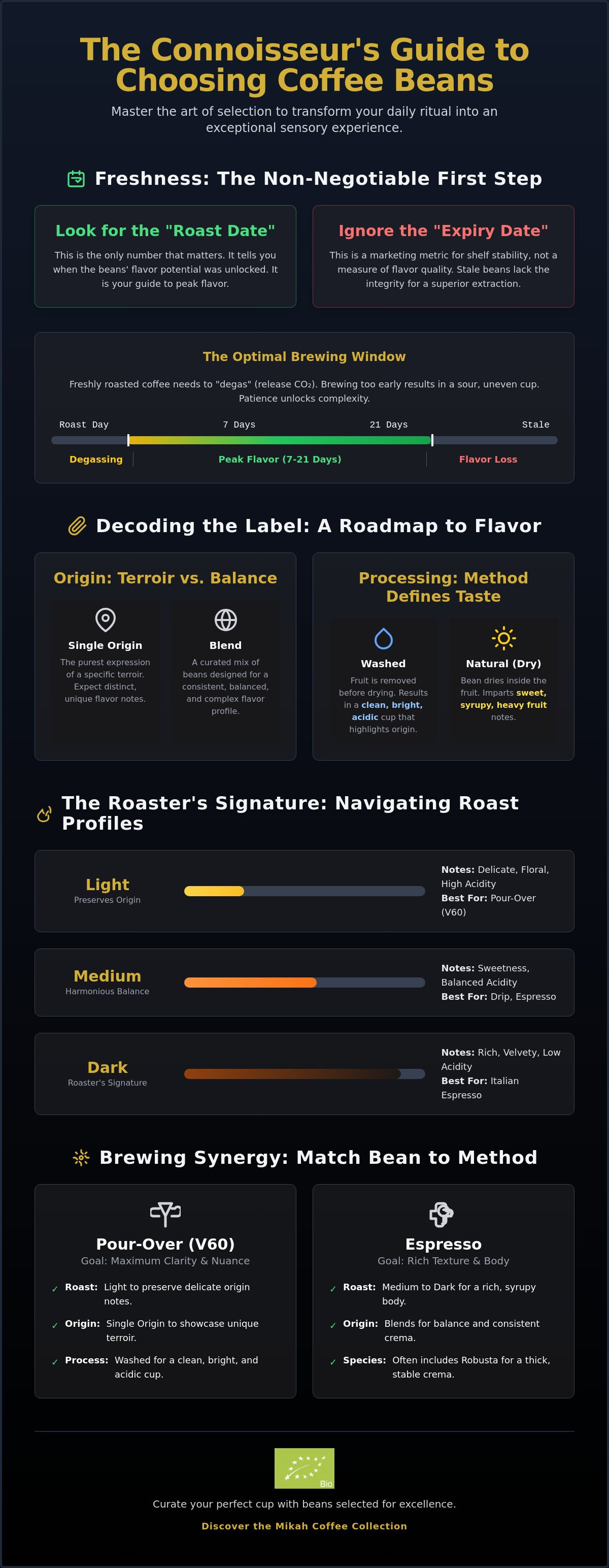
Forget the "Expiry Date." That's a marketing metric for shelf stability, not a guide for flavor. For the true enthusiast, the "Roast Date" is the only number that matters. However, the freshest bean isn't always ready for the cup. Freshly roasted coffee contains carbon dioxide that needs to escape. This is the degassing window. If you brew too early, the escaping gas interferes with the water's ability to saturate the grounds, leading to a sour, uneven cup. For those enjoying traditional Italian roasts, the optimal brewing window is usually 7–21 days post-roast. This allows the oils to stabilize and the flavor profile to reach its peak complexity.
Deciphering the Label: Origins, Varieties, and the Art of the Blend
Reading a coffee label should feel like examining the provenance of a fine vintage. It is a roadmap of flavor, yet many enthusiasts find themselves lost in the technicalities. Mastering how to choose coffee beans for brewing requires looking past the brand name and into the DNA of the bean itself. This begins with understanding the botanical species. While the industry often dismisses Robusta as inferior, a true connoisseur understands its role in providing structural integrity. High-quality Robusta, when curated correctly, provides the thick, elastic crema and the punchy caffeine backbone that defines traditional Italian espresso. Arabica, by contrast, offers the delicate acidity and aromatic complexity that we prize in specialty cups. The magic happens when these species are treated with a deep respect for their inherent characteristics.
Processing methods further refine this profile. A "Washed" coffee has been stripped of its fruit before drying, resulting in a clean, bright cup that highlights the bean's origin. Conversely, "Natural" or "Dry Processed" beans dry inside the cherry. This imparts a wild, syrupy sweetness and heavy fruit notes. Which do you prefer? The answer often dictates your entire brewing strategy.
Single Origin vs. Signature Blends
The choice between a single origin and a blend depends entirely on your desired outcome. Single origin beans are the purest expression of a specific terroir. They are ideal for high-clarity V60 pour over kit UAE sessions, where the goal is to isolate subtle floral or citrus notes. However, single origins can be temperamental. This is where the art of the blend excels. Professional blends, such as the Milano blend coffee beans, are meticulously crafted to ensure a consistent, multi-dimensional experience. By combining beans from various regions, a roaster can balance the bright acidity of one origin with the deep, chocolatey body of another, creating a harmonious profile that remains reliable every morning.
Regional Flavor Maps for the UAE Palate
Geography is destiny in the world of coffee. African beans, particularly from Ethiopia or Kenya, are the darlings of the adventurous brewer. They offer vibrant acidity and tea-like floral notes that flourish in manual brewers. For those seeking a daily comfort profile, Central and South American beans provide the classic chocolate, nut, and caramel notes that ground the palate. This development is driven by volcanic soil and high-altitude farming. At higher elevations, the oxygen is thinner and the temperature is cooler. This forces the coffee cherry to grow more slowly, concentrating the sugars and creating a denser, more flavorful bean.
Understanding the science of coffee roasting and origin selection ensures you aren't just buying coffee; you're investing in a specific sensory result. If you are ready to explore these nuances firsthand, you might find your perfect match among our curated specialty coffee selections, designed for those who value precision in every pour.
The Roaster’s Signature: Navigating Roast Profiles from Light to Italian Dark
Roasting is where science meets alchemy. It is the transformative moment when green, flavorless seeds become the aromatic beans we recognize. Understanding these profiles is essential when learning how to choose coffee beans for brewing, as the roast level dictates which chemical compounds are highlighted and which are subdued. This transformation is driven by the Maillard reaction, a complex chemical process where heat reorganizes sugars and amino acids. This reaction creates the hundreds of flavor compounds that define our sensory experience. For those seeking expert answers on coffee beans, the roast level is often the most significant indicator of how the coffee will eventually taste in the cup.
Light roasts, often labeled as Cinnamon or New England roasts, stop early in the process. They preserve the high acidity and delicate fruitiness of the origin. Medium roasts offer a crowd-pleasing balance. They trade some of that vibrant acidity for the developing sweetness of caramelization. But for many, the journey ends at the dark roast. This is where we find the bold, smoky, and full-bodied characteristics that define the traditional morning ritual.
The Authentic Italian Slow-Roast Standard
There is a common misconception that dark roasts are simply "burnt" coffee. This is a failure of technique, not the roast level itself. An authentic Italian roast is achieved through a meticulous slow-roasting process. This method allows the beans to develop a deep, syrupy body and a low-acid profile without introducing the bitter, ashy notes of over-roasting. This high-body profile is the gold standard for milk-based drinks. It ensures the coffee's character isn't lost when paired with steamed milk. It provides a reliable, comforting foundation that remains the soul of the Milano tradition.
Visual Cues: What the Bean Tells You
A bean's appearance offers immediate insights into its quality and age. Matte surfaces are typical of light and medium roasts. As the roast deepens and the internal structure breaks down, natural oils migrate to the surface. While a light sheen is expected in dark roasts, excessively oily beans can sometimes indicate they are past their peak freshness. Consistency is also key. You should look for a uniform color across the entire bag, which signals precision and control during the roasting process. You can identify a high-quality dark roast by its deep chocolate hue and lack of charred aroma. These visual cues, combined with an understanding of roast levels, empower you to make more informed decisions for your home setup.
Brewing Synergy: Selecting Beans Based on Your Preferred Method
The synergy between your equipment and your chosen bean is the final bridge to a perfect cup. If you've ever wondered why a high-scoring single origin tastes thin in your espresso machine or why a dark roast feels muddy in a pour-over, the answer lies in extraction physics. Mastering how to choose coffee beans for brewing means recognizing that every method has a specific appetite for different bean characteristics. High-pressure environments demand structural integrity. Low-pressure, gravity-fed methods reward clarity and delicate acidity. Without this alignment, even the most expensive equipment fails to deliver its full potential.
The Best Beans for Professional Espresso Machines
Espresso is a rigorous process. It uses nine bars of pressure to force water through a compact puck of coffee in under thirty seconds. To survive this intensity, you need beans with a significant body and a low-acid profile. This is why medium-dark to dark roasts are the preferred choice for professional espresso machines. These roasts provide the soluble compounds necessary for a rich, elastic crema. This golden layer isn't just aesthetic; it's a sign of a well-preserved bean structure. When you're crafting milk-based drinks, this intensity is vital. Pairing a robust espresso with a Mikah milk frother online ensures that the coffee's soul remains present through the sweetness of the gourmet foam.
The Best Beans for Manual Brewing (V60 & Chemex)
Manual brewing is an exercise in patience and transparency. In a V60 or Chemex, water lingers with the grounds for several minutes, allowing for a more complete extraction of subtle aromatics. Light to medium single-origin beans shine here. They offer a tea-like clarity that would be lost in an espresso shot. Look for tasting notes like jasmine, bergamot, or stone fruit on the label. These indicate a bean that rewards precision. To avoid over-extraction, pair these delicate beans with a coarser grind and a steady pour. This balance prevents the bitterness that often masks the bean's natural heritage.
The same principles of synergy apply to the iconic Moka Pot, which sits comfortably between espresso and drip coffee in terms of intensity. For those who prioritize speed without sacrificing this curated profile, Nespresso compatible capsules UAE offer a way to replicate these professional results with a single touch. Ready to find the perfect match for your setup? Browse our collection of specialty coffee and elevate your brewing ritual today.
Curating Your Collection: The Mikah Standard for Premium Home Brewing
Mastery over your morning cup isn't a destination; it's a continuous journey of curation. By now, you understand that how to choose coffee beans for brewing is a balance of science, heritage, and personal preference. To truly elevate your home experience, we suggest moving beyond the single-bag mindset. Instead, consider building a "Coffee Library." This approach allows you to select specific profiles based on the time of day, your mood, or the guest you're hosting. A bold, structured blend might anchor your sunrise ritual, while a vibrant, floral single origin provides the perfect mid-afternoon clarity. This is the essence of the Mikah philosophy—bringing the timeless craftsmanship of Milano into the sophisticated rhythm of the modern UAE home.
Realizing the full potential of premium beans requires an uncompromising commitment to hardware. Even the most exquisite harvest can't express its heritage through subpar equipment. Professional-grade tools act as the voice for the bean's soul, ensuring that every nuance you've learned to identify on the label is actually present in the cup. As you refine your selection process, your equipment should evolve alongside your palate, creating a seamless synergy between the raw material and the final pour.
The Milano Blend: Our Signature Recommendation
If you're beginning your journey into the world of premium Italian coffee, the Milano blend serves as the definitive benchmark. This flagship selection is meticulously crafted to offer a syrupy body with deep notes of toasted cocoa and hazelnut. It represents the "Connoisseur Standard" we've discussed, providing a low-acid, high-intensity profile that remains remarkably forgiving during the brewing process. For the ultimate Italian breakfast ritual, we recommend pairing a short, punchy shot of this blend with a buttery pastry or a selection of fresh dates. It's a versatile starting point that helps you understand how to choose coffee beans for brewing by providing a consistent, high-quality baseline for comparison.
Investing in the Ritual
As you explore more adventurous single origins, a V60 pour over kit becomes an essential companion. The precision of manual brewing allows you to isolate the delicate aromatics of high-altitude beans that might be overwhelmed in an espresso machine. Conversely, for those mornings when only a velvet-textured latte will do, the role of a Mikah milk frother cannot be overstated. It allows you to create cafe-quality microfoam that complements rather than masks the character of your chosen roast. We encourage you to experiment. Trust your developing palate. The "perfect" cup is the one that brings you a moment of stillness and genuine pleasure in your daily ritual.
Elevating Every Pour: Your Journey Toward Coffee Mastery
The transition from a casual drinker to a true connoisseur is defined by an appreciation for the finer details. You now possess the framework to align terroir and roast profile with your specific brewing equipment, ensuring every extraction is a masterpiece of clarity and body. Mastering how to choose coffee beans for brewing is about more than just flavor; it's about honoring the journey from the farm to your cup. By focusing on the synergy between the bean's density and your chosen method, you ensure that your daily ritual remains a source of genuine inspiration.
We invite you to bring the excellence of the Milano tradition into your home. Since 1984, we've maintained an authentic Italian heritage through an expert-curated selection of specialty coffee and professional machines. With nationwide UAE delivery, premium quality is always within reach. Trust your evolving palate and embrace the process of discovery. Your perfect cup is waiting to be brewed.
Explore the Mikah Milano Blend and start your brewing journey today.
Frequently Asked Questions
Is Arabica always better than Robusta for home brewing?
High-quality Arabica is prized for its aromatic complexity, but specialty Robusta is essential for achieving the thick crema and structural body found in traditional Italian espresso. While commercial Robusta can be bitter, premium varieties offer a punchy, low-acid backbone that balances beautifully with milk. It isn't about one being "better," but rather which species serves your specific brewing goal. A masterfully crafted blend often uses both to create a multi-dimensional experience.
How can I tell if coffee beans are fresh just by looking at them?
You can identify freshness by looking for a vibrant, healthy sheen on dark roasts or a clean, matte surface on lighter ones. However, the most reliable visual cue occurs during the "bloom" phase of brewing. If the grounds swell and release bubbles when they first touch water, the beans are still degassing and full of flavor. Dully colored, ashy-looking beans often indicate oxidation and a loss of volatile oils.
What is the best roast level for a beginner coffee drinker?
A medium roast is the most accessible entry point for those learning how to choose coffee beans for brewing because it balances natural acidity with developing sweetness. These beans have spent enough time in the roaster to develop chocolate and caramel notes without losing the unique fruitiness of their origin. It provides a balanced profile that works well across most home brewing equipment, from drip machines to French presses.
Can I use espresso beans in a V60 pour-over kit?
You can certainly use espresso-profile beans in a V60, though the resulting cup will be significantly bolder and less nuanced than a dedicated light roast. Since espresso roasts are designed for high-pressure extraction, they may taste smoky or overly intense when brewed with a gravity-fed method. If you enjoy a heavy-bodied cup, this pairing works well, but it won't highlight the delicate floral notes characteristic of pour-over brewing.
How much coffee should I buy at once to ensure it stays fresh?
Buy only enough coffee to last you for fourteen to twenty-one days to ensure you are always brewing at the peak of flavor. Coffee is a perishable agricultural product that begins to oxidize the moment it leaves the roaster. For most home enthusiasts, a 250g bag is the perfect size for a week or two of daily rituals. This frequency allows you to rotate through different origins while maintaining a high standard of freshness.
Why does my coffee taste bitter even with expensive beans?
Bitterness often stems from over-extraction rather than the bean quality itself. If your water temperature is too high or your grind size is too fine, the water pulls out harsh, astringent compounds that mask the bean's natural sweetness. Try coarsening your grind or lowering your water temperature to approximately 92 degrees Celsius. Even the most prestigious single origin will taste unpleasant if the brewing physics aren't respected during the process.
What are the best coffee beans for making a latte at home?
The best beans for a latte are those with enough structural body to cut through the sweetness of steamed milk. A medium-dark or dark blend, such as a traditional Milano selection, is ideal here. It provides the deep cocoa and toasted nut notes that anchor the drink. When you use a professional milk frother, these roasts create a harmonious balance, ensuring the coffee's character remains the star of the beverage.
How do I read the "tasting notes" on a coffee bag?
Tasting notes are sensory descriptors intended to guide your expectations rather than a list of added flavorings. When a label mentions "stone fruit" or "jasmine," it refers to the natural chemical compounds present in the bean due to its soil and processing. Learning how to choose coffee beans for brewing involves matching these notes to your preferences. If you enjoy brightness, look for citrus notes; if you prefer comfort, seek out caramel or nutty descriptors.