


In less than a decade, honey processed coffee has surged from a niche experiment to a specialty powerhouse, now accounting for 34% of global specialty coffee purchases. Having honey processed coffee explained reveals why connoisseurs are willing to pay a premium for this artisan hybrid that originated in the high-altitude mills of Costa Rica. Despite the evocative name, no actual honey touches the beans; the term refers to the sticky, viscous mucilage left on the seed during drying. This precise management of fruit sugars results in a cup with up to 60% more reducing sugars than traditional washed methods, offering a sensory experience that's both indulgent and refined.
You've likely stood before a shelf of specialty beans, curious about the vibrant labels but hesitant to commit without knowing if the profile suits your palate. It's a common challenge to distinguish between technical processing terms when you simply want a cup that resonates. We understand that the art of the craft should be accessible, not exclusionary. You deserve to feel confident in every selection you make for your daily ritual.
This guide will demystify the intricate world of honey processing, a method that bridges the gap between the heavy sweetness of naturals and the crystalline clarity of washed coffees. We'll explore the spectrum of White, Red, and Black honey variations, the sustainable science behind their 95% water savings, and how to brew these beans to highlight their unique, amino-acid-rich complexity.
Key Takeaways
- Understand the sustainable Costa Rican origins of this hybrid method and why "honey" refers to the cherry's sticky mucilage rather than an added sweetener.
- Learn how precise sugar levels and mucilage management during drying create the distinct spectrum of White, Yellow, Red, and Black honey beans.
- Gain a clear perspective with honey processed coffee explained through its unique flavor profile, which masterfully balances the clarity of washed beans with the syrupy sweetness of naturals.
- Identify your ideal cup by mapping acidity, body, and sweetness across the honey spectrum to find the perfect match for your personal palate.
- Master the connoisseur’s ritual by learning which brewing techniques, such as the V60, best highlight the density and complexity of these artisan beans.
The Essence of Honey Processed Coffee: Beyond the Name
The name "honey" often leads to a delightful misconception. Many enthusiasts expect a cup infused with bee-produced nectar; however, having honey processed coffee explained reveals a far more technical, artisan reality. The term describes the sticky, viscous texture of the coffee cherry's inner fruit layer, which feels remarkably like honey during the drying stage. This method isn't about additives. It's about the sophisticated management of the coffee cherry's anatomy to coax out a sweetness that feels almost structural.
To appreciate this craft, one must understand the cherry itself. Beneath the outer skin (exocarp) lies the pulp (mesocarp), a layer of succulent fruit flesh. While traditional coffee processing methods often involve scrubbing this layer away entirely, the honey process retains a calculated portion of it. This technique was pioneered by visionary farmers in Costa Rica who sought to elevate quality while navigating environmental challenges. By leaving varying amounts of this fruit flesh on the seed, they discovered they could manipulate the final flavor profile with surgical precision.
In the UAE's thriving speciality scene, honey processed beans have become a hallmark of sophisticated taste. Discerning palates in Dubai and Abu Dhabi often gravitate toward these coffees for their balanced, syrupy mouthfeel and complex sugar browning notes. It's a profile that mirrors the region's appreciation for luxury and meticulous preparation, offering a cup that feels curated rather than merely produced.
What is Mucilage? The 'Honey' in the Machine
At the heart of this method is the mucilage. This is the inner mesocarp, the sticky substance that clings to the parchment of the coffee bean after the outer skin is removed. Mucilage is the viscous, sugar-rich layer that acts as the primary flavor catalyst in honey processing. During the drying phase, the sugars and acids within this layer undergo a slow, controlled fermentation. This chemical interaction infuses the bean with 40-60% more reducing sugars than a standard washed coffee, creating that signature honey-like sweetness that defines the artisan cup.
The Hybrid Philosophy: Bridging Washed and Natural
The honey process is frequently described as the "Goldilocks" of coffee production. It successfully bridges the gap between the heavy, wine-like body of a natural process and the crystalline acidity of a washed coffee. By retaining some fruit but removing the skin, producers achieve a clarity of origin that isn't muddied by over-fermentation, yet they retain a plush sweetness that washed coffees sometimes lack.
Beyond the sensory benefits, this method is a triumph of sustainability. The honey process reduces water consumption by 90-95% compared to the traditional washed process, as it eliminates the need for the intensive washing cycles used to strip mucilage. It's the artisan's choice for a future where environmental respect and sensory excellence are inextricably linked. This balance of ethics and elegance makes it a true connoisseur's staple.
The Craftsmanship: A Step-by-Step Breakdown of the Honey Method
Precision is the hallmark of the artisan. While we have already seen honey processed coffee explained as a hybrid of two worlds, the actual execution of this method requires a level of vigilance that borders on the obsessive. It isn't enough to simply leave the fruit on the seed. Every stage, from the initial harvest to the final resting period, must be managed with surgical accuracy to ensure the sugars develop into a complex profile rather than a fermented defect.
The journey begins at the Brix meter. Producers don't just pick cherries that look ripe; they measure the actual sugar content. For a successful honey process, a high Brix level is non-negotiable. Once harvested, the cherries undergo precision pulping. The skin is removed, but the machinery is calibrated to leave a specific, calculated amount of the viscous fruit flesh. This is where the producer decides the fate of the bean, setting the stage for The Spectrum of Color that defines the final product.
Drying is the most precarious ritual. Unlike washed coffees that dry quickly, or naturals that dry in the skin, honey beans are exposed and sticky. They're spread onto raised beds where constant agitation is mandatory. Workers must turn the beans every 30 to 60 minutes during the first few days. This prevents the beans from clumping together or developing mold. The goal is a delicate balance, reaching a precise 10-12% moisture content over a period of two to three weeks.
The Role of Fermentation in Honey Processing
Fermentation in this method is primarily aerobic, occurring in the open air as the mucilage breaks down. This stage is highly sensitive to environmental shifts. In the intense heat of the UAE, the storage of green honey-processed beans requires climate-controlled environments to prevent the sugars from continuing to degrade after export. Even a slight spike in temperature can turn a bright, honey-toned cup into something unpleasantly medicinal. It's a high-stakes game where the risk of "defect" flavors is ever-present, demanding more labor and attention than almost any other processing style.
From Parchment to Export: The Final Milling
Once the beans reach their target moisture, they enter a mandatory resting period. They stay inside their parchment layer for weeks to stabilize the internal chemistry. This patience is rewarded with a more consistent flavor profile. However, the final milling presents a mechanical challenge; that "honey" layer becomes like concrete when dry. Specialized hulling equipment is required to clean the seeds without damaging them. Only the most consistent beans, graded for density and size, are selected for a premium coffee beans UAE collection. If you're ready to experience this level of dedication in your own cup, you can explore our curated specialty selections to find your perfect match.
The Spectrum of Color: Understanding White, Yellow, Red, and Black Honey
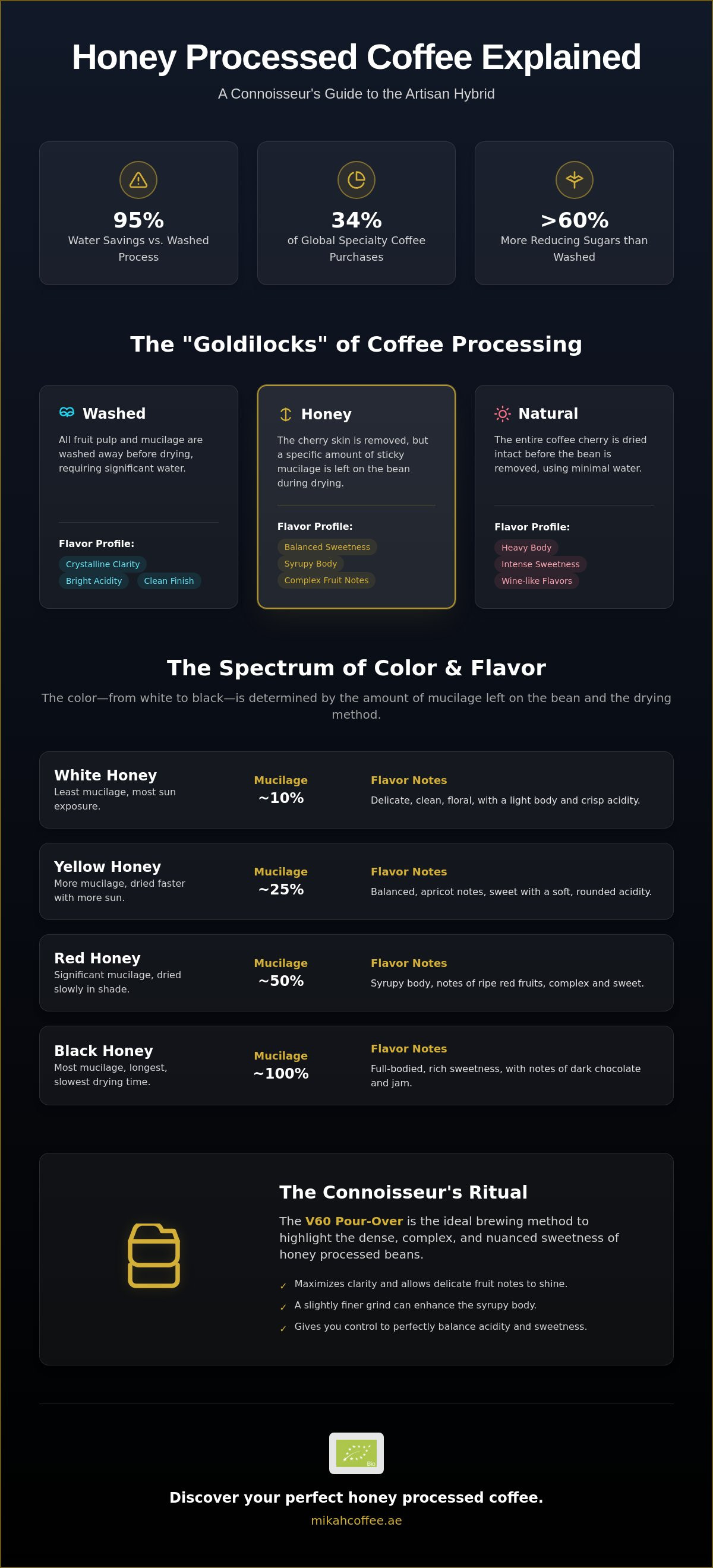
The color of a honey-processed bean is its visual signature. It tells a story of mucilage, light, and time. Having honey processed coffee explained through this color spectrum allows you to predict the sensory experience before the water even touches the grounds. These classifications aren't arbitrary; they indicate the precise percentage of fruit flesh left on the seed and the specific drying conditions the producer chose to employ.
Producers manipulate two main variables to achieve these shades: the amount of mucilage and the speed of drying. When beans are dried quickly in direct sunlight, they remain lighter. When they're dried slowly under shade, the sugars oxidize and darken, much like a sliced apple turns brown when left on a counter. This artisan management of oxidation is what separates a standard harvest from a world-class specialty lot.
White vs. Yellow: Clarity and Crispness
White Honey is the most transparent of the hybrid family. Producers leave a minimal 10-15% of the mucilage on the bean and dry it in full sun. This results in a profile that closely mimics a washed coffee, offering high acidity and a tea-like body, but with a subtle, honeyed finish that lingers on the palate. It's a refined choice for those who appreciate the "clean" side of the coffee spectrum.
Yellow Honey retains a more substantial 25-50% of the fruit flesh. It's also dried in direct light, which develops creamy mouthfeels and distinct stone fruit notes like apricot or plum. These lighter honeys are perfect for those who value precision. They excel in a V60 pour over kit UAE preparation, where the filter's clarity highlights the bean's delicate, floral sweetness without the weight of heavy fermentation.
Red vs. Black: The Depth of Fermentation
Red Honey pushes the boundaries of intensity. With 50-75% of the mucilage remaining, these beans are typically dried under shade or during overcast conditions. This slows the drying time, allowing the bean to absorb deep berry sweetness and a syrupy, coating body. It's a luscious middle ground for the adventurous drinker.
Black Honey is the ultimate expression of this craft. By leaving nearly 100% of the mucilage intact and drying the beans under heavy shade or plastic covers, producers create a slow-motion fermentation. This is truly The Essence of Honey Processed Coffee; a method that yields boozy, jammy complexity and a thick, velvety texture. It's often the most prized and expensive variety in the specialty market. Why? It's a matter of risk. Black Honey can take twice as long to dry as White Honey, requiring constant agitation to avoid spoilage. For the connoisseur, the result is a cup of unparalleled richness that justifies its premium status.
Sensory Architecture: Comparing Honey, Washed, and Natural Profiles
Every cup of specialty coffee is a dialogue between the bean's genetics and the hands that processed it. To navigate this dialogue, we use the flavor triangle; a sensory map that balances acidity, body, and sweetness. Having honey processed coffee explained through this architectural lens reveals a profile that is neither too sharp nor too heavy. It occupies a sophisticated middle ground that neither the washed nor the natural process can fully replicate.
Washed coffees act as a high-definition lens for the bean's origin. By removing all fruit flesh before drying, this method emphasizes high acidity and a tea-like body. It's crystalline and clean. On the opposite end, natural coffees are the eccentric cousins of the coffee world. Dried with the full cherry intact, they boast a heavy, winey body and intense, sometimes wild, fruit notes. While naturals are bold, they can sometimes lack the precision that a connoisseur seeks in a morning ritual.
Honey processing provides the bridge. It captures the plush, syrupy sweetness of a natural while retaining the elegant clarity and moderate acidity of a washed coffee. The result is a cup that feels intentional and balanced, offering a sensory experience that's both indulgent and refined.
Why Honey Processed Coffee Tastes Sweeter
A common theory suggests that the bean "soaks up" sugar from the mucilage during the drying phase. While the science is more complex than simple absorption, the presence of organic acids and the slow breakdown of fruit sugars during fermentation significantly transform the perceived sweetness. This isn't a superficial sugary note. Instead, it's a deep, integrated sweetness that affects the very structure of the brew. The sweetness of a honey-processed coffee is not a sugary additive, but a structural enhancement of the bean's natural caramelization potential. This creates a profile rich in notes of butterscotch, toasted nuts, and cooked stone fruits.
Mouthfeel and Texture: The Syrupy Advantage
The defining characteristic of a honey-processed cup is its viscosity. There's a coating, velvety quality to the liquid that sets it apart from the thinner texture of a washed coffee. This syrupy advantage makes these beans exceptionally versatile. When used in milk-based drinks like lattes or cappuccinos, the inherent sweetness and heavy mouthfeel cut through the dairy beautifully, creating a harmonious, dessert-like finish. If you're looking to experience this syrupy complexity in your own home, you can browse our collection of specialty coffee to find your next favorite origin. The lingering finish of a honey-processed bean ensures that the experience stays with you long after the final sip, making it a true staple for the dedicated enthusiast.
The Connoisseur’s Ritual: Brewing and Enjoying Honey Processed Speciality Beans
The journey from high-altitude mills to your morning cup is one of meticulous care. Having honey processed coffee explained reveals that these beans are fragile treasures of sugar and acid. To unlock their full potential, your brewing ritual must match the producer's dedication. Precision isn't just a preference; it's a requirement for complex hybrids. Because these beans contain higher concentrations of amino acids, they're often more soluble. This means they give up their flavors more readily than washed counterparts. It requires a steady hand and a deep understanding of extraction variables.
At Mikah Coffee UAE, we believe that elevating your daily ritual starts with artisan-grade equipment that respects the bean's journey. Selecting the right gear allows you to manipulate water temperature and agitation with the same precision the producer used during the drying phase. Whether you prefer the clarity of a filter or the intensity of an espresso, the goal is to highlight the syrupy sweetness without overshadowing the bean's inherent origin notes.
The Perfect Pour-Over with Honey Processed Beans
For many, the V60 is the ultimate tool for exploring the nuances of White and Yellow honeys. However, the high sugar content of these beans can lead to a slower drawdown, as the dissolved solids create a more viscous flow. To manage this, we recommend using a slightly coarser grind than you'd use for a standard washed coffee. This ensures the water moves through the bed at a consistent pace, preventing over-extraction and bitterness.
Temperature is equally critical. While lighter honeys thrive at standard temperatures, Red and Black honeys find their sweet spot between 92-94°C. This slightly lower range prevents the delicate fruit sugars from scorching, preserving the jammy complexity. For those seeking the ultimate brewing experience, investing in a V60 pour over kit UAE provides the control necessary to master these variables.
Honey Processed Espresso: A Syrupy Revelation
When used in professional espresso machines, honey-processed beans are a revelation. They create an exceptional crema, thick and persistent, thanks to the remaining mucilage. The resulting shot is intensely sweet with a heavy, coating mouthfeel that lingers. Dialing in requires patience; you want to balance that intense sweetness with enough acidity to keep the shot vibrant. This process also gives birth to the Honey Latte. Because the bean provides such a structural, caramel-like sweetness, the need for added syrups is virtually eliminated. It's the final, polished expression of an artisan process that values quality above all else.
Refining Your Speciality Coffee Ritual
Mastering the nuances of the honey process transforms a simple morning beverage into a curated sensory experience. You now understand that this artisan hybrid isn't about flavoring; it's about the masterful management of fruit mucilage to achieve a syrupy sweetness and crystalline clarity. Whether you gravitate toward the crispness of a White Honey or the jammy depth of a Black Honey, you possess the knowledge to brew with confidence. Having honey processed coffee explained through the lens of craftsmanship ensures that every selection you make is intentional and rewarding.
Since 1984, our authentic Italian heritage has driven us to bring only the finest selections to the discerning palates of the UAE. We invite you to continue your journey with a curated selection of premium speciality beans and the precision tools necessary to honor their complexity. With UAE-wide delivery, your next exceptional cup is never far away. It's time to elevate your daily ritual into something truly meaningful.
Explore Mikah Coffee UAE Specialty Selections and Professional Brewing Gear
Frequently Asked Questions
Does honey processed coffee contain actual honey?
No, honey processed coffee contains no actual honey or bee-produced sweeteners. The name is purely descriptive of the sticky, viscous texture of the mucilage that clings to the bean during the drying stage. This artisan method relies entirely on the natural sugars found within the coffee cherry to create a profile that is inherently sweet and syrupy without any external additives.
Is honey processed coffee sweeter than natural processed coffee?
Honey processed beans aren't always sweeter than natural processed beans, but they offer a more refined, structured sweetness. While natural coffees provide a wild, boozy, and berry-like profile, honey processing yields a cleaner, syrupy sweetness. It masterfully balances the deep sugar-browning notes of a natural with the elegant clarity of a washed cup, providing a balanced sensory experience for the connoisseur.
What is the difference between Red Honey and Black Honey coffee?
The primary difference lies in the amount of mucilage retained and the speed of the drying process. Red Honey typically retains 50-75% of the fruit flesh and dries under moderate shade. Black Honey leaves nearly 100% of the mucilage intact and dries very slowly under heavy shade, resulting in a deeper, more jammy complexity and a significantly more labor-intensive production cycle.
Is honey processed coffee low acid?
Honey processed coffee is generally perceived as having moderate, balanced acidity rather than being strictly low acid. It's less biting than a traditional washed coffee because the remaining fruit sugars buffer the sharpness on the palate. It's an ideal choice for those who find washed coffees too bright but still want more clarity and definition than a natural process provides.
Which brewing method is best for honey processed beans?
The V60 is often considered the best brewing method for highlighting the delicate floral notes and clarity of lighter honey beans. For Red or Black honeys, professional espresso machines excel at intensifying the syrupy mouthfeel and rich crema. Both methods allow you to appreciate the intricate extractions that having honey processed coffee explained through its color spectrum reveals.
Why is honey processed coffee usually more expensive?
This method is more expensive because it's incredibly labor-intensive and carries a higher risk of crop loss. Workers must manually turn the sticky beans as often as every 30 to 60 minutes during the initial drying stages to prevent fermentation defects. The extended drying time required for darker honeys also limits the total volume a farm can produce each season.
Does honey processed coffee have more caffeine?
No, the processing method doesn't increase the caffeine content of the bean. Caffeine is a stable compound that remains largely unaffected by whether the fruit flesh is removed or left on during the drying phase. The perceived strength of the cup usually comes from the bean's density and the specific roast profile rather than the honey process itself.
How should I store honey processed coffee beans to maintain freshness?
You should store these beans in an airtight container in a cool, dark place to preserve their volatile aromatic compounds. This is especially important for maintaining the integrity of honey processed coffee explained in terms of its unique sugar structure, as these beans are more sensitive to humidity. Avoid the refrigerator, as moisture can quickly degrade the delicate sugars and ruin the syrupy mouthfeel.