


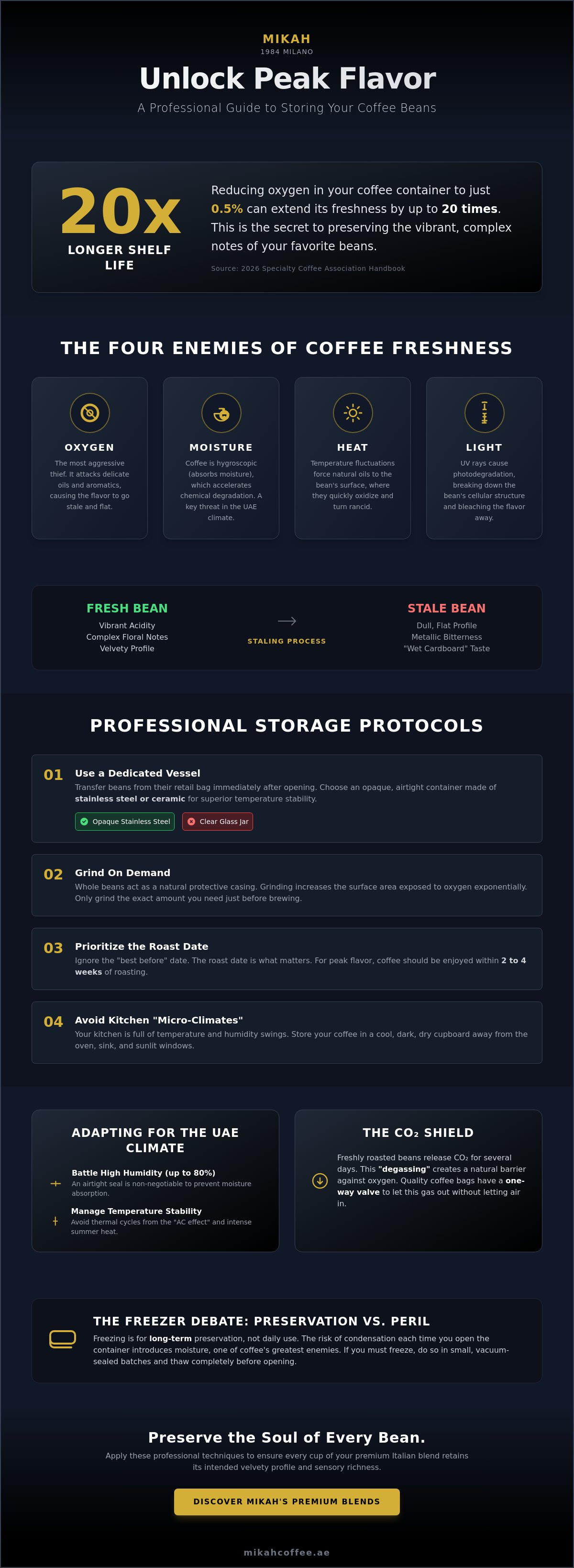
Did you know that reducing the oxygen in your coffee container to just 0.5% can extend its shelf life by up to 20 times? This striking insight from the 2026 Specialty Coffee Association Handbook highlights why so many enthusiasts struggle with fading flavors despite their best efforts. You've likely spent your hard-earned Dirhams on a premium Milano Blend or a delicate specialty roast, only to find those vibrant, floral notes replaced by a flat, metallic bitterness after just a few days. It's a common frustration, especially when conflicting advice about fridges and freezers makes the simple act of preservation feel like a complex chemistry experiment.
Understanding how to store coffee beans is less about hiding them away and more about managing the biological life of the bean itself. In the UAE, where coastal humidity can reach a staggering 80%, protecting your investment requires a more intentional approach. We'll show you how to master the art of professional storage to keep your coffee tasting just-roasted for weeks. You'll learn which vacuum-sealed equipment actually works and how to establish a repeatable ritual that preserves the soul of every bean you brew.
Key Takeaways
- Identify the four environmental enemies that compromise your beans' aromatic integrity and learn why moisture is particularly treacherous for specialty roasts.
- Master the professional ritual of how to store coffee beans by selecting the ideal vessel and avoiding common kitchen "micro-climates" that accelerate staling.
- Resolve the freezer debate by understanding the science behind long-term preservation versus the risks of daily condensation.
- Navigate the unique challenges of the UAE climate, from the drying "AC effect" to maintaining temperature stability during the intense summer months.
- Learn to read the visual cues of premium Italian blends, such as our Milano selection, to ensure every cup retains its intended velvety profile.
The Four Enemies of Coffee Freshness
To truly appreciate a premium Milano Blend, you must understand that coffee is a living, breathing product. From the moment the roasting process concludes, a countdown begins. Preserving that peak sensory experience requires a defensive strategy against four primary environmental adversaries. If you are learning how to store coffee beans properly, you are essentially fighting a battle against oxidation, moisture, heat, and light. Each of these elements works to strip the bean of its character, turning a curated ritual into a mundane chore.
- Oxidation: Oxygen is the most aggressive thief. It attacks the delicate oils and volatile aromatics that give coffee its soul. Once these compounds interact with air, they begin to dissipate, leaving behind a hollow version of the original bean.
- Moisture: Coffee is hygroscopic. It acts like a sponge, absorbing water vapor from the surrounding environment. In the UAE, where humidity is a constant factor, this is a significant threat. High humidity doesn't just dampen the bean; it accelerates chemical degradation.
- Heat: Temperature fluctuations are disastrous for stability. Heat causes the natural oils within the bean to migrate to the surface. Once there, they oxidize at an accelerated rate. In a household where air conditioning levels might shift, these thermal cycles can ruin a batch in days.
- Light: UV rays are equally damaging. Light energy breaks down the cellular structure of the roasted bean, causing a process of photodegradation that bleaches the flavor right out of the coffee.
Understanding Degassing and the CO2 Shield
Freshly roasted beans aren't ready for a vacuum seal the second they leave the roaster. They need to breathe. For several days after roasting, beans release significant amounts of carbon dioxide. This gas actually acts as a temporary natural shield, pushing oxygen away from the bean's surface. Modern packaging utilizes a one-way valve to let this gas escape without allowing outside air to enter. You should never store beans in a completely airtight container without a valve immediately after roasting; the built-up pressure can compromise the seal and trap gases that lead to "off" flavors in your cup.
The Science of Staling: What Happens to the Flavor Profile?
When the four enemies win, the result is staling. You'll notice the vibrant acidity and complex floral notes of your specialty coffee begin to fade into a dull, flat profile. This often tastes reminiscent of wet cardboard. This decline happens as the lipids, or natural oils, turn rancid through exposure to the elements. Staling is a chemical loss of volatile organic compounds. By mastering the fundamentals of Coffee bean storage, you can halt this decline and ensure your daily ritual remains an elevated, sensory experience.
Professional Protocols for Daily Coffee Storage
Elevating your morning coffee from a simple habit to a sophisticated ritual requires more than just high-quality beans; it demands a disciplined approach to preservation. Learning how to store coffee beans correctly is the essential bridge between a mediocre cup and a sensory masterpiece. To maintain the integrity of your beans, follow these professional protocols for your daily routine.
- Transfer immediately: Retail bags are designed for transport. Once opened, they rarely provide a sufficient seal. Transfer your beans to a dedicated vessel to stop the clock on flavor loss.
- Avoid micro-climates: Your kitchen is full of temperature swings. Keep your beans away from the heat of the oven, the moisture of the sink, and the UV rays from sunlit windows.
- Grind on demand: Whole beans act as their own protective casing. Only grind the exact amount you need for your immediate brewing session to prevent rapid oxidation.
- Prioritize the roast date: Ignore the "best before" date, which can be over a year away. Focus on the roast date; for the best experience, beans should be enjoyed within two to four weeks of being roasted.
- Eliminate headspace: Every cubic centimeter of air left in your jar is actively aging your coffee. Reducing the volume of air inside the container is a critical step in professional preservation.
Choosing the Right Storage Vessel
The material of your container matters. While glass is popular for its aesthetic, it offers poor protection against light and thermal shifts. Stainless steel and ceramic are the preferred choices for connoisseurs because they provide superior temperature stability. When selecting a mechanism, vacuum-sealed canisters that actively pump out air are excellent. However, air-displacement containers, which use a plunger to physically push air out, are often even more effective at minimizing headspace. If you have recently invested in a premium Mikah Milano Blend, don't let its complex profile perish in a decorative clear jar; choose a vessel that prioritizes science over style.
The 'Cool, Dark Place' Redefined
The National Coffee Association suggests that temperature stability is the most important factor in a storage location. A deep pantry shelf is far superior to a countertop. You should also avoid the "spice cabinet trap." Coffee is highly porous and will readily absorb the pungent aromatics of nearby cumin or cardamom. In the UAE, the constant cycling of air conditioning can create subtle moisture shifts. A stable, dark cupboard remains the most reliable sanctuary for your whole beans, protecting them from the humidity that can ruin ground coffee in minutes.
The Freezer Debate: Preservation vs. Peril
The question of whether to use the freezer is one of the most polarizing topics in the specialty coffee world. While some enthusiasts view it as a sanctuary for flavor, others see it as a graveyard for aromatic oils. The truth depends entirely on your intent. If you are looking for how to store coffee beans for several months, the freezer is a powerful tool. Scientific findings from the 2026 SCA Handbook on Coffee Freshness indicate that storing coffee at -25°C can slow the degassing process by up to 35 times compared to warmer environments. This theoretically extends a standard four-week freshness window into a year-long preservation cycle.
However, the freezer becomes a peril when used for daily access. Every time you open a frozen bag in the humid UAE climate, warm air rushes in and moisture condenses instantly on the cold beans. This moisture accelerates staling and can lead to a "muted" or even "sour" taste in your morning espresso. To avoid this, you must follow a strict "Defrost Protocol." Never open a container until the beans have reached room temperature. This transition usually takes several hours, meaning the freezer is strictly for long-term reserves, not your daily brew.
Why the Refrigerator is Never an Option
If the freezer is a debated sanctuary, the refrigerator is a definitive "humidity chamber" that should be avoided at all costs. It doesn't reach the temperatures required to stop chemical degradation, yet it provides enough moisture to ruin the bean's structure. Worse still, coffee is an incredible deodorizer. Without a perfect seal, your delicate specialty beans will absorb the pungent aromas of onions, garlic, or yesterday's leftovers. Following the National Coffee Association guidelines, it's clear that the fridge offers none of the benefits of deep-freezing while introducing all the risks of moisture and odor contamination.
Bulk Storage Strategy for the Connoisseur
For those who purchase in bulk to save on shipping or secure a limited-edition roast, a strategic approach is essential. Don't simply toss a large bag into the freezer. Instead, divide your beans into smaller, weekly portions. Use vacuum-sealed bags to remove as much air as possible, then utilize a double-bagging technique to provide an extra layer of protection against freezer burn. This allows you to take out only what you need for the week ahead without exposing the rest of your collection to thermal shock. Once coffee is thawed, it must never be refrozen. This methodical ritual ensures that even your six-month-old beans retain the vibrant, "just-roasted" profile you expect from a premium selection.
Adapting Coffee Storage for the UAE Climate
Living in the Emirates presents a unique set of challenges for any coffee connoisseur. While global guides offer generic advice, they often fail to account for the extreme ambient heat and the persistent presence of heavy air conditioning. In coastal regions like Dubai or Abu Dhabi, where external humidity frequently exceeds 80%, the stakes are even higher. Mastering how to store coffee beans in this environment requires a nuanced understanding of the "AC Effect." Constant air conditioning can strip the air of moisture, potentially drying out your beans, yet it also creates a high risk of condensation if beans are moved between different temperature zones within your home.
During the peak summer months, finding a temperature-stable zone is paramount. You should avoid cupboards on external walls that may absorb heat from the sun, even if the room feels cool. A central pantry or a lower-level cabinet away from windows provides the most consistent environment. Airtight seals are non-negotiable here; they don't just keep oxygen out, they act as a barrier against the volatile humidity shifts that can turn a vibrant roast flat in a matter of hours. If you want to experience the true depth of a premium roast, order our specialty coffee in smaller batches to ensure you're always brewing at the peak of freshness.
The Hopper Trap: Why You Shouldn't Store Beans in Your Machine
Many home baristas make the mistake of filling their espresso machine's hopper to the brim. This is a recipe for rapid degradation. The heat radiating from a professional boiler rises directly into the hopper, essentially "re-baking" the beans and causing natural oils to turn rancid. We advocate for a "single dosing" philosophy. Only place the exact weight of beans needed for your current brew into the hopper. Between uses, keep the hopper clean and free of oily residue, which can contaminate fresh batches with a stale, bitter aftertaste. This simple change in habit preserves the cellular integrity of the bean far better than any decorative storage solution.
Navigating National Logistics: Freshness from Delivery to Cup
Freshness begins long before the beans reach your kitchen. In a climate as demanding as ours, ordering smaller, more frequent batches is the most effective way to ensure peak flavor. Large bags might seem efficient, but the last 250g will rarely taste as good as the first. We treat the journey of our beans with the utmost care, utilizing climate-controlled logistics to maintain a "cold chain" of freshness from our roastery to your door. This ensures that the delicate aromatics are preserved through every kilometer of the journey, arriving at your home in the same pristine condition they left the roaster. By aligning your purchase habits with our delivery speed, you minimize the time beans spend in storage, which is the ultimate secret to a perfect cup.
Elevating the Ritual: Storing Premium Italian Blends
The art of coffee preservation reaches its most critical point when dealing with the velvet complexity of a dark-roasted Italian selection. While lighter specialty roasts are resilient in their own way, our signature Milano Blend requires a more protective touch. Why? Darker roasts are physically more porous. Their cellular structure has expanded further during the slow-roasting process, making them far more susceptible to the oxygen-driven decay we explored earlier. When you are mastering how to store coffee beans of this caliber, you aren't just protecting a product; you're safeguarding the legacy of Massimo Barbieri and decades of roasting tradition.
Observe the surface of your beans regularly. A fresh Milano roast should possess a gentle, satin sheen. If the beans appear excessively oily or "sweaty," they have likely been exposed to heat, causing the lipids to migrate outward where they will quickly turn rancid. Conversely, a dull, grayish appearance suggests a "tired" bean that has already lost its volatile aromatics. Your storage ritual must also adapt to your brewing method. For espresso, a slight amount of residual CO2 is essential for that rich, hazelnut-toned crema. For a V60 pour-over, you might prioritize a slightly longer degassing period to ensure clarity of flavor. Every choice you make in how to store coffee beans directly impacts the texture and body of the final extraction.
The Milano Blend: A Case Study in Freshness
Slow-roasting creates a profile that is deep, chocolatey, and low in acidity. This complexity is fragile. Proper CO2 management is the secret; the beans need enough space to breathe initially but must be sealed before those precious oils begin to oxidize. A "tired" bean will produce a flat, bitter shot that lacks the syrupy mouthfeel of a fresh extraction. Spotting the difference between a vibrant roast and one that has succumbed to the UAE heat is a skill every connoisseur should develop. It is the difference between a functional caffeine hit and a true moment of luxury.
Investing in the Right Gear
Your defense against staling is only as strong as your equipment. A high-end espresso machine provides the thermal stability needed to extract the nuances of a well-preserved bean. However, the grinder is perhaps your most vital ally. Professional-grade burrs ensure a uniform particle size, which is crucial when working with the more brittle structure of dark-roasted coffee. To experience the pinnacle of Italian craftsmanship, explore our curated selection of Milano Blend beans and professional storage accessories designed to keep your ritual pristine. By pairing the right beans with the right protocols, you ensure that every cup is a testament to quality, from the first bean to the last.
Master the Art of Every Extraction
Preservation is the final, vital step in the journey from the roastery to your cup. By mastering the nuances of how to store coffee beans, you ensure that the vibrant aromatics and complex lipids remain intact until the very moment of extraction. You now possess the specialized knowledge to combat environmental enemies and navigate the specific climatic demands of the UAE with complete confidence. Whether you're shielding your beans from the coastal humidity or managing the thermal stability of your pantry, these rituals are what separate a standard brew from a connoisseur's experience.
At Mikah, we believe that such quality deserves absolute protection. We bring an authentic Italian heritage dating back to 1984 to every roast, ensuring that our professional-grade beans and equipment meet the standards of the region's top baristas. With nationwide delivery across the Emirates, your next exceptional sensory moment is just a click away. Experience the peak of Italian freshness with our Milano Blend and transform your daily coffee into a meaningful ritual. The perfect cup is a pursuit of precision. Enjoy every sip.
Frequently Asked Questions
Can I store coffee beans in the bag they came in?
You shouldn't rely on retail packaging once the seal is broken. While many premium roasts feature one-way valves, these bags rarely provide a truly airtight environment after opening. Transferring your beans to a dedicated, opaque vessel is the most effective way to protect your investment from the rapid onset of oxidation.
How long do coffee beans stay fresh after the roast date?
Coffee beans generally reach their peak sensory profile between 48 hours and 4 weeks after the roast date. During this window, the beans have finished their initial degassing but haven't yet lost their volatile aromatic compounds. Learning how to store coffee beans properly can help you maintain this "just-roasted" quality for the full duration of that month.
Is it better to store whole beans or ground coffee?
Whole beans are far superior for long-term freshness. Grinding coffee exponentially increases the surface area exposed to oxygen, which can cause the flavor to degrade in as little as 15 minutes. To preserve the soul of your coffee, keep it in whole bean form and only grind the exact amount you need for your immediate brewing session.
Should I put my coffee beans in the fridge?
No, you should never store coffee in the refrigerator. The fridge is a high-moisture environment that acts as a humidity chamber, while the porous nature of the bean causes it to absorb the pungent odors of nearby food. This results in a cup that tastes flat and tainted rather than clean and vibrant.
What is the best type of container for coffee storage?
The gold standard is an opaque, airtight container made of stainless steel or ceramic. These materials offer the best temperature stability and protection against UV rays. For those serious about how to store coffee beans in the UAE, air-displacement canisters that physically remove oxygen from the headspace are the most effective professional choice.
How can I tell if my coffee beans have gone bad?
Trust your olfactory senses. Fresh beans should have a complex, inviting aroma, whereas "bad" beans often smell rancid, musty, or simply like nothing at all. Visually, if a dark roast looks excessively oily or has a dull, grayish cast, it's a sign that the lipids have oxidized and the flavor will be flat and bitter.
Does the roast level affect how I should store my beans?
Yes, darker roasts are significantly more fragile. The roasting process makes dark beans more porous, which allows internal oils to migrate to the surface where they oxidize more rapidly. These beans require even stricter adherence to airtight, cool storage protocols than lighter roasts to prevent them from turning rancid in the heat.
Can I freeze coffee beans to make them last longer?
Freezing is an excellent solution for bulk storage of two months or more, but it's not for daily use. You must divide the beans into small, vacuum-sealed portions to prevent moisture buildup. Always allow the frozen beans to reach room temperature before opening the seal, or the resulting condensation will ruin the batch instantly.