


A truly exceptional cup of coffee is never a matter of chance; it's a deliberate intersection of chemistry and craft. You've likely experienced the disappointment of a morning ritual gone wrong, where a bag of premium beans yields a brew that's either frustratingly bitter or hollow and watery. It's a common struggle to find consistency when variables like grind size and thermal stability seem to shift with every pour. We understand that you don't just want caffeine. You want the clarity and nuance that only a perfectly executed extraction can provide.
This guide will show you exactly how to brew pour over coffee with the precision of a seasoned barista. By following our professional framework, you'll move beyond guesswork to achieve sensory excellence every single time you pick up your kettle. We'll examine the refined 2026 SCA standards for extraction, the technical role of your V60, and the specific steps required to transform your Mikah Milano beans into a transparent, elegant experience. Prepare to slow down and master a repeatable recipe that turns your daily preparation into a meditative, high-end ritual.
Key Takeaways
- Understand the fundamental shift from immersion to percolation to achieve the transparent, nuanced flavor profile that defines a true connoisseur's cup.
- Master how to brew pour over coffee by applying the industry-standard Golden Ratio and a precise grind architecture to ensure consistent, professional results.
- Learn the technical importance of the bloom phase to release trapped gases and unlock the deep, aromatic potential of your specialty roast.
- Develop a professional palate to troubleshoot extraction issues, allowing you to correct bitterness or sourness with intentional, methodical adjustments.
- Elevate your daily experience by merging modern precision with the sophisticated heritage and slow-roast tradition of the Mikah Milano Blend.
The Philosophy of the Pour Over: Why Precision Matters
Why do we choose the manual path? It's a question of intent. For the connoisseur, coffee isn't just a morning stimulant; it's a complex agricultural product with a story to tell. Learning how to brew pour over coffee is the first step in moving from mindless consumption to an intentional, sensory ritual. This method prioritizes "clarity" above all else, allowing the distinct characteristics of the bean's origin to shine through without the interference of heavy oils or silty sediment. It's a transition from a simple caffeine fix to a curated experience that rewards patience and precision.
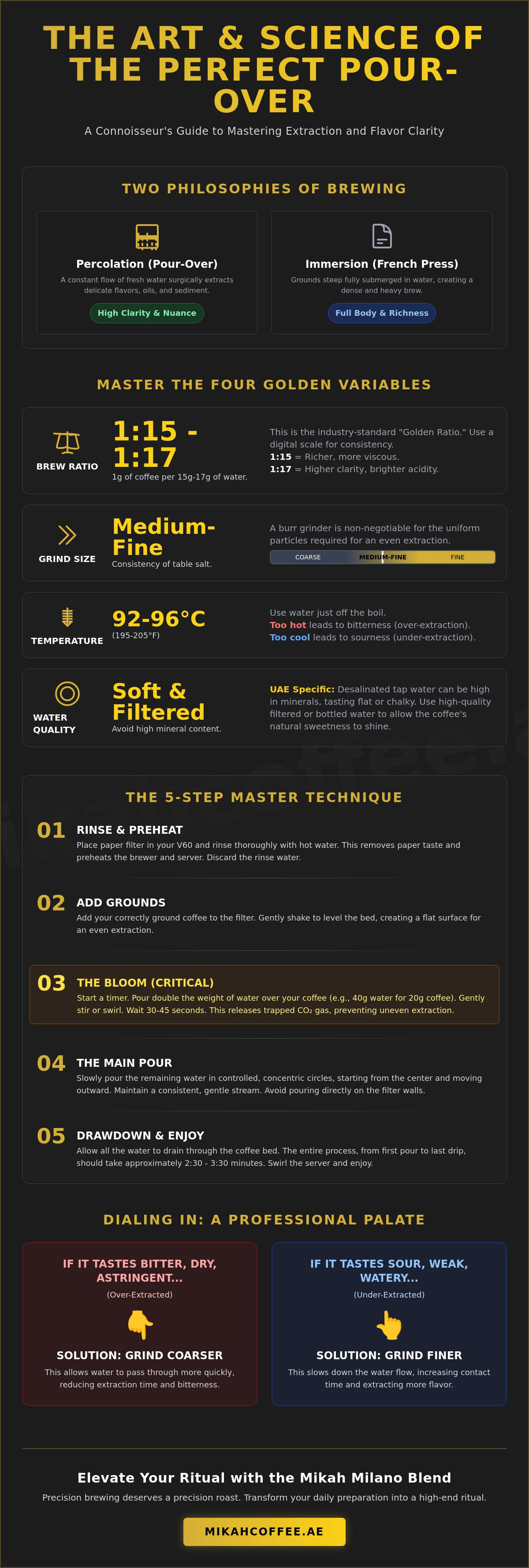
Most coffee drinkers are familiar with immersion brewing, such as the French Press, where grounds sit in water for several minutes. While this creates a bold body, it often masks the delicate floral or citrus notes of high-quality beans. In contrast, the manual method of pour-over coffee relies on percolation. Here, fresh water constantly flows through the grounds, extracting flavors and then moving on to the carafe. It's a more surgical approach to flavor that demands a deeper connection with the process.
The Sensory Advantage of Paper Filtration
The defining feature of this ritual is the paper filter. It acts as a sophisticated barrier, capturing microscopic coffee particles and diterpenes, which are the oils that contribute to a heavy, creamy mouthfeel. While some enjoy that weight, the pour over enthusiast seeks a crisp, tea-like finish. This removal of oils isn't a loss. It's a refinement. It heightens the aromatic clarity, making it easier to distinguish between a hint of jasmine and a note of bergamot. Compared to the concentrated intensity of espresso, the pour over offers an expansive, wide-angle view of the coffee's profile.
Understanding the Percolation Process
Understanding how to brew pour over coffee requires a respect for the physics of percolation. Because the water is never static, it maintains a high capacity to pull soluble compounds from the beans throughout the entire brew. Gravity serves as your silent partner, pulling the water through the bed of coffee at a controlled pace. This dynamic interaction is why precision is non-negotiable. If your grind is too coarse, water rushes through too quickly, leaving flavor behind. If it's too fine, the water stalls, leading to bitterness. When you master the flow, you unlock the ability to identify the subtle tasting notes that make specialty coffee so rewarding.
The Golden Variables: Mastering the Science of Extraction
Precision is the silent difference between a muddied cup and a sensory masterpiece. When you're learning how to brew pour over coffee, you aren't merely pouring water over grounds; you're managing a delicate chemical reaction. Four pillars define this extraction: ratio, grind, temperature, and water quality. Adjusting even one of these variables can dramatically shift the flavor profile from bright and acidic to deep and chocolatey. Mastery begins with measurement.
The Math of the Brew: Ratios Explained
The industry standard for a balanced extraction sits between 1:15 and 1:17. This simple ratio means that for every gram of coffee, you'll use 15 to 17 grams of water. A 1:15 ratio provides a richer, more viscous mouthfeel, while a 1:17 ratio highlights acidic clarity and those elusive floral notes. Don't guess. A digital scale is your most essential tool. It ensures that today's perfect cup can be replicated tomorrow with absolute certainty, removing the frustration of inconsistent results.
Water Quality in the UAE
In the UAE, our water source presents a specific challenge for the connoisseur. Most tap water is desalinated, which often leads to high mineral content or chemical treatments that interfere with delicate coffee compounds. If your water's Total Dissolved Solids (TDS) are too high, your coffee will taste flat, chalky, or metallic. Always use a high-quality charcoal filter or bottled water with a balanced, soft mineral profile. Using the right water allows the inherent sweetness of specialty coffee to emerge without being suppressed by local mineral interference.
Grind Precision and Uniformity
Consistency is king in the world of manual brewing. A burr grinder is non-negotiable because it crushes beans into uniform shapes, unlike blade grinders that create a chaotic mix of fine dust and large boulders. For a V60, aim for a medium-fine consistency, similar to table salt or slightly coarser sea salt. This specific texture regulates the "draw-down" time—the speed at which water passes through the coffee bed. If your total brew time exceeds four minutes, your grind is likely too fine, which risks over-extracting bitter, dry flavors.
Temperature acts as the final catalyst in this ritual. The "sweet spot" for most specialty roasts remains between 90°C and 96°C. Boiling water at 100°C is often too aggressive, scorching the delicate compounds of a light roast. Conversely, water below 90°C lacks the thermal energy to extract the full spectrum of complex sugars. Understanding how to brew pour over coffee means respecting these boundaries. Invest in a gooseneck kettle with a built-in thermometer to maintain this narrow window and ensure your ritual remains as precise as it is pleasurable.
Step-by-Step: The Master Pour Over Technique
Mastering how to brew pour over coffee requires more than just following steps; it requires a choreography of movement. Once you've calibrated your variables, the physical ritual begins. This is where your focus shifts from the science of the bean to the grace of the pour. Every motion should be intentional, moving with a rhythm that respects the delicate nature of the extraction. By treating the process as a performance, you ensure that the final cup is a true reflection of the coffee's origin.
Phase 1: The Preparation and Bloom
Begin by placing your paper filter into the dripper. Rinse it thoroughly with hot water. This step is vital. It eliminates any lingering papery taste while simultaneously pre-warming your carafe to maintain thermal stability. Discard the rinse water before adding your grounds. Once your bed is level, start the bloom. Pour roughly double the weight of your coffee in water, ensuring every ground is wet. Wait 30 to 45 seconds. This brief pause allows the coffee to release trapped carbon dioxide, an effervescent process that prevents gas from blocking the water. The bloom prepares the coffee for extraction by ensuring water can penetrate the grounds without being blocked by escaping gas.
Phase 2: The Main Pours
After the bloom, begin your main pours in steady, concentric circles. Start from the center and spiral outward, but avoid pouring directly against the walls of the filter. This preserves the structural integrity of the coffee bed. Whether you choose a single continuous pour or a series of pulse pours, consistency is your goal. Utilizing professional pour over coffee accessories, such as a precision-balanced gooseneck kettle, allows you to dictate the flow with surgical accuracy. A gentle, steady flow prevents excessive agitation, which can lead to over-extraction and unwanted bitterness.
Phase 3: The Final Draw and Aeration
Watch the draw-down carefully. As the water passes through, the grounds should settle into a perfectly flat, level bed. A sloped or "high and dry" bed suggests uneven pouring. Aim for a total brew time between 2:45 and 3:30 minutes, depending on your device and grind size. Once the process is complete, remove the dripper and swirl the carafe. This aeration step integrates the different layers of the brew, ensuring every sip is uniform from the first taste to the last. You've now mastered how to brew pour over coffee with the quiet confidence of a professional barista.
Dialing In: Troubleshooting and Refinement
Even the most meticulous ritual can occasionally yield a cup that falls short of excellence. Mastering how to brew pour over coffee is not a static achievement; it's a continuous process of refinement. When the flavor profile isn't quite right, we look to the science of extraction to guide our corrections. The goal is to reach that "sweet spot" where sweetness, acidity, and body exist in perfect harmony. To get there, you must adopt the "One Variable Rule." Never change your grind size and your water temperature at the same time. If you do, you'll never know which adjustment led to success.
Fixing the Flavor Profile
If your coffee tastes sharp, sour, or surprisingly salty, you're likely dealing with under-extraction. This happens when the water hasn't had enough time or thermal energy to pull out the complex sugars. To fix this, try a finer grind or slightly hotter water within the 90°C to 96°C range. Conversely, a muddy, bitter, or astringent cup indicates over-extraction. This "dry" finish on the tongue is a sign that you've pulled out the heavier, less desirable compounds. Coarsening your grind is the most effective way to mitigate this bitterness and restore clarity. Small, methodical changes are always better than drastic shifts.
Technique vs. Equipment
Your choice of vessel also dictates the variables you must manage. When comparing the V60 vs French press, remember that the V60's percolation method is far more sensitive to technique. A gooseneck kettle is your most vital upgrade here. It provides the flow control necessary to avoid "channeling," where water bypasses the coffee grounds entirely. Additionally, consider your dripper's material. Ceramic drippers have high thermal mass and require significant pre-heating to prevent them from stealing heat from your brew water. In contrast, plastic drippers are surprisingly efficient at maintaining thermal stability during the draw-down.
Modern standards, including the updated 2026 SCA guidelines, increasingly emphasize digital monitoring to ensure these variables remain constant. By using a scale and a thermometer, you remove the guesswork that leads to inconsistent results. Precision is a journey, and having the right tools makes the path much clearer. If you're ready to elevate your home setup with professional-grade gear, you can explore our curated selection of V60 drippers and precision brewing equipment to ensure every ritual is a success. Understanding how to brew pour over coffee means embracing this role as a sensory curator.
Elevating the Ritual: The Mikah Milano Experience
The final piece of the connoisseur’s puzzle isn't the technique alone, but the character of the bean itself. Mastering how to brew pour over coffee allows you to bridge the gap between two distinct worlds: the historic elegance of Italian roasting and the clinical precision of modern specialty standards. While many associate Italian coffee exclusively with the intense pressure of espresso, the manual percolation method offers a revolutionary way to experience these traditional profiles. It strips away the heavy intensity to reveal the architectural soul of the roast.
At the heart of this experience are the Milano blend coffee beans. This selection represents a sophisticated curation of heritage and quality. By applying the framework of precision brewing to a slow-roast tradition, you create a high-end cafe experience within the sanctuary of your own home. This isn't just about a beverage. It's about a commitment to excellence, from ethical sourcing to the final, meditative pour.
Brewing Italian Blends for Clarity
Italian blends often feature a more developed roast profile, which requires a slight adjustment to your extraction strategy. To bring out the signature chocolatey and nutty notes of the Milano Blend without introducing bitterness, consider dropping your water temperature to the lower end of the spectrum, around 90°C. A slightly coarser grind will also ensure that the draw-down remains efficient, preventing the water from lingering too long on the more soluble, darker surfaces of the bean. A perfectly brewed Mikah bean reveals a harmonious balance of deep cocoa richness and toasted hazelnut, finished with a syrupy, elegant sweetness.
Your Next Steps in the Coffee Journey
Mastering how to brew pour over coffee is merely the beginning of a lifelong exploration of flavor. As you become more comfortable with the variables of extraction, you can begin to explore different specialty origins through the V60 method—perhaps by sourcing unique roasts from Caffeine Lab—noting how terroir and processing affect the final cup. We invite you to continue building your home laboratory with professional-grade tools that match your growing expertise.
- Invest in a high-quality V60 to explore the heights of aromatic clarity.
- Experiment with different water mineral profiles to see how they interact with the Milano Blend.
- Engage with the wider community of UAE coffee connoisseurs to share insights and refinements.
The journey of a coffee educator never truly ends. By valuing precision and tradition, you elevate a daily necessity into a meaningful ritual that honors the journey of the bean from the farm to your carafe. Welcome to the Mikah community, where every pour is an act of craftsmanship.
Mastering Your Daily Masterpiece
Transforming your morning routine into a refined sensory ritual is a journey of continuous discovery. By mastering the delicate balance of the Golden Ratio and the intentional choreography of the pour, you've moved beyond simple preparation into the realm of true craftsmanship. You now possess the methodical framework required to ensure every cup is a transparent, elegant reflection of the bean's origin. Now that you understand how to brew pour over coffee with professional precision, the difference in clarity and sweetness will be undeniable.
True excellence requires tools that match your ambition. Since 1984, our authentic Italian heritage has been dedicated to the art of the roast, resulting in our signature Milano Blend. This slow-roasted masterpiece is perfectly suited for the manual extraction methods we've explored today. To ensure your technique is supported by the finest gear, we invite you to elevate your morning ritual with our V60 Pour Over Kit. We're honored to be part of your pursuit of the perfect cup. Enjoy the quiet beauty of your next brew.
Frequently Asked Questions
What is the best coffee-to-water ratio for pour over coffee?
The industry standard for a balanced extraction is a ratio between 1:15 and 1:17. This means you should use 15 to 17 grams of water for every single gram of coffee grounds. Using a digital scale to maintain this precise ratio is essential for anyone learning how to brew pour over coffee with professional consistency. While 1:15 produces a richer body, 1:17 highlights the delicate acidity and floral notes of specialty beans.
How long should the total brewing time be for a V60?
A total brew time of 2:45 to 3:30 minutes is the ideal target for a standard V60 extraction. This duration includes the initial 30 to 45 second bloom followed by steady, concentric pours. If your draw-down exceeds four minutes, your grind is likely too fine. Conversely, a time under two minutes suggests a coarse grind that will lead to a watery, under-extracted cup that lacks complexity and sweetness.
Do I really need a gooseneck kettle for pour over coffee?
A gooseneck kettle is highly recommended because it provides the surgical precision required for a controlled flow. Unlike standard kettles, the narrow spout allows you to target specific areas of the coffee bed and manage agitation levels. This control prevents "channeling," where water takes the path of least resistance. It ensures every ground is extracted evenly, which is vital for a balanced, professional result in every cup you pour.
Can I use regular pre-ground coffee for a pour over?
Using pre-ground coffee is generally avoided by connoisseurs because it lacks the necessary freshness and grind specificity. Coffee begins to oxidize and lose its aromatic complexity within minutes of being ground. Additionally, pre-ground bags are often sized for auto-drip machines, which may be too coarse for the precision required in a manual V60 ritual. Freshly grinding your beans just before brewing is a non-negotiable step for achieving sensory excellence.
What is the "bloom" and why is it important in coffee brewing?
The bloom is the initial wetting phase where you pour a small amount of water to release trapped carbon dioxide from the grounds. This degassing process, lasting 30 to 45 seconds, is visible through small bubbles forming on the coffee's surface. It's a critical step because escaping gas can physically block water from entering the coffee particles. A successful bloom ensures the water can extract the full spectrum of hidden aromatic compounds during the main pours.
Why does my pour over coffee taste bitter or burnt?
Bitterness is typically a symptom of over-extraction, meaning the water has pulled too many heavy, astringent compounds from the grounds. This often happens if your water is too hot or if your grind size is too fine, causing the water to linger too long in the dripper. To fix this, try coarsening your grind or reducing your water temperature to the lower end of the 90°C to 96°C range to restore clarity and sweetness.
How does water temperature affect the flavor of my coffee?
Water temperature acts as the primary catalyst for extraction, with the ideal range sitting between 90°C and 96°C. Hotter water extracts soluble compounds more aggressively, which is why darker roasts often benefit from a lower temperature to avoid harshness. Understanding how to brew pour over coffee means respecting these thermal limits. Using water straight from a rolling boil at 100°C can scorch delicate oils and ruin the cup’s intended flavor profile and clarity.
What is the difference between a V60 and a Chemex?
The primary difference lies in the filtration and the resulting body of the coffee. The V60 uses thinner filters and internal ribs to encourage airflow, producing a cup with high clarity and nuanced acidity. The Chemex utilizes much thicker, proprietary filters that remove almost all oils and sediment. This results in an exceptionally clean, tea-like body that many enthusiasts prefer for bright origins, whereas the V60 offers a more vibrant, expansive flavor experience.